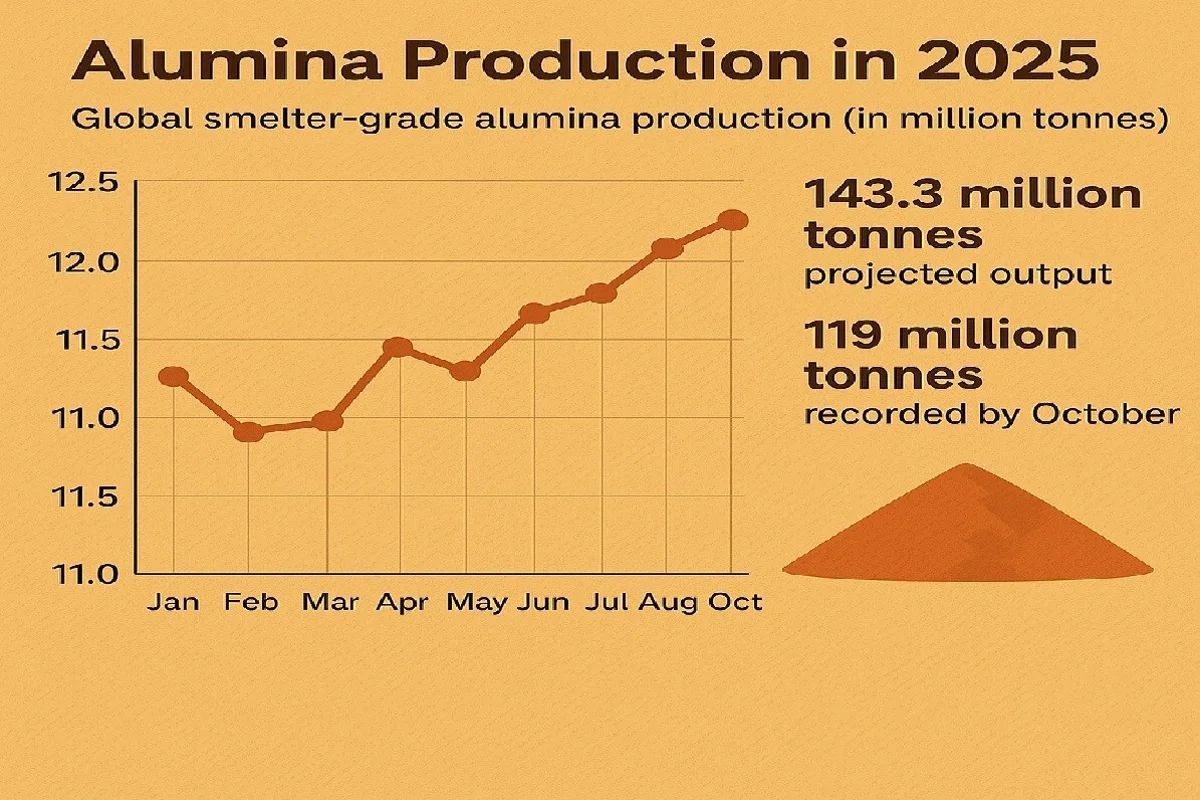
The story of alumina production in 2025 played out much the way analysts had expected, even if the year didn’t unfold in a straight line. Smelter-grade alumina production was projected at about 143.3 million tonnes, as per AL Circle report and by October the International Aluminium Institute had already recorded 119 million tonnes alumina.
Production fluctuated from month to month, creating an irregular trajectory: alumina output began 2025 at 12.23 Mt in January, fell 9.45 per cent in February to 11.08 million tonnes, then rebounded 8.6 per cent in March to 12.03 million tonnes before slipping 4.76 per cent in April to 11.46 million tonnes. The middle of the year was steadier — May edged up 2.68 per cent to 11.76 million tonnes, June dipped 0.38 per cent to 11.72 million tonnes, and July climbed 5.4 per cent to 12.35 million tonnes, with August adding another 1.31 per cent to reach 12.51 million tonnes.
September eased 3.0 per cent to 12.14 million tonnes, but October broke the pattern with a strong 4.03 per cent rise to 12.63 million tonnes, one of the highest totals of the year. If November and December stay on a similar path, 2025 is likely to end almost exactly where forecasters expected. Read Global Aluminium Industry Outlook 2025 for more details.
Early-year volatility and supply pressures
Much of the early-year volatility came from a mix of high running costs, supply issues and the usual maintenance shutdowns that tend to ripple across the industry. China — still the centre of global alumina output — had to deal with both scheduled outages and unexpected hydropower shortages in Yunnan and Guizhou, where dry reservoirs cut available power by as much as 30 to 40 per cent.
Chalco’s partial stoppage at one of its 2-million-tonne refineries added to the pressure, and delays at Indonesia’s PT BAI project removed another 200,000 tonnes from expected supply. With global inventories sitting near 8.5 million tonnes, many producers responded by trimming capacity by 5 to 10 per cent, adding another layer to the year’s uneven production profile.
Additional disruptions arrived in April as Rio Tinto overhauled its Yarwun and Boyne refineries in Queensland, work that stretched over six weeks. Hindalco undertook similar maintenance in India after the Qingming holiday.
Guinea’s decision to restrict bauxite exports removed roughly 1.2 million tonnes of ore that normally flowed to China and Europe, while EU ETS carbon prices pushing toward EUR 80 a tonne forced Norwegian operators to trim aluminium output by close to 15 per cent, reverberating back into alumina demand.
Mid-year constraints and growing supply gaps
June brought its own pressure points. China’s “dual control” policy removed around 1.2 million tonnes per year of capacity in Shandong, Odisha’s grid failures cut Indian supply by about 500,000 tonnes, and four weeks of maintenance at Australia’s Pinjarra refinery shaved off roughly 80,000 tonnes.
Demand for chemical-grade alumina was also softer, falling 12 per cent as the refractories sector eased. By the third quarter, the pattern repeated: Almatis carried out a global halt across its 1.5-million-tonne specialty network, China slowed operations ahead of the National Day holiday, idling another 800,000 tonnes, and Brazil’s Alunorte trimmed output by around 100,000 tonnes while adjusting anode-baking operations. Lower LME aluminium premiums late in the period reduced run rates by about 4 per cent across several regions.
Guinea’s export situation added yet another layer of strain. The government’s restrictions, aimed at Emirates Global Aluminium’s GAC unit over unpaid duties and pending refinery commitments, froze shipments from October 2024 and left roughly 2 million tonnes stockpiled at Kamsar by early 2025. With GAC typically shipping between 14 and 20 million tonnes a year — most of it to the UAE — the halt tightened supply for EGA’s Al Taweelah alumina refinery, which relies on around 2.4 million tonnes of imported ore and was forced to seek costlier Australian bauxite.
Pricing, market balance and the emerging surplus
Alumina prices in 2025 drifted lower under the weight of new supply, particularly from Indonesia, where more than 8.5 million tonnes of fresh capacity entered the system across 2024 and 2025, supported by a longer pipeline totalling over 25 million tonnes in various stages of development. India’s expanding capacity added to the surplus. Against this backdrop, Alcoa’s permanent closure of its Kwinana refinery, confirmed in September 2025 and removing around 2.2 million tonnes a year — equivalent to 16 per cent of its global refining footprint — briefly unsettled the market, but the impact faded as new supply came online and bauxite disruptions moderated.
Although primary aluminium itself may face a deficit of roughly 250,000 to 300,000 tonnes this year, longer-term demand remains firm, especially in China and India, where investment cycles continue to support consumption.
For 2025, however, alumina supply is still expected to grow faster than demand, leaving a projected surplus of around 1 to 1.5 million tonnes of metallurgical-grade alumina. This cushion could ease pressure on smelters and temper operating costs heading into next year.
Outlook for 2026 and the next wave of refining growth
Early signs for 2026 point toward a more comfortable supply landscape. Smelter-grade alumina production is estimated at about 147 million tonnes, with China’s ongoing expansion playing the central role in lifting global availability. To know about 2026 alumina industry trend, visit: Global Aluminium Industry Outlook 2026.
Refinery projects across Indonesia continue to advance, several already in trial production, pushing the country’s refining capacity from roughly 4 million tonnes in 2024 toward a projected 17.2 million tonnes by 2032 through developments led by PT Bintan Alumina Indonesia, PT Borneo Alumina Indonesia, PT Kalimantan Alumina Nusantara, PT Tianshan Alumina Indonesia and PT Borneo Alumindo Prima.
India is building its own growth trajectory, with Vedanta aiming for 12 million tonnes per year by the mid-2030s and NALCO expanding its refinery to 3.1 million tonnes by 2027.
Other regions are stepping in as well: Egyptalum and Alba are planning a joint refinery project valued at roughly USD 3 billion, Vinacomin is committing USD 7.3 billion to developments in Vietnam including a 2-million-tonne refinery by 2029, and Duc Giang Chemicals has proposed a major complex in Lam Dong that would produce 2 million tonnes of alumina and 500,000 tonnes of aluminium between 2031 and 2034. Guinea will also continue to position itself as a long-term refining centre, planning to commission five to six refineries by 2030 and targeting around 7 million tonnes of capacity by 2035. Taken together, these developments are expected to push alumina production on an upward trajectory.
Explore our B2B marketplace - AL Biz













_md.webp)
_md.webp)
_md.webp)







