Failing initially doesn’t mean failing overall - it just means something needs to be fixed, and that’s what summarises the whole of Alcoa’s financial report card. Alcoa started the year well, but after that it mostly went quiet. The business didn’t really improve again until the last quarter, which is what ended up saving the year. Alcoa President and CEO William F. Oplinger said, “Reflecting on 2025, we maintained our pace of delivering on key operational, strategic, and capital allocation objectives, while setting numerous production records. We continue to build on our positive momentum through disciplined operational and financial execution, along with strategic initiatives to maximise value creation.”
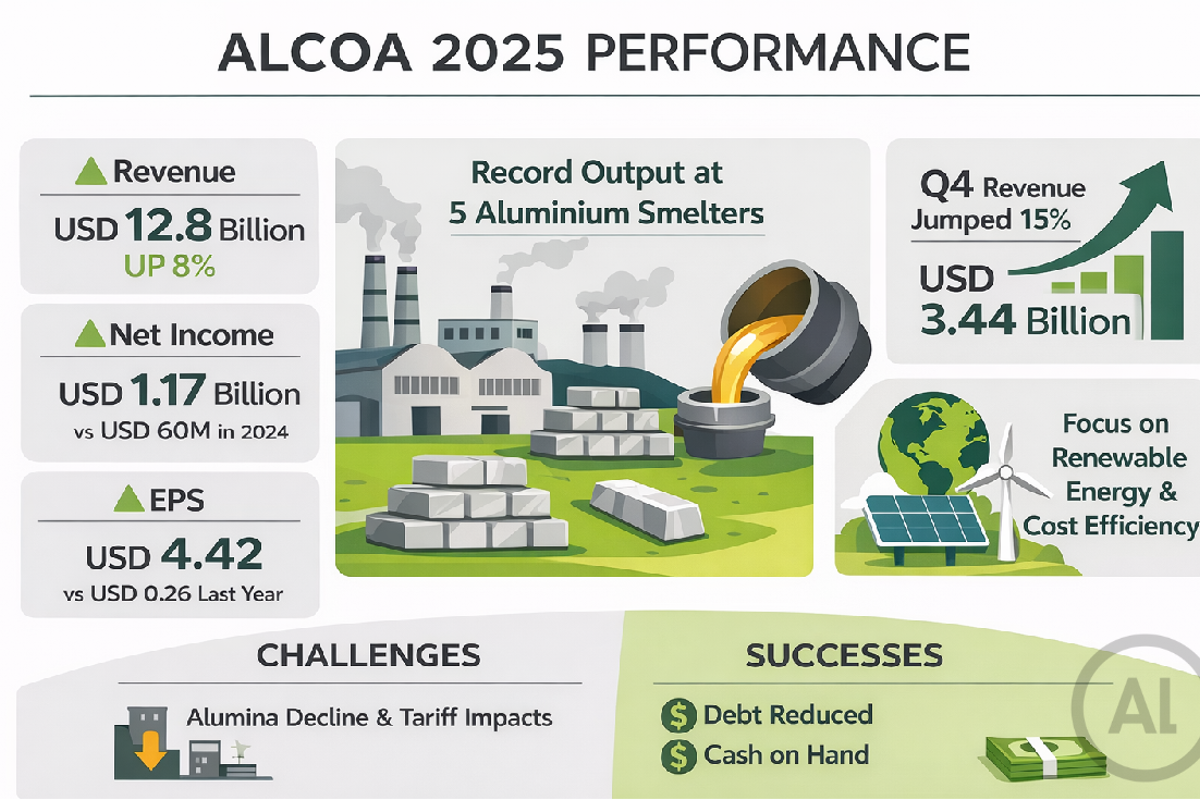
If we look at the numbers, revenue started strong. In the first quarter, Alcoa pulled in USD 3.36 billion, enough to make it look like the rebound was finally for real. But that didn’t last. By Q2, revenue slipped to USD 3 billion, dropping more than 10 per cent. Things didn’t fall off a cliff after that, but they didn’t pick up either - Q3 landed just barely lower at USD 2.99 billion. Momentum was nowhere to be found. Then, Q4 flipped the whole story around. Revenue shot up to USD 3.44 billion, a 15 per cent jump that made it the best quarter of 2025. All in, Alcoa closed the year with USD 12.83 billion in revenue, up from USD 11.90 billion in 2024 - a USD 936 million boost and almost 8 per cent growth.
Earnings bounced around too. Net income peaked early at USD 548 million in Q1, then dropped off a cliff in Q2 to just USD 164 million - a 70 per cent plunge. Things started to pick back up in Q3, rising to USD 232 million, then softened a bit in Q4 at USD 226 million.
Even with those swings, the turnaround was obvious: Alcoa finished 2025 with USD1.17 billion in net income, compared to just USD 60 million the year before, that’s USD 1.11 billion more in the bank.
Earnings per share moved in the same pattern. EPS started at USD 2.07 in Q1, tumbled to USD 0.62 in Q2, crept up to USD 0.88 in Q3, and landed at USD 0.85 in Q4. For the year, EPS came in at USD 4.42, miles ahead of last year’s USD 0.26.
For 2026 aluminium market outlook, download our report TOC: Global Aluminium Industry Outlook 2026
Adjusted net income was even more of a rollercoaster - starting at USD 568 million in Q1, crashing to USD 103 million in Q2, an 81.87 per cent drop and then declined more in Q3 to USD 6 million loss, and then came roaring back to USD 335 million in Q4. When you add it all up, adjusted net income for 2025 totalled USD 1 billion, up from USD 296 million the year before.
Aluminium value chain performance
On the operations side, 2025 was full of mixed messages for Alcoa’s aluminium value chain. Bauxite production faded early and never really got back on track. It slid from 9.5 million dry metric tonnes (mdmt) in Q1 to 9.3mdmt in Q2, stayed flat in Q3, and nudged up a bit to 9.4mdmt in Q4. For the year, bauxite output hit 37.5mdmt, down about 2 percent from 2024 (38.3 mdmt).
Alumina was all over the place. Output dipped a little in the first half, moving from 2,355 thousand tonnes in Q1 to 2,351 thousand tonnes in Q2. Then things snapped back: Q3 jumped 4 per cent to 2,453 thousand tonnes, and Q4 edged up again to 2,481 thousand tonnes. Still, the early losses stuck. Full-year alumina production fell to 9,640 thousand tonnes - down 4 percent from last year.
Primary aluminium told a different story. Output increased steadily quarter after quarter. Output climbed every quarter - 564 thousand tonnes in Q1, then 572 thousand tonnes in Q2, 579 thousand tonnes in Q3, and finally 604 thousand tonnes in Q4. That brought yearly output to 2,319 thousand tonnes, which is up about 5 per cent. The jump came from restarting capacity at the Alumar smelter in Brazil, San Ciprián in Spain, and Lista in Norway.
Don't miss out- Buyers are looking for your products on our B2B platform
What worked in Alcoa’s favour in 2025
Given all the ups and downs, a few things definitely worked Alcoa’s way. Revenue climbed to USD 12.8 billion, up 8 per cent, with the help of stronger aluminium prices and more bauxite moving under new supply deals.
Profit followed. Net income soared to USD 1.17 billion, up from just USD 60 million. Adjusted net income hit USD 1 billion. Even when you strip out the one-time stuff, pricing improved and Alcoa ran a tighter ship as the year went on.
Q4 really made the difference. Revenue jumped 15 per cent to USD 3.45 billion, powered by higher prices and better shipments, and adjusted EBITDA surged. Operationally, Alcoa set new annual production records at five aluminium smelters and one alumina refinery.
Cash flow stayed steady all year. Operating cash flow reached USD 1.2 billion, giving Alcoa room to cut debt down to USD 2.4 billion and finish the year with USD 1.6 billion in cash. On the strategy front, Alcoa sold its stake in the Ma’aden joint venture, teamed up with IGNIS Equity Holdings to back the San Ciprián complex in Spain, and even scored a favorable outcome in an Australian tax dispute, which took some pressure off.
Where the recovery fell short
The recovery was far from frictionless. Alumina production declined 4 per cent year on year, largely due to the permanent closure of the Kwinana refinery, which continued to weigh on output. Shipments were another weak spot. Third-party alumina shipments fell 2 per cent annually as production dropped and trading activity slowed. Total aluminium shipments declined 3 per cent, mainly because Ma’aden offtake volumes disappeared following the sale of Alcoa’s joint venture stake. Working capital also edged higher, rising by one day year on year to 35 days.
Comparability was further complicated by large one-off items booked in the prior year. These included USD 895 million in charges linked to the Kwinana closure, a USD 786 million gain from the sale of the Ma’aden joint venture interest, and charges tied to higher asset retirement obligations.
Results were also influenced by USD 133 million in favourable tax impacts related to the reversal of valuation allowances on deferred tax assets at Alcoa World Alumina Brasil Ltda., carbon dioxide compensation of USD 32 million in Spain and USD 25 million in Norway, and a USD 23 million correction to interest expense tied to the capitalisation of earlier capital expenditures. A USD 144 million goodwill impairment in the alumina segment further weighed on GAAP results.
Tariffs continued to weigh on results. Higher aluminium prices helped cover the cost of US tariffs on Canadian imports, but rising tariff expenses in other markets still chipped away at overall gains.
Adjusted EBITDA excluding special items stood at USD 546 million, up USD 276 million sequentially, supported by pricing strength and carbon dioxide compensation but constrained by higher tariff expenses.
2026 Outlook: How Alcoa plans to improve performance
Looking ahead, Alcoa is aiming for steadier execution rather than dramatic expansion. In 2026, the company plans to advance targeted restarts and operational optimisations to lift output and improve cost efficiency, in line with its Q4 2025 guidance. A USD 60 million investment is planned at the Massena aluminium operations in New York, backed by a grant from Empire State Development, to upgrade the anode baking furnace and support more sustainable aluminium production in the US.
Energy will play a central role. Alcoa has signed a 10-year renewable power agreement with the New York Power Authority, securing nearly 240 megawatts of renewable power for Massena from April 1, 2026, with options to extend the deal by two additional five-year periods.
For 2026, the company is targeting cost reductions aimed at first-quartile positioning, alongside lower CO₂e emissions through energy-related assets, including a USD 10-per-tonne CBAM premium uplift in Europe. Alumina production is guided at 9.7-9.9 million tonnes, with shipments of 11.8-12.0 million tonnes. Aluminium production is forecast at 2.4-2.6 million tonnes, driven by smelter restarts, with shipments expected at 2.6-2.8 million tonnes.
With supply tightening outside China and regional premiums such as the US Midwest premium and the EU’s Carbon Border Adjustment Mechanism in focus, Alcoa is positioning itself to turn a volatile recovery into something more stable in 2026.
Must read: Key industry individuals share their thoughts on the trending topics