AL Circle Analysis: How US scrap, EU carbon rules, Indian duties drive aluminium industry
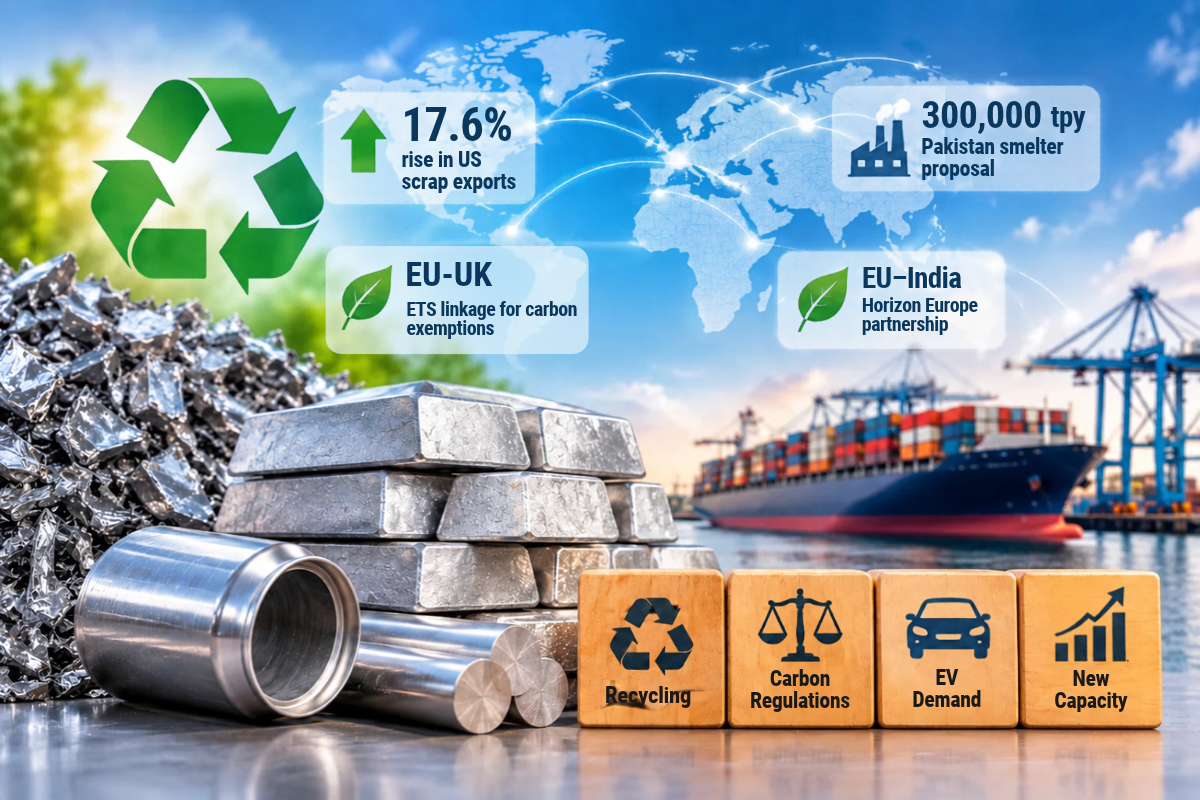
The image used in this article is generated with an AI tool and does not depict any real-time moment
The global aluminium industry is being reshaped by four driving forces: the race to secure quality scrap, improving technologies for better scrap sorting, changing trade and decarbonisation policies, and investment in new production capacity. From rising US scrap exports and India’s raw material concerns to Europe’s evolving carbon rules and Pakistan’s proposed smelter, recent developments reveal an industry navigating both fresh opportunities and structural challenges.
The underlying question is no longer simply how much aluminium can be produced, but where the aluminium will come from, how it can be processed and which markets will remain accessible.
Recycling and circularity: Technology, data and industry accountability
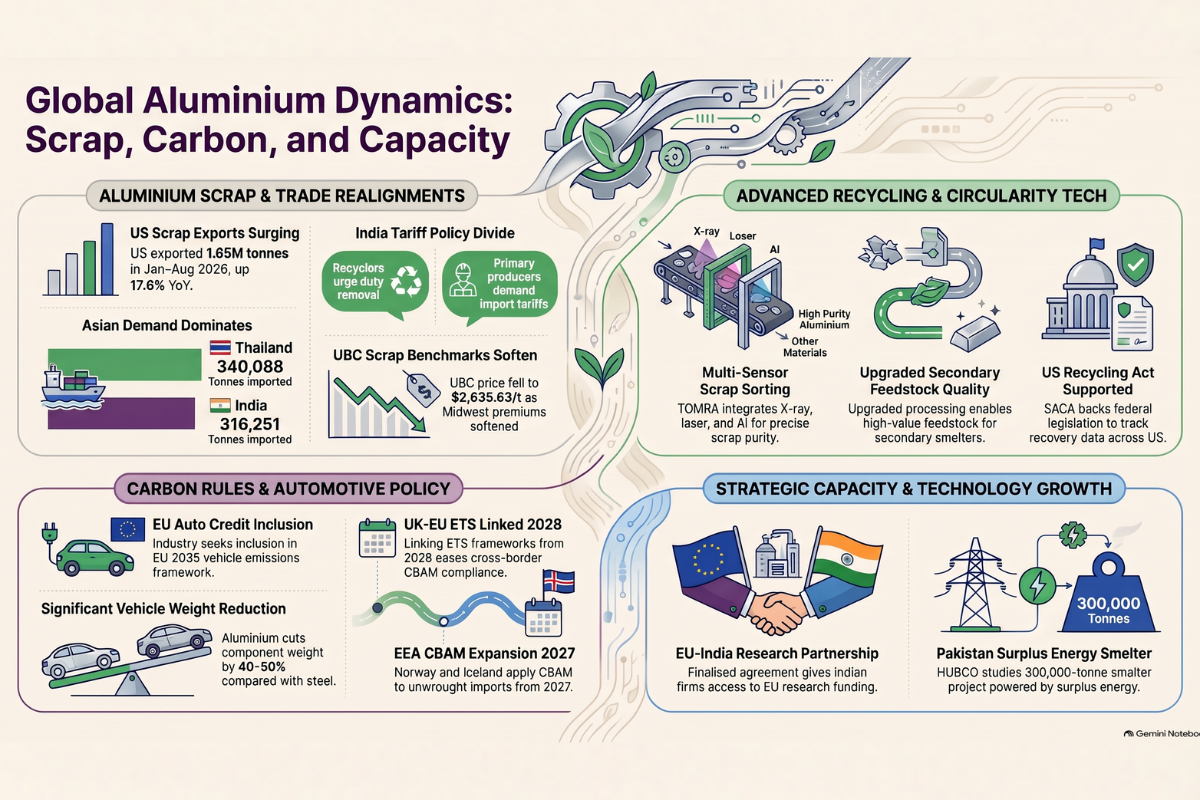
Mixed scrap such as Zorba presents a major obstacle to high-quality aluminium recycling, with different alloys and contaminants restricting its use in demanding applications. TOMRA is combining X-ray transmission, laser spectroscopy and AI-based sorting to remove unwanted materials, identify alloy grades and improve recovery. The objective is to produce cleaner, more consistent feedstock for secondary aluminium smelters.
The Secondary Aluminum Coalition for America (SACA) has backed the bipartisan Recycling and Composting Accountability Act, which seeks to improve nationwide reporting on recycling infrastructure and material recovery. This would help identify gaps in collection systems and underused recyclable resources. SACA believes better information could guide investment, strengthen domestic recycling networks and improve scrap availability for American manufacturers.
Participate in AL Circle’s upcoming e-Magazine Smart ALuminium: Advancing Industrial Technologies in 2027 to showcase the advancement of technologies in aluminium recycling
Key takeaways:
- Better sorting could turn mixed scrap into higher-value feedstock, helping recyclers meet the demanding alloy specifications.
- Better recovery data could help the US collect more recyclable aluminium for domestic manufacturing instead of leaving valuable material underutilised.
Aluminium scrap markets: Pricing, trade flows and import pressures
US used beverage can (UBC) scrap prices came under pressure as the underlying aluminium benchmark and Midwest premium expectations softened. The exchange-based UBC contract settled at USD 2,635.63 per tonne on November 18, down 0.66 per cent on the day. The decline indicated weakening primary aluminium prices and regional premiums, highlighting the importance of local pricing dynamics while determining scrap values.
The US exported 1.65 million tonnes of aluminium scrap during January–August 2026, a 17.6 per cent increase year-on-year. Thailand remained the largest destination at 340,088 tonnes, followed by India at 316,251 tonnes. Malaysia, Hong Kong and South Korea also recorded higher purchases. The shift reinforces Asia’s growing importance as a destination for US secondary raw materials.
Imported aluminium scrap prices in India declined sharply in the week ended November 24 as a 6.2 per cent weekly fall in three-month LME aluminium prices and subdued demand weighed on buying interest. US-origin Taint Tabor fell by USD 90 to USD 2,640 per tonne, while UK-origin Zorba declined by USD 70 to USD 2,500 per tonne. Additional availability from Thailand intensified domestic competition.
Ahead of the Union Budget 2027–28, the Material Recycling Association of India (MRAI) sought removal of the 2.5 per cent customs duty on imported aluminium scrap to reduce input costs for domestic recyclers, particularly MSMEs. The Aluminium Association of India (AAI) has instead proposed retaining or increasing the duty until mandatory quality controls for imported scrap are introduced.
Looking for secondary aluminium? Explore a wide range of aluminium scrap and recycled aluminium products from global suppliers on AL Biz
Key takeaways:
- Regional premiums remain a critical influence on US scrap economics, making recycled aluminium prices vulnerable to movements beyond the LME benchmark.
- While rising exports improve Asia’s access to US scrap, they raise doubts about the availability of recyclable feedstock for domestic US processors.
- Lower international benchmarks and increased regional supply are improving buying opportunities, although demand dip slows market momentum.
- India’s scrap-duty debate exposes a wider divide between recyclers seeking affordable raw materials and primary producers prioritising import protection.
Carbon rules and automotive policy: Aluminium’s place in the next trade order
European Aluminium has urged the EU to include low-carbon aluminium in its proposed 2035 automotive emissions credit system alongside low-carbon steel. It warns that steel-only incentives could distort material choices and weaken aluminium’s competitiveness, wherein aluminium is the metal capable of reducing component weight by 40–50 per cent compared with steel, reinforcing vehicle efficiency and EV range.
The UK is reviewing its Zero-Emission Vehicle mandate, with reports suggesting that the 2030 EV sales target could be reduced from 80 per cent to around 60 per cent. The Climate Change Committee has warned that weakening the requirements could put legally binding climate targets at risk.
The UK and EU plan to link their Emissions Trading Systems from January 1, 2028, allowing carbon allowances issued under either framework to be recognised in both markets. The arrangement expects to have mutual CBAM exemptions and a UK move towards the EU’s phase-out of free allowances for covered products, including aluminium. The Metal Packaging Manufacturers Association (MPMA) has welcomed the linkage, as it could reduce CBAM charges and administrative requirements for manufacturers trading across both markets.
Norway and Iceland would bring aluminium imports under the EU Carbon Border Adjustment Mechanism (CBAM) from January 1, 2027, after its incorporation into the European Economic Area framework. The rules would cover specified unwrought and semi-finished aluminium products, with a 50-tonne annual cumulative threshold for qualifying importers.
Trading aluminium across borders? Find out the exact cost you need to bear for the embedded carbon in the product by using this CBAM calculator.
Key takeaways:
- Recognising aluminium in automotive emissions credits could boost material-neutrality, lightweighting and support investment in Europe’s aluminium processing.
- Slowdown in EV transition could alter the pace of automotive aluminium demand, though the long-term shift to lighter, more efficient vehicles, remains essential.
- ETS alignment may simplify the UK–EU carbon market scenario, but could change the cost competitiveness of aluminium imported from outside Europe.
- CBAM’s scope expansion would require aluminium traders to reassess import volumes, authorisation and embedded-emissions reporting.
- The UK–EU ETS agreement could improve cost certainty for cross-border metal packaging supply chains, offering a practical benefit to aluminium-consuming manufacturers.
Beyond trade barriers: Partnerships and new capacity shape future growth
While scrap availability and carbon compliance dominate near-term industry discussions, long-term competitiveness would also depend on technology partnerships and investment in production.
India and Europe are exploring a deeper research relationship at a time when recycling and decarbonisation are gaining importance. At the same time, Pakistan’s proposed smelter signals an attempt to convert surplus electricity into a new industrial opportunity, although the project remains at an early stage.
The EU and India concluded negotiations on India’s association with Horizon Europe on November 6, 2026, with participation envisaged from January 2027, subject to the agreement entering into force. The framework could give Indian aluminium producers, recyclers and research organisations access to European funding and technical partnerships. Nonetheless, tighter EU waste shipment rules remain a challenge for scrap trade.
Pakistan’s Hub Power Company (HUBCO) is exploring a 300,000-tonne-per-year aluminium smelter to convert surplus electricity into industrial output. Its wholly owned subsidiary, Hub Power Holdings, has appointed a Chinese design institute to conduct a bankable feasibility study. The proposal remains at an exploratory stage, with investment requirements, construction timelines, financing and approvals yet to be established.
Key takeaways:
- Research collaboration could strengthen technology exchange and recycling capabilities, but it would not by itself resolve regulatory barriers affecting India’s access to European metal scrap.
- Pakistan’s surplus power could offer a potential foundation for domestic aluminium production, but the project’s viability would depend on securing competitive electricity, financing and regulatory clearances.
To know the world's future aluminium recycling market and its growing trends, download our report - World Recycled ALuminium Market Analysis Industry Forecast
NKT Begins HVDC cable production for 2 GW IJmuiden Ver Beta offshore wind project using Hydro’s low-carbon aluminium
Next articleHydro converts 279,000 tonnes of açaí waste into industrial fuel to reduce coal use at Alunorte alumina refinery
Grow with
AL Circle














_md.webp)