5 Mt by 2030: India’s green hydrogen investment pipeline expands from Gujarat to Odisha
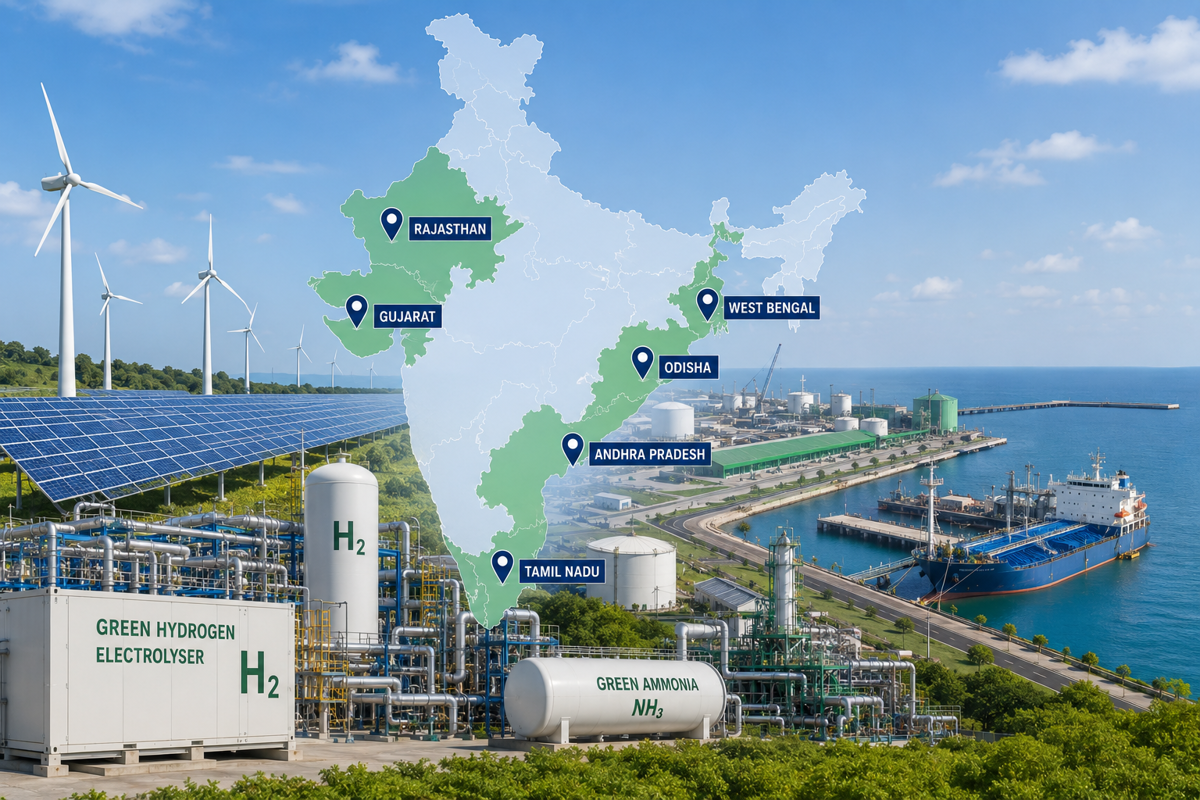
The image used in this article is generated with an AI tool and does not depict any real-time moment
India’s green hydrogen push is gradually moving from targets and project announcements towards building the infrastructure needed for large-scale production. Manufacturing facilities, renewable power projects, ammonia plants and port infrastructure are becoming important parts of the next stage of development.
The country aims to produce 5 million tonnes of green hydrogen by 2030 under the National Green Hydrogen Mission. So far, the government has awarded 3 GW of annual electrolyser manufacturing capacity to 15 companies and 862,000 tonnes per year of green hydrogen production capacity to 18 companies. Another 724,000 tonnes per year of green ammonia supply has been allocated for 13 fertiliser units across the country.
Gujarat is emerging as a major location for these investments. Around Mundra and Kandla, projects are bringing together manufacturing, renewable energy and port access. At Kandla, the Deendayal Port Authority also signed an MoU with Green-Kutch NextGen Pvt. Ltd. in January 2026 to develop the Kutch Green Hydrogen Park, adding dedicated infrastructure for green hydrogen production and storage.
To learn about the market potential of aluminium dross, explore "ALuminium Dross Processing: Generation, Recovery & Strategic Roadmap"
Adani is building an integrated electrolyser manufacturing ecosystem at Mundra with planned capacity of 5 GW per year. Its wider plans include green hydrogen production equivalent to 1 million tonnes per year by 2030.
Other states are also developing their own roles in the growing industry. Odisha's Gopalpur has attracted proposed green hydrogen and green ammonia projects involving companies such as ACME, Avaada and Hygenco.
In Tamil Nadu, investment is centred around Thoothukudi, or Tuticorin, and VOC Port, where port infrastructure could support the development of green ammonia projects.
Andhra Pradesh is looking to develop Visakhapatnam as a green hydrogen hub, while Kakinada is becoming part of the country's growing green ammonia investment chain. Rajasthan also has potential for renewable-energy-backed hydrogen production.
In eastern India, the green ammonia ecosystem is beginning to connect with existing industrial demand. West Bengal and Odisha are part of this developing supply and demand network, with fertiliser-linked projects and procurement involving locations such as Haldia and Paradeep.
To explore trade opportunities of aluminium consumables, visit AL Biz
Odisha’s Gopalpur region is developing a 405,000-tonne-per-year green ammonia project being developed by an ACME Group–IHI Corporation joint venture, with 25 years of Japanese price support secured for exports of 228,000 tonnes annually from September 2030.
Green ammonia is becoming increasingly important because transporting and storing hydrogen at scale can be difficult. Converting it into ammonia provides another route for moving and using the energy carrier. Potential applications include fertiliser production, maritime fuel, industrial use and energy exports.
This is also widening the scope of investment. Alongside hydrogen plants, the sector requires renewable electricity, electrolysers, water treatment facilities, ammonia and derivative plants, storage and compression systems, process equipment and industrial automation. Ports and export terminals could also become increasingly important as India develops its ability to supply overseas markets.
Unlock key insights from leading companies and experts across the aluminium ecosystem with our e-Magazine - Mine to Market: Aluminium Producers & Manufacturers 2026
The pattern of investment is therefore taking shape differently across the country. Gujarat is combining manufacturing capacity with large-scale production and port infrastructure. Odisha is attracting hydrogen and ammonia projects with export potential, while Tamil Nadu is developing around port-linked ammonia infrastructure. Andhra Pradesh is building its hydrogen and ammonia project base, Rajasthan offers renewable energy potential, and West Bengal is becoming connected to fertiliser and industrial demand.
Hyundai expands beyond cars as robotics becomes a new growth engine
Next articleEpsilon gets $15.2m boost to build India's indigenous graphite anode supply chain
Grow with
AL Circle