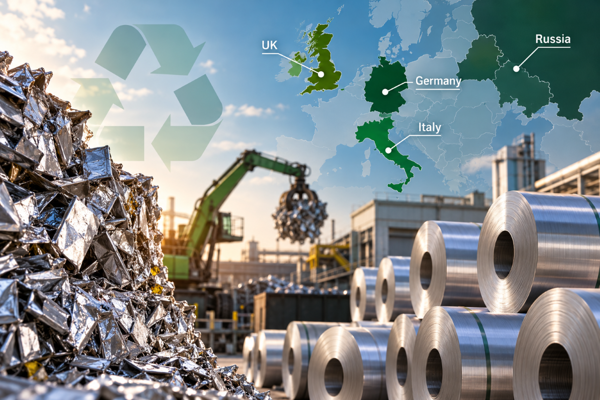
Europe’s recycled aluminium industry is an important component of the global secondary aluminium supply chain, with Germany, Italy and the United Kingdom (UK) representing key national markets. Production across the European region stood at nearly 6 million tonnes in 2023, supported by established scrap recovery systems, industrial recycling capacity and demand for recycled metal. Russia also contributes to the regional landscape through secondary aluminium production units concentrated in several industrial centres. According to AL Circle’s analysis in its report, “ World Recycled ALuminium Market Analysis Industry Forecast ”, the four countries present different market structures, from Germany’s substantial recycling capacity and Italy’s scrap-based production to the UK’s organised...
Alumil India, the fully-owned Indian subsidiary of Alumil Group, has successfully delivered advanced fenestration solutions for NICMAR University in Pune, transforming a precast campus vision into a functional, durable and future facing learning environment. The project required approximately three hundred windows within a tight timeline which was successfully delivered by Alumil India. The project deployed Alumil’s top-hung window systems combined with sleek mullions and glazing. “NICMAR University presented an opportunity to demonstrate how fenestration can become an integral part of both a building’s architecture and its performance. The project required us to respond to large openings, intensive daily usage, acoustic and weather considerations, safety, and the specific challenges of...
Grow with
AL Circle

After nearing USD 3,200 per tonne in the previous trading session , the London Metal Exchange (LME) aluminium price graph cooled across almost all the pricing and inventory segments at the July 28 close. The LME aluminium cash bid price eased 1 per cent day-on-day on July 28, shifting from USD 3,191 per tonne to USD 3,159 per tonne. The offer price, moving from USD 3,192 per tonne to USD 3,159.5 per tonne, recorded a slightly higher 1.02 per cent dip. Explore: The most comprehensive and forward-looking industry-focused report — Global Bauxite & Alumina Market Forecast to 2036: Supply–Demand, Trade Flows & Price Report On July 28, the LME aluminium 3-month bid price contracted by 1.16 per cent to USD 3,143 per tonne from USD 3,180 per tonne on July 27. The offer price recorded a decline of...

Maan Aluminium Limited has secured overwhelming shareholder approval to expand its business into power generation, paving the way for the company to formally include renewable and conventional energy activities within its corporate objectives. Through a postal ballot conducted via remote e-voting, shareholders approved two special resolutions with 99.9976 per cent of votes cast in favour, including an amendment to the company's Memorandum of Association (MOA) and the appointment of a new Independent Director. Solar power supports aluminium operations The approved MOA amendment allows Maan Aluminium to generate, manufacture, transmit and distribute electricity from multiple sources, including solar, wind, hydro, tidal, nuclear and hydrocarbon fuels, for captive use or commercial purposes....

Workers of Volta Aluminium Company (VALCO), supported by members of the Industrial and Commercial Workers' Union (ICU-Ghana), staged a questioning on Monday over what they described as alleged plans to privatise the state-owned aluminium producer. The demonstration took place at the VALCO Club House in Tema, where workers gathered wearing red and displayed placards expressing their opposition to any proposal that could result in changes to the company's ownership structure. Workers oppose reported investment plans According to the participants, the Ghana Integrated Aluminium Development Corporation (GIADEC) is pursuing plans to introduce strategic equity investors into VALCO. They argued that such a move would effectively amount to the privatisation of the state-owned aluminium company....

The International Energy Agency (IEA) has warned that escalating tensions involving Iran are increasing risks to global energy security, with concerns centred on potential disruptions to key oil transit routes and critical energy infrastructure across the Middle East. According to the agency, the deteriorating geopolitical situation has heightened uncertainty in international oil markets, particularly around the Strait of Hormuz and the Bab el-Mandeb Strait, two of the world's most strategically important maritime chokepoints for crude oil and refined petroleum shipments. Any sustained disruption to these corridors could significantly impede global energy trade. Despite the heightened risks, the oil market has so far demonstrated resilience, supported by alternative supply channels and...

Century Aluminum has brought its Mt Holly aluminium smelter in South Carolina back to full capacity through an expansion expected to increase the country's primary aluminium production by approximately 10 per cent. According to the US Department of Commerce, Century Aluminum invested USD 50 million in the project. The ceremony was attended by US Secretary of Commerce Howard Lutnick, Senior Counselor to President Trump Dr Peter Navarro, South Carolina Attorney General Alan Wilson, US Senator Tim Scott, South Carolina Governor Henry McMaster and Century Aluminum President and CEO Jesse Gary, underscoring the strategic importance of strengthening domestic aluminium production. Expansion strengthens US aluminium supply Century Aluminum said the expansion will increase the Mt Holly workforce...

Sustainable aluminium beverage can manufacturer Ardagh Metal Packaging (AMP) Europe has partnered with Xolution Germany to become the official European distributor of XO resealable can ends, expanding its range of beverage packaging solutions. The agreement enables AMP Europe to offer XO’s resealable technology across Europe, giving beverage manufacturers a new aluminium can-end solution that combines portability, ease of use and product protection. To learn the future of aluminium in the packaging industry, explore our report “ ALuminium in Packaging: Consumer Trends and Market Dynamics ” The resealable system has been designed for one-handed use, boosting convenience and allowing consumers to securely close cans after opening, thereby catering to the growing demand for beverages...

After nearly three decades off the radar, Italian yacht builder Tecnomarine is making a stylish comeback. The iconic brand is reviving its legacy with a fresh range of five custom-built aluminium superyachts, proving that some legends are too good to stay anchored. Founded in Viareggio in 1972, Tecnomarine earned recognition for producing premium aluminium yachts before ceasing operations in the early 2000s following a change in ownership from Moreno Maestrelli and the Picchiotti family to Azimut-Benetti. The brand has now been revived by entrepreneur Massimiliano Zilioli, who has restarted production at the Navicelli Canal shipyard in Pisa. To know the aluminium casting demand forecast in the transportation sector, explore our report “ Global Aluminium Casting Market 2026-2032: Plant...

Aluminium stocks on the London Metal Exchange (LME) have slumped to their lowest level this century as supply constraints stemming from the conflict in the Middle East continue to force consumers to draw down exchange inventories to secure physical metal. While the market is still forecasting aluminium surpluses in the coming years, the relentless decline in warehouse stocks points to tightening physical availability, underscoring the growing impact of geopolitical disruptions on the global aluminium supply chain. According to LME data, total aluminium inventories stood at 271,275 tonnes on July 24, the lowest level since the exchange's records began in January 1998. The remaining stock is equivalent to less than one day's global aluminium consumption, highlighting how little...

African nations have been urged to accelerate domestic processing of bauxite and "other" critical minerals instead of continuing to export raw materials, as leaders push to transform the continent into a global hub for value-added mineral production. Speaking at the African Development Bank (AfDB) Ministerial Forum in Abidjan, Nigeria's Minister of Solid Minerals and Chair of the Africa Mineral Strategy Group, Dele Alake, said Africa must break its long-standing dependence on exporting raw minerals while importing higher-value finished products at significantly higher costs. Value addition key to industrialisation Alake said Africa possesses abundant reserves of bauxite and "other" critical minerals, including cobalt, lithium, manganese, platinum and rare earth elements, that are...

Trading in the shares of Nigeria-based Aluminium Extrusion Plc has been suspended on the Nigerian Exchange (NGX) after the company failed to submit its audited financial statements for the financial year ended December 31, 2025, within the regulatory deadline. The suspension, which took effect on July 22, 2026 , was imposed by NGX Regulation Limited under the Exchange’s Rules for Filing of Accounts and Treatment of Default Filing , following the expiry of the prescribed cure period granted to the company. According to the Exchange, issuers that do not file their required financial statements within the stipulated timeframe are subject to trading suspension until compliance is achieved. To know the production, demand and consumption forecasts of aluminium casting, explore our report "...

Luxury luggage maker RIMOWA has expanded the use of its signature grooved aluminium beyond suitcases with the launch of a limited-edition Dartboard Case, reimagining a traditional pub favourite as a high-end design object priced at USD 6,300. Developed in collaboration with professional darts equipment manufacturer Winmau, the new Dartboard Case combines tournament-grade performance with the German brand's signature aluminium craftsmanship, reflecting a growing trend of premium brands using aluminium in products far beyond their traditional categories. Aluminium takes centre stage Handcrafted in Cologne, the double-door cabinet is constructed from anodised grooved aluminium, the same material that has become synonymous with RIMOWA's luggage. The case also features custom latch locks,...

Global metallurgical-grade alumina production remained almost unchanged in the first half of 2026, totalling 70.24 million tonnes, compared with 70.27 million tonnes in H1 2025-a marginal decline of just 0.04 per cent year on year. But that near-flat headline conceals one of the most eventful six-month periods the alumina industry has witnessed in recent years. While China's expanding refining capacity helped cushion the global output, Africa and Asia (excluding China) struggled with tightening bauxite availability and weakening refinery margins. North America remained constrained by operational changes at its only operating refinery, Europe continued to battle elevated energy costs, Oceania adjusted to the permanent loss of refining capacity, and South America stood out as one of the few...

Indonesia is working to resolve a regulatory issue that has delayed exports of alumina and nickel products after authorities raised concerns over the presence of rare earth elements in some shipments. The country’s Presidential Chief of Staff, Dudung Abdurachman, has called for closer coordination among government agencies, law enforcement bodies, and industry to address the lack of regulations specifying the maximum allowable rare earth content in exports of other minerals. Officials acknowledged that the absence of clear rules has disrupted mineral shipments. Industry sources said alumina exports have been directly affected. One source in the aluminium industry said, "The government claims our alumina contains rare earth materials." Indonesia is a major exporter of alumina, a key raw...

Indian aluminium stocks remained under pressure as the sector extended its recent decline, tracking softer aluminium prices, a stronger US dollar and cautious market sentiment. Share prices of Vedanta Aluminium and Vedanta Limited Hindalco Industries, and National Aluminium Company Limited (NALCO), all traded lower. At the same time, brokerage InCred Equities issued a bearish outlook, advising investors to reduce exposure to aluminium-focused stocks and “sell all aluminium names.” During Thursday’s trade, Vedanta Aluminium fell 4.13 per cent to INR 444 (USD 4.64) per share, Vedanta Limited slipped 2.75 per cent to INR 274.95 (USD 2.87), Hindalco declined 1.6 per cent to INR 960.5 (USD 10.03), and NALCO dropped 3.2 per cent to INR 337.5 (USD 3.52). Explore: The most comprehensive and...

Aluminium extrusion maker Alumex inaugurated its “Alum Transcend Space” in Kotte, Sri Lanka. The new centre will display advanced aluminium applications for architecture, construction, and industry. The facility was created to show how aluminium can be used for more than just doors and windows. It highlights solutions for modern interior and exterior design and supports sustainable building practices. Visitors can explore proprietary aluminium systems from internationally recognised brands, including AluK and Capral, giving architects, builders and homeowners access to global design and engineering solutions. To know the production, demand and consumption forecasts of aluminium casting, explore our report " Global Aluminium Casting Market 2026-2032: Plant Economics, Alloy Segmentation,...

Canadian climate technology company Enervoxa is planning to establish a commercial-scale rare earth processing plant in India that would recover critical minerals from red mud, the aluminium waste residue generated during alumina refining. The company is exploring partnerships with Vedanta Aluminium, Hindalco Industries and state-run National Aluminium Company Limited (NALCO) for the project. According to Vandit Verma, Enervoxa Chief Executive Officer, the proposed facility would require an investment worth USD 250 million to USD 350 million, developed in eastern India, through a mix of strategic equity and project financing. To know the futuristic market and value proposition of red mud, explore the report A Comprehensive Analysis of Bauxite Residue (Red Mud): Sustainability, Resource...

LME aluminium prices recovered their upward trend on July 27, supported by higher alumina prices and continued declines in exchange inventories, indicating a firmer market compared with the previous trading sessions. The LME aluminium cash bid and offer prices increased on July 27. The bid rose by 0.52 per cent to USD 3,191 per tonne on July 27 from USD 3,174.5 per tonne on July 24 . The offer climbed 0.53 per cent to USD 3,192 per tonne from USD 3,175 per tonne. On July 27, the three-month bid gained 0.63 per cent. The bid increased to USD 3,180 per tonne from USD 3,160 per tonne, while the offer moved up 0.65 per cent to USD 3,181 per tonne from USD 3,160.5 per tonne. On the longer-dated contracts, both the Dec-27 bid and offer prices recorded a 0.71 per cent increase over the previous...

VBX has moved a step closer to developing its flagship Wuudagu Bauxite Project after signing a framework agreement with a major Chinese aluminium group that could deliver both project funding and a long-term bauxite offtake arrangement. The non-exclusive agreement, signed with the Hong Kong subsidiary of the Chinese aluminium producer, establishes a pathway for the parties to negotiate investment in the development and operation of the Western Australian project. Under the proposed arrangement, the Chinese group would purchase between 2 million and 3 million tonnes of bauxite per year, while also providing funding expected to cover a significant portion of the project's construction and commissioning costs. Funding linked to project development Investment commitments will be determined...