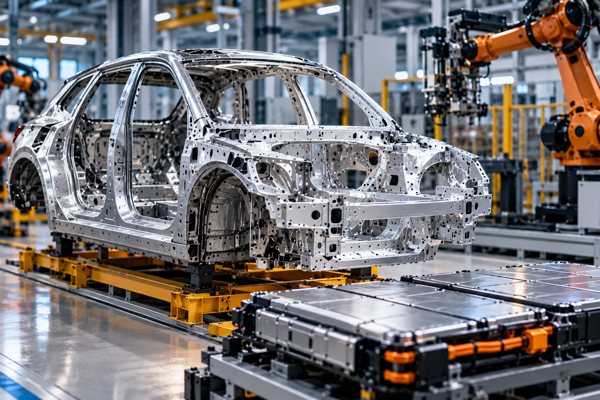
Aluminium-intensive vehicle design could reduce electric vehicle (EV) weight, battery requirements and manufacturing complexity, according to a joint theoretical study by Stellantis and Alumobility. Using Stellantis’ STLA Medium platform as its reference, the study found that an optimised aluminium-based architecture could cut total vehicle mass by around 20 per cent and create the potential to reduce battery capacity by 15 per cent while maintaining equivalent range. Presented at EuroCarBody 2026 in Bad Nauheim, Germany, on October 22, the study examined how aluminium could be incorporated across the vehicle structure rather than simply replacing steel components on a like-for-like basis. The concept reduced body-in-white mass - the vehicle’s structural body before components such as...
Rio Tinto’s planned USD 1.9 billion investment in the Kangwinan bauxite project is expected to support more than 1,300 construction jobs in Queensland, while helping secure the long-term future of its Weipa mining operations as existing sources of production approach the end of their lives. Located on Western Cape York Peninsula, Kangwinan will add 20 million tonnes of annual bauxite production capacity, with first output targeted for 2029 and full production expected by 2032. The project will raise Weipa Operations’ annual capacity to around 44 million tonnes from current production of approximately 38 million tonnes. Construction is scheduled to ramp up in 2027. Beyond the immediate employment boost, the investment is expected to help sustain Rio Tinto’s residentially based workforce of...
Grow with
AL Circle

The Middle East tension is affecting small and medium enterprises (SMEs) in South Korea that depend on the region for aluminium and naptha. A report says these firms need support to manage raw material supply and exports. SMEs do not import much overall from the Middle East, but they depend on it for some key materials. According to a report by The Small and Medium Venture Business Research Institute, about 82.8 per cent of naphtha imports come from countries like Kuwait, the UAE and Qatar. Some aluminium products also rely on the region, including scrap (11.2 per cent) and non-alloy ingots (8.8 per cent). This creates a risk of supply problems. For the global aluminium value-chain 2026 outlook, book our exclusive report “ Global ALuminium Industry Outlook 2026 " SMEs are also more...

Century Aluminum Company (CENX) has reported higher costs and expenses in 2025. Cost of sales increased by 10.9 per cent compared to the previous year. Selling, general and administrative expenses rose by about 41 per cent. Other operating costs also increased by more than 100 per cent. The main cost pressures came from key inputs like alumina, electricity and carbon products. These made up over 84 per cent of total production costs. Changes in energy and raw material prices have also added pressure. Equipment issues at the Grundartangi plant in Iceland affected the cost efficiency. For the global aluminium value-chain 2026 outlook, book our exclusive report “ Global ALuminium Industry Outlook 2026 " Despite this, the company has worked to improve performance. It focused on cost control,...

Germany, the wider European Union and South Korea are increasingly finding themselves on the back foot in securing rare earth supplies, even as countries like the United States and Japan move quickly to lock in access through strategic deals and investments. The imbalance is becoming more visible amid China’s prolonged restrictions on rare earth exports, which have tightened global availability over the past year. Explore- Most accurate data to drive business decisions with Global ALuminium Industry Outlook 2026 across the value chain “The EU and, in particular, Germany, and Korea are quite exposed, right? Where are they going to get their supply from?” stated Darryl Cuzzubbo, CEO of Arafura Resources, emphasising the urgency of the situation. While Western economies are increasing their...

The importance of aluminium for the global energy transition is undeniable, yet the fact remains that its production is one of the most carbon-intensive processes in the industrial sector. According to the International Aluminium Institute (2023), the aluminium value chain accounts for roughly 3 per cent of global direct industrial carbon emissions . Primary aluminium production, which involves three key stages, is the main contributor to this footprint. On average, each tonne of primary aluminium emits about 14.8 tonnes of carbon dioxide equivalent (CO₂e). When the emissions profile is broken down across the production chain, bauxite mining contributes around 0.1 tonnes of CO₂e per tonne of aluminium, alumina refining adds approximately 2.6 tonnes, and the primary smelting process...

The ongoing Middle East conflict led to the London Metal Exchange (LME) aluminium prices soaring above USD 3,500 per tonne , with forecasts pointing to a potential rise to USD 4,000 by 2026. While the rally offers the primary aluminium producers a strong earnings opportunity, it is severely straining India’s downstream sector, specifically micro, small and medium enterprises (MSMEs) . Explore- Most accurate data to drive business decisions with Global ALuminium Industry Outlook 2026 across the value chain Industry comparison: Primary aluminium vs MSME India’s primary aluminium industry, with a capacity of 4.1 million tonnes, remains nearly 98 per cent operational and maintains margins of around 10 per cent. Yet, domestic supply is tightened because almost half of its produce is exported....

The Government Service Insurance System (GSIS) has been getting strong demand for its Ginhawa Solar Energy Loan (GSEL), recording over 1,200 applications worth nearly PHP 400 million (USD 7.2 million) within 24 hours of launch. For the global aluminium value-chain 2026 outlook, book our exclusive report “ Global ALuminium Industry Outlook 2026 " The loan is for government employees to reduce electricity costs while promoting renewable energy adoption. It is aligned with Executive Order 110, the Unified Package for Livelihoods, Industry, Food and Transport. GSIS president and general manager Wick Veloso said the initiative translates national policy into member benefits. Also Read: Vedanta chairman, Anil Agarwal calls for greater entrepreneurial participation to unlock value in India’s...

中文翻译附于新闻末尾,敬请继续阅读。 Ever since the emergence of recycled aluminium as a key lever for both decarbonisation and supply security in the industry, the United States (US) has emerged as one of the world’s leading exporters of aluminium scrap, with a well-established collection network and surplus generation. Large volumes of US-origin scrap are shipped to processing hubs in Asia, indicating a strategic supply corridor between the West and the East. That being said, with the stark demand surge for recycled aluminium across the world, the US has also been weighing the value of the metal, and as advised by the Aluminium Association, looking to treat its “aluminium scrap as a strategic asset.” Explore- Most accurate data to drive business decisions with Global ALuminium Industry Outlook 2026...

Boosting a legacy that stretches back 127 years? Well, it has been rightly done by the luggage brand, Rimowa, aligning rich history with smart strategies. By tapping into the design roots and aluminium craftsmanship, the Classic Aluminium Grid has been reintroduced by the firm in the market. This marks the right blend between the firm’s historical identity and that of the modern-day appeal. A limited-edition release, the firm has unveiled the Classic Aluminium Grid, making people turn their heads, especially for the design enthusiasts and the premium shoppers alike. Just because it is not another newly introduced product in the market, people are buzzing because it upholds the past and blends with modern thoughts. Created back in 1969, a hand-carry case marked the design inspiration for...

Swedish aluminium rolling and recycling company Gränges has issued two five-year senior unsecured green bonds, adding up to SEK 6 million (USD 64 million) under its Medium-Term Note (MTN) programme. Marking a step in the low-carbon aluminium industry and sustainability, the bond is dated to mature in 2031. Explore- Most accurate data to drive business decisions with Global ALuminium Industry Outlook 2026 across the value chain The structure of the green bond goes like this – SEK 400 million (USD 42.8 million) of the total amount is to carry a coupon of 3-month Stibor plus 1.25 per cent, and SEK 200 million (USD 21 million) carries a fixed coupon of 4.15 per cent. Proceeds obtained from it will be distributed among eligible green projects under the Gränges’ Green Finance Framework. CFO...

The NSW Government has been called upon by the Australian Workers’ Union (AWU) to conclude the financial support with consideration of the Tomago aluminium smelter. The union warned that any hold-ups could jeopardise jobs and weaken Australia’s industrial strength. Within the recently released news, the union highlighted that the firm's smelter is one of the largest single employers in the Hunter Valley energy precinct. Further emphasis was made on the local businesses, supply chains and communities that rely heavily on the assurance of its ongoing operation. Moreover, they also indicated that backing the smelter does not mean only saving jobs, but also ensuring that Australia can process bauxite into aluminium domestically, instead of exporting raw materials and bringing in finished...

After two days of declining price trend, on March 24, the London Metal Exchange (LME) aluminium price rose significantly. However, the longer-dated contracts were deduced from the previous season. The LME alumina platts price also rose from the last day. Both the LME cash bid and offer rose by USD 52 per tonne or 2 per cent, where the bid shifted from USD 3,242 per tonne to USD 3,294 per tonne. Similarly, the offer moved from USD 3,242.5 per tonne to USD 3,294.5 per tonne. Must read: Key industry individuals share their thoughts on the trending topics The LME 3-month bid expanded by USD 28 per tonne or 1 per cent, changing from USD 3,217 per tonne to USD 3,245 per tonne. A similar trend is seen in the 3-month offer price, which gained by USD 29 per tonne or 1 per cent, from USD 3,218 per...

India is planning to increase its domestic production of rare earth permanent magnets, like lithium, with a target of reaching 5,000 tonnes by 2030. The idea is to reduce dependence on imports and slowly build a stronger base for critical minerals within the country. At the moment, demand is around 4,000 tonnes, but that number is expected to rise quite a bit. Some estimates suggest it could go up to nearly 8,000 tonnes by 2030, which is why there’s a push to expand production. To get things moving, a pilot project for neodymium-iron-boron magnets has already been started. At the same time, a samarium-cobalt magnet plant in Visakhapatnam is now operational, with an initial capacity of 500 tonnes per year. The scale-up is expected to happen in steps. First to around 2,000 tonnes, and then...

The Nothing Phone (4a) Pro sits in the mid-range segment, with a strong focus on its aluminium build. It features a 6.8-inch display (2800×1260), a 5,080 mAh battery, and is powered by the Snapdragon 7 Gen 4 chipset, with base variants starting at 8GB RAM and 128GB storage. Design-wise, this is probably where the phone shines the most. The aluminium unibody makes a real difference. Both the frame and the back panel use aluminium, and it gives the device a sturdier, more premium feel compared to older models. The display is a 6.83-inch AMOLED panel with a 1260×2800 resolution and roughly 440 ppi. It supports a 144Hz refresh rate and can hit up to 5,000 nits of peak brightness. The device features a triple rear camera setup, comprising a 50MP main sensor, a 50MP periscope lens with 3.5x...

Leadrive Technology has moved into mass production of its EV0062 hybrid dual motor controller, bringing into focus a design that incorporates a dual-channel water-cooled aluminium capacitor to manage thermal performance under demanding conditions. The unit, confirmed on March 23, 2026, is being integrated into Schaeffler’s next-generation DHT assembly and will support both plug-in hybrid (PHEV) and hybrid electric vehicle (HEV) platforms for a major European automaker.n Production has initially started with a plug-in hybrid platform, targeting multiple B-segment vehicles. The controller is designed to serve across both PHEV and HEV configurations, with a platform approach that enables more than 95 per cent parts commonality between the two. For the global aluminium value-chain 2026...

Brewers in India are grappling with rising costs and supply disruptions as a gas shortage-linked to geopolitical tensions around the Iran-US conflict-hits the supply chain. The shortage has pushed up prices of glass bottles and has also slowed aluminium imports used for cans. With gas supply tightening, some glass manufacturers have either cut back or temporarily stopped production. This has led to a roughly 20 per cent increase in glass bottle prices. At the same time, aluminium can suppliers have warned that supply could tighten further, just as the peak summer season approaches and beer demand usually picks up. Paper carton costs have also doubled, and other packaging materials are becoming more expensive. For the global aluminium value-chain 2026 outlook, book our exclusive report “...

Rio Tinto is increasing its focus on aluminium as part of a long-term strategy, driven by rising demand for low-carbon metals. The company is now looking beyond its long-established base in Canada to expand across Europe, Asia and Latin America. Jérôme Pécresse, Chief Executive of Rio Tinto, said, “It was clear that aluminium was becoming more important for Rio Tinto and there was more willingness to put capital in the business.” For the global aluminium value-chain 2026 outlook, book our exclusive report “ Global ALuminium Industry Outlook 2026 " A key part of this strategy is the AP60 smelter technology. It is more energy efficient and produces lower emissions. When used with hydropower in Canada, it generates about one-seventh of the industry’s average emissions per tonne of aluminium,...

Global automakers are accelerating aluminium procurement as the ongoing Middle East conflict continues to disturb supply chains, disrupting production and trade routes, thereby raising concerns over near-term supply shortages and escalating costs. The situation has catalysed a wave of precautionary purchases. As the conflict advances towards a full month, executives from automakers and component suppliers observe that companies are building emergency reserves. Explore- Most accurate data to drive business decisions with Global ALuminium Industry Outlook 2026 across the value chain Shipping disruptions and regional exposure The Gulf Corporation Council (GCC) nations produce about 10 per cent of global refined aluminium, making the region an essential supply hub. Europe sources...

The federal and Queensland governments of Australia are to jointly sponsor a USD 2 billion support package for Australia’s second-largest aluminium smelter, the Boyne aluminium smelter of Rio Tinto. The joint funding is being rendered as a large-scale renewable energy transition while aiming to secure jobs and long-term industrial stability. Explore- Most accurate data to drive business decisions with Global ALuminium Industry Outlook 2026 across the value chain Anthony Albanese, the Prime Minister of Australia, commented on the investment’s contribution to transforming Queensland’s energy grid. Noting the present global trade disruptions owing to the Middle East conflict, he emphasised the essentiality of a strong domestic manufacturing base. Funds aligned with renewables and jobs In...