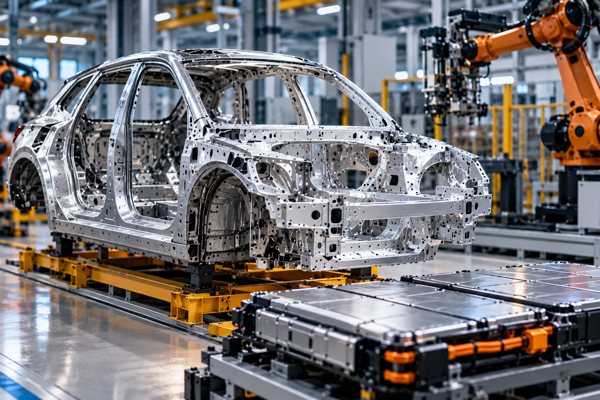
Aluminium-intensive vehicle design could reduce electric vehicle (EV) weight, battery requirements and manufacturing complexity, according to a joint theoretical study by Stellantis and Alumobility. Using Stellantis’ STLA Medium platform as its reference, the study found that an optimised aluminium-based architecture could cut total vehicle mass by around 20 per cent and create the potential to reduce battery capacity by 15 per cent while maintaining equivalent range. Presented at EuroCarBody 2026 in Bad Nauheim, Germany, on October 22, the study examined how aluminium could be incorporated across the vehicle structure rather than simply replacing steel components on a like-for-like basis. The concept reduced body-in-white mass - the vehicle’s structural body before components such as...
Rio Tinto’s planned USD 1.9 billion investment in the Kangwinan bauxite project is expected to support more than 1,300 construction jobs in Queensland, while helping secure the long-term future of its Weipa mining operations as existing sources of production approach the end of their lives. Located on Western Cape York Peninsula, Kangwinan will add 20 million tonnes of annual bauxite production capacity, with first output targeted for 2029 and full production expected by 2032. The project will raise Weipa Operations’ annual capacity to around 44 million tonnes from current production of approximately 38 million tonnes. Construction is scheduled to ramp up in 2027. Beyond the immediate employment boost, the investment is expected to help sustain Rio Tinto’s residentially based workforce of...
Grow with
AL Circle

Global automakers are accelerating aluminium procurement as the ongoing Middle East conflict continues to disturb supply chains, disrupting production and trade routes, thereby raising concerns over near-term supply shortages and escalating costs. The situation has catalysed a wave of precautionary purchases. As the conflict advances towards a full month, executives from automakers and component suppliers observe that companies are building emergency reserves. Explore- Most accurate data to drive business decisions with Global ALuminium Industry Outlook 2026 across the value chain Shipping disruptions and regional exposure The Gulf Corporation Council (GCC) nations produce about 10 per cent of global refined aluminium, making the region an essential supply hub. Europe sources...

The federal and Queensland governments of Australia are to jointly sponsor a USD 2 billion support package for Australia’s second-largest aluminium smelter, the Boyne aluminium smelter of Rio Tinto. The joint funding is being rendered as a large-scale renewable energy transition while aiming to secure jobs and long-term industrial stability. Explore- Most accurate data to drive business decisions with Global ALuminium Industry Outlook 2026 across the value chain Anthony Albanese, the Prime Minister of Australia, commented on the investment’s contribution to transforming Queensland’s energy grid. Noting the present global trade disruptions owing to the Middle East conflict, he emphasised the essentiality of a strong domestic manufacturing base. Funds aligned with renewables and jobs In...

The Guinea-China bauxite corridor has long powered global aluminium supply chains. However, this high-volume trade now appears to be entering a more fragile phase, as rising freight costs, shifting trade flows, and emerging policy signals from Guinea begin to test the resilience of one of the world’s most critical bulk routes, according to shipbroker Intermodal. Guinea exported about 183 million tonnes of bauxite in 2025, up 25 per cent year-on-year, with most of the material shipped to China. On the demand side, China’s aluminium output remains close to its effective ceiling of around 45 million tonnes per year, keeping it dependent on imported feedstock. China’s bauxite imports have exceeded 200 million tonnes, reflecting the scale of the trade and its role in supporting Capesize vessel...

The largest alumina producer in Europe is reported to supply the aluminium smelting raw material to the defence industry of Russia. The shipment is said to have started from Ireland's Aughinish plant and is subject to the US and EU sanctions. In the production of military equipment, the need for strong and corrosion-resistant aluminium is vital. Keeping the urgent need in mind, the European Commission, for building up alumina stocks, deemed crucial for the defence sector, has called on the member states. Patrick O’Donovan, the representative for the Limerick constituency in the parliament, claimed, “It supplies Europe with up to 30 per cent of the alumina needed for the continent’s construction, aviation and automotive industries… and is in no way connected to the Russian military...

Aluminium Extrusion Manufacturers Association of India (ALEMAI) has warned that the strained fuel supply, with rising energy prices, is weighing on key industrial units as they run below capacity. Consequently, these challenges are taking a toll on the micro, small and medium enterprises (MSMEs), the fundamental players in the Indian aluminium extrusion industry. Explore- Most accurate data to drive business decisions with Global ALuminium Industry Outlook 2026 across the value chain Owing to the ever-inflating prices of energy-intensive operations, manufacturers in Ahmedabad, Bengaluru and Pune have reported an output slowdown. As aluminium extrusion generally depends on gas-powered high-temperature furnaces, it is exposed to volatile fuel prices and supply uncertainties. Industry...

The Bureau of Indian Standards (BIS) has made ISI certification mandatory for aluminium utensils used in food and beverage applications, effective October 1, 2026. For the global aluminium value-chain 2026 outlook, book our exclusive report “ Global ALuminium Industry Outlook 2026 " G. Bhavani, senior director and head of the BIS Coimbatore branch, said the move aims to ensure safety and quality. The mandate covers IS 1660:2024 for wrought aluminium utensils and IS 14407:2023 for aluminium beverage cans. Also Read: Aluminium anode EV battery achieves high efficiency and fast charging at -25°C Parameters under the standard include thickness, size, handle strength, load-bearing capacity and resistance to temperature variations. Aluminium utensils must also contain a minimum of 99.5 per cent...

29 thousand equity shares in Banco Products (India) Limited, on March 23, 2026, were sold by Banco Aluminium Private Limited. This marks an inter-se transfer between Banco Aluminium and Mr Mehul Kanubhai Patel, the buyer. After acquiring these stocks, the buyer, along with his Persons Acting in Concert (PACs), is deemed to hold 67.88 per cent of the total equity in the target company. Activity involving the share transfer The document highlights a major shift in shareholding concerning the target company, which here is the Banco Products (India) Limited. It confirms the sale of 29 thousand equity shares, each valued at INR 2, with the transaction finalised on March 23, 2026. Undertaking the transaction was done via an off-market inter-se transfer, where Banco Aluminium Private Limited...

As the US-Israel conflict with Iran persisted, blocking the Strait of Hormuz, Emirates Global Aluminium (EGA) secured an alternative route for export activities last week, easing the global trade disruption along the Middle East route. The impact was immediate, as the London Metal Exchange (LME) aluminium prices fell nearly 1 per cent on March 18 , with the trend continuing till the latest close of LME aluminium on March 24. Both LME aluminium cash bid and offer prices saw a decline of 0.28 per cent. The bid price eased to USD 3,242 per tonne on March 24 from USD 3,251 per tonne on March 23 , as the cash offer settled at USD 3,242.5 per tonne, slipping from USD 3,251.5 per tonne. To know more about the global primary aluminium industry 2026 outlook, book the report “ Global ALuminium...

Aluminium prices remained low, dipping by 0.12 per cent to settle at USD 330.9 per kilogram, as mixed supply developments and demand concerns kept the market range-bound. However, output has picked up in some regions, with Alvance British Aluminium increasing production at its Lochaber smelter by around 10 per cent, supported by improved export opportunities to the US following tariff changes. Explore- Most accurate data to drive business decisions with Global ALuminium Industry Outlook 2026 across the value chain The current production disruptions in the Middle East, such as partial shutdowns at Aluminium Bahrain and reduced operations at Qatalum, have offered some support. However, public opinion still varies. Global inventories have risen above 1.3 million tonnes, the highest since...

While the global aluminium industry is grappling with the impact driven by the ongoing geopolitical tension, one company is silently marking the upswing in the price to its advantage. According to the Hong Leong Investment Bank Bhd (HLIB Research), Press Metal Aluminium Holdings Bhd, the world-class aluminium producer, is deemed to yield benefits due to the elevated aluminium price. The firm’s earnings forecasts, as raised by HLIB Research, for the financial years 2026 and 2027, show an increase of 13 per cent and 18.7 per cent, respectively. The increase in the forecasted earnings is owed to the higher aluminium prices assumptions by the London Metal Exchange (LME). Additionally, the higher forecasts are also owed to the revised hedging positions and the stronger Main Japanese Port (MJP)...

On 4 March 2026, the European Commission presented its Proposal for a Regulation on establishing a framework of measures for accelerating industrial capacity and decarbonization in strategic sectors, which aims at “improving the functioning of the internal market by establishing a framework to support the development, competitiveness and resilience of the Union’s manufacturing sector, with a focus on selected strategic sectors”, in order to contribute to the EU’s “climate objective, economic security and the creation, retention of, and transition into high-quality jobs." Among other things, the Industrial Accelerator Act would establish a framework for the application of EU origin and low-carbon requirements for certain products and services within strategic sectors in the context of...

Lyra Energy has started building the Thakadu solar power plant in South Africa. The project is worth about USD 238 million and will have a capacity of 255 megawatts. It is located between the Free State and North West provinces. The project will be built in two phases. Part of the electricity output has already been sold to three private buyers through power purchase agreements. These agreements allow companies to buy electricity directly from the plant. The first phase is expected to start operating in the first half of 2027. Construction of the second phase will begin in the second half of 2026. For the global aluminium value-chain 2026 outlook, book our exclusive report “ Global ALuminium Industry Outlook 2026 " The project will be funded through equity and project debt, with 80 per...

Australia is considering a shift to ‘green’ aluminium and iron production using renewable energy. This could increase iron ore export earnings from about USD 116 billion to around USD 386 billion a year by 2060. Metal production uses large amounts of energy. Producing aluminium and steel without fossil fuels could reduce emissions and increase export value. Aluminium production currently accounts for about 2 per cent of global carbon emissions, while iron and steel add about 6-8 per cent. Australia is one of the world’s largest exporters of aluminium and iron ore, with about 55 per cent of the global supply. Most of this comes from the Pilbara region. However, Pilbara ore has lower iron content (55-62 per cent) and contains impurities (mostly in silica and alumina). This makes it...

The government of Egypt has signed three agreements covering renewable energy and battery storage projects with a combined capacity of 5.62 GW. The agreements were concluded under the supervision of Prime Minister Mostafa Madbouly. Minister of Electricity Mahmoud Esmat said the developments are in line with the country’s energy roadmap. For the global aluminium value-chain 2026 outlook, book our exclusive report “ Global ALuminium Industry Outlook 2026 " The deals span wind and solar power installations alongside a standalone battery storage system. The projects will be implemented through collaborations between domestic and international developers. Wind project anchors first agreement One of the key agreements involves a land lease for a 900 MW wind power project in Ras Shukeir. The...

Hulamin has indicated that it will post a loss for the 2025 financial year, pointing to a combination of operational setbacks and unfavourable currency movements ahead of its full-year results due on Monday. Explore- Most accurate data to drive business decisions with Global ALuminium Industry Outlook 2026 across the value chain The aluminium manufacturer, headquartered in Pietermaritzburg, explained that a prolonged shutdown of its integrated plant formed part of a major project to expand its wide can body capacity. However, this interruption made it challenging to restore consistent mill performance once operations resumed. Conversely, the disruption presented difficulties in re-establishing stable mill operations upon the resumption of activity. As indicated in the company's SENS...

The Tomago aluminium smelter is planning to shift to renewable electricity, with an expectation of targeting 50 per cent renewable energy by 2030 and 100 per cent by 2035, while also strengthening the case for government-backed financial support. To know how the Middle East crisis is affecting the smelters worldwide, read the report “ Global ALuminium Industry Outlook 2026 ” Last December, the Australian and New South Wales governments announced their support to ensure the continued operation of the Tomago smelter. As part of this support, they will ensure electricity infrastructure development and offer a fixed-price, long-term power purchase agreement that allows the smelter to remain internationally competitive. The smelter is a major employer and energy consumer in NSW. It is the...

While global attention remains fixed on China, a quieter transformation is unfolding across Africa and Asia. Across Africa and Asia (excluding China), metallurgical alumina production climbed from 13.8 million tonnes in 2024 to 14.5 million tonnes in 2025. That’s a gain of around 700,000 tonnes, or about 5 per cent year-on-year. On paper, it looks steady. In reality, it reflects a shift that’s being built piece by piece. 2025: A year of steady build-up What stands out in 2025 is not just the total output, but how it evolved through the year. Production averaged around 39,800 tonnes per day, but the path to that number was far from linear. The year opened quietly. Q1 came in at 3.4 million tonnes, weighed down by a softer February. Things began to turn in March, and that recovery carried...

Over USD 2.6 billion in Foreign Direct Investment (FDI) for the mining sector has been pooled by Nigeria in the last two and a half years. This has been updated during the Powering Africa Summit in Washington by Solid Minerals Development Minister Dele Alake. As pointed out by Alake, recent inflows, which were a result of reforms, are designed to make the sector more appealing to investors. These included a more robust regulatory framework, digitised licensing and better protection of mineral rights. Moreover, the authorities pushed efforts against illegal mining, leading to over 350 arrests in just one year. He added, “We have successfully de-risked and sanitised the mining environment, making it conducive to Foreign Direct Investment (FDI).” Also read: South32 pauses Worsley Alumina...