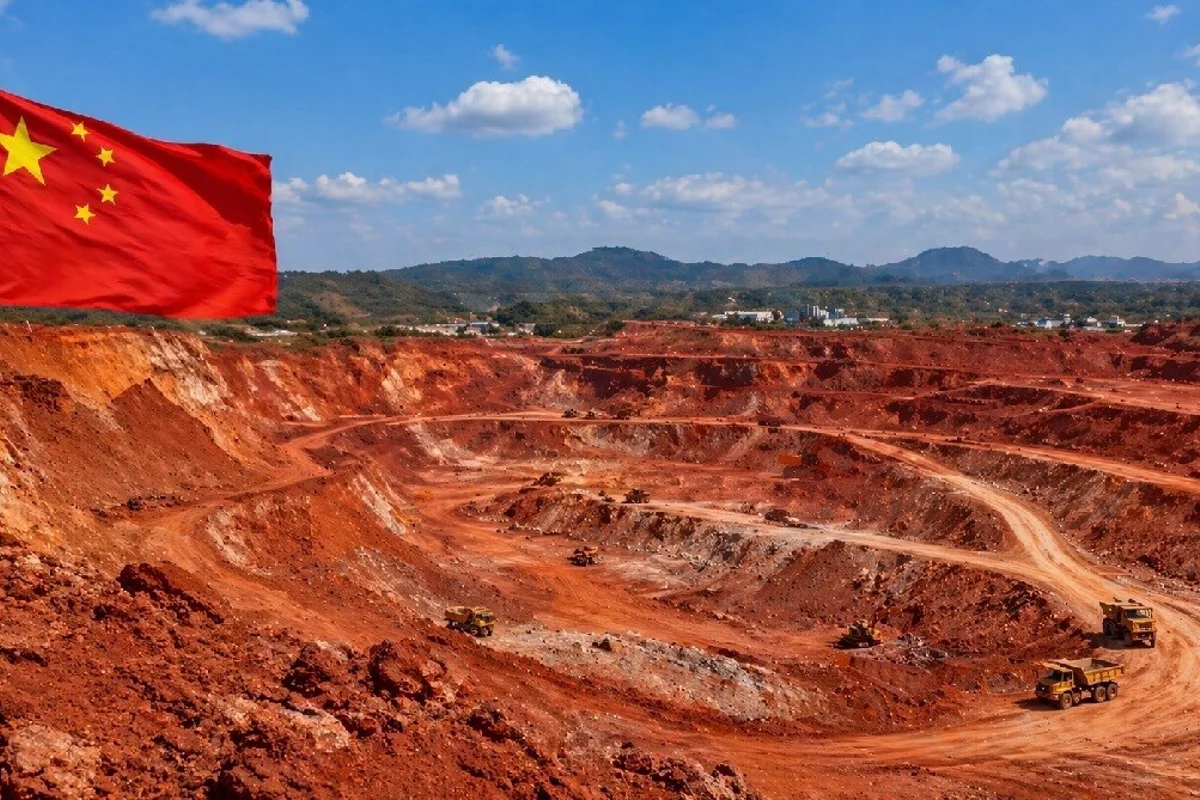
Is China’s aluminium industry gradually finding itself more dependent on overseas suppliers for a critical raw material? That question becomes difficult to ignore when the 2025 numbers come into focus. During the year, China’s bauxite imports climbed to 201 million tonnes, rising from 159 million tonnes in 2024-an increase of about 26.5 per cent-clearly pointing to stronger reliance on external supply chains.
China produced around 87 million tonnes of bauxite in 2025, while demand stood in the range of 232.4–278.8 million tonnes. That created a structural gap of around 191 million tonnes, which imports increasingly had to bridge, a trend closely analysed in AL Circle’s Global Bauxite & Alumina Market Forecast to 2036: Supply–Demand, Trade Flows & Price Outlook report.
Who really controls China’s bauxite imports?
China’s bauxite import structure in 2025, based on total imports of 201 million tonnes, is heavily skewed toward a small cluster of exporters, making the supply map look far more concentrated than diversified.
At the top, Guinea stands out with a dominant 74.13 per cent share of total imports, effectively shaping the direction of China’s bauxite inflows. Australia follows at 18.61 per cent, holding a distant but still critical second position in the sourcing mix.
Beyond this duo, the curve drops sharply. Turkey accounts for 1.54 per cent, Sierra Leone 1.09 per cent, Guyana 0.90 per cent, and Malaysia 0.79 per cent. Lao PDR sits at 0.74 per cent, while Côte d’Ivoire and Ghana are both at 0.46 per cent. Brazil rounds off the list with a 0.45 per cent share of China’s total bauxite imports in 2025.
Guinea sets the tone, Australia follows
Guinea, for instance, isn’t just leading volumes-it is effectively anchoring the entire import system. In 2025, it exported 149 million tonnes of bauxite to China, up sharply from 110 million tonnes in 2024. Prices also moved up from USD 69 per tonne to USD 81 per tonne, reinforcing its strong market position. Even in 2026, the flow stayed firm with 14 million tonnes in January (USD 70 per tonne) and 13 million tonnes in February (USD 68 per tonne).
Australia, meanwhile, continues to act as the second stabilising pillar, though at a much smaller scale. It shipped 37.4 million tonnes in 2025, slightly down from 39.8 million tonnes in 2024, while prices rose from USD 58 per tonne to USD 70 per tonne. In early 2026, volumes stood at 3.9 million tonnes in January (USD 60 per tonne) and 2.4 million tonnes in February (USD 59 per tonne).
Together, these two markets carry the weight of China’s import dependence.
Emerging and mid-tier suppliers
Below the top two, the rest of the suppliers are growing-but in uneven bursts rather than steady expansion.
Turkey recorded moderate growth, rising from 2.5 million tonnes in 2024 to 3.1 million tonnes in 2025, with prices steady at USD 74 per tonne. In 2026, it exported 58,007 tonnes in January (USD 98 per tonne) and 56,646 tonnes in February (USD 68 per tonne).
Sierra Leone, however, has made a much sharper leap-moving from just 47,687 tonnes in 2024 to 2.2 million tonnes in 2025. Prices eased slightly from USD 80 per tonne to USD 77 per tonne. In 2026, shipments stood at 241,969 tonnes in January and 218,851 tonnes in February, both at USD 63 per tonne.
Guyana shows a similar breakout story, rising from almost negligible 55 tonnes in 2024 to 1.8 million tonnes in 2025. Prices, however, dropped sharply from USD 173 per tonne to USD 87 per tonne. In January 2026, exports reached 143,259 tonnes.
It stems mainly from massive government and foreign investment upgrading an underutilised, long‑dormant sector, plus strong pull from China’s still‑growing alumina‑refining needs.
After years of decline and collapse under mismanagement, Guyana’s government has pushed to revive bauxite, with official plans to add 400,000 extra tonnes of production in 2025 on top of 2024’s 250,000‑tonne increase, largely centred on the Linden area and Bosai Minerals’ operations.
Another key factor is price dynamics- in 2025, a decline of USD 86 per tonne made Guyana’s bauxite more attractive, supporting a rise in China’s imports from the country.
This rapid emergence of Guyana reflects how quickly new supply centres can alter global trade flows and pricing dynamics, trends closely tracked in AL Circle’s Global Bauxite & Alumina Market Forecast to 2036: Supply–Demand, Trade Flows & Price Outlook report.
Malaysia also strengthened its position meaningfully, climbing from 949,117 tonnes in 2024 to 1.59 million tonnes in 2025, with prices rising to USD 66 per tonne. In February 2026, it exported 51,805 tonnes at USD 61 per tonne.
Are smaller suppliers shaping a shifting balance?
Lao PDR shipped 1.49 million tonnes in 2025, slightly below 1.5 million tonnes in 2024, while prices increased from USD 67 per tonne to USD 75 per tonne. In 2026, it exported 127,055 tonnes in January and 76,966 tonnes in February.
Côte d’Ivoire moved upward, reaching 927,371 tonnes in 2025 compared to 709,32 tonnes in 2024, with prices steady at USD 74 per tonne. Early 2026 figures stood at 99,908 tonnes in January and 51,926 tonnes in February, both at USD 69 per tonne.
Ghana moved in the opposite direction, declining from 1.1 million tonnes in 2024 to 927,097 tonnes in 2025, even as prices climbed to USD 95 per tonne.
Brazil also saw volumes ease from 1.2 million tonnes in 2024 to 901,146 tonnes in 2025, while prices rose to USD 115 per tonne. In 2026, exports were 214,726 tonnes in January (USD 119 per tonne) and 41,485 tonnes in February (USD 115 per tonne).
To extend this trend into the current year, China imported 36.2 million tonnes in just the first two months of 2026-suggesting that the same dependence pattern is not only continuing but already locking in momentum, a trend explored in depth in AL Circle’s Global Bauxite & Alumina Market Forecast to 2036: Supply–Demand, Trade Flows & Price Outlook.
Don't miss out- Buyers are looking for your products on our B2B platform













_md.webp)
_md.webp)
_md.webp)







