Bauxite grades decoded: How Guinea, Australia, Brazil, China, India & Indonesia measure up against global refinery standards
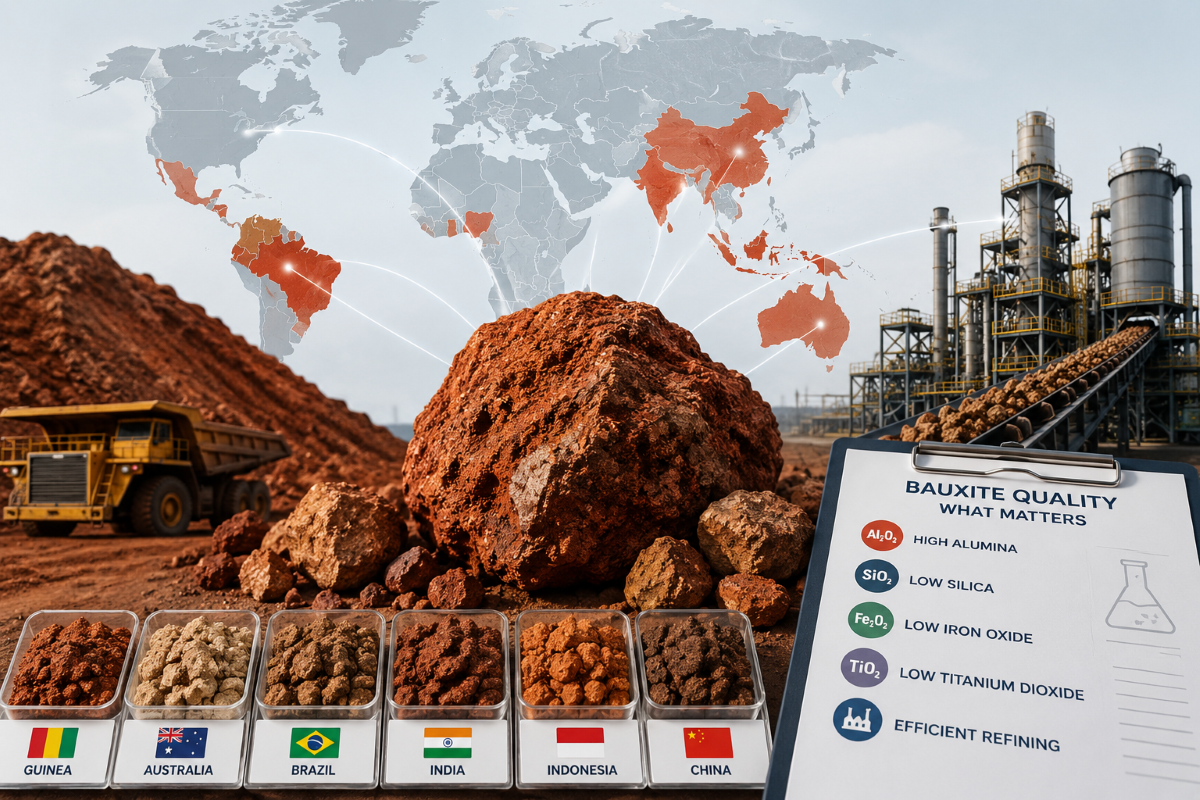
The image used in this article is generated with an AI tool and does not depict any real-time moment
The world's largest bauxite producers are not always the ones supplying the highest-quality ore. While countries such as Guinea, Australia, China, Brazil, India and Indonesia dominate global bauxite mining, the quality of the ore they produce varies significantly, making production volume only part of the story.
During the first quarter of 2026, Guinea remained the world's largest bauxite producer with 34.342 million tonnes, followed by Australia at 23.117 million tonnes and China at 18.806 million tonnes. Brazil produced 7.920 million tonnes, India 7.398 million tonnes and Indonesia 5.449 million tonnes. However, for alumina refiners, the more critical factor is not how much bauxite is mined, but how much recoverable alumina the ore contains and how efficiently it can be processed.
The competitiveness of refinery-grade bauxite is determined by its chemical composition. Higher recoverable alumina content, combined with lower levels of impurities such as reactive silica, iron oxide and titanium dioxide, improves alumina recovery, reduces energy consumption and lowers refining costs. Commercially mined bauxite is broadly divided into two categories. Metallurgical-grade bauxite, containing around 40-55 per cent alumina (Al₂O₃), accounts for nearly 77 per cent of global commercial production and serves as the primary feedstock for alumina refineries. The remaining output comprises non-metallurgical-grade bauxite, which is mainly used in refractories, abrasives, cement and speciality chemical applications.
The global benchmark: What defines refinery-grade bauxite?
To compare producing countries fairly, their ore characteristics must first be measured against the internationally accepted metallurgical-grade benchmark used by alumina refineries.
Metallurgical-grade bauxite is classified into Grade A, Grade B and Grade C according to its chemical composition and physical properties.
Grade A requires a minimum alumina (Al₂O₃) content of 44 per cent, while Grades B and C require at least 42 per cent alumina. Silica (SiO₂), one of the most critical impurities during alumina refining, is restricted to a maximum of 8 per cent for Grades A and B and 7 per cent for Grade C.
Iron oxide (Fe₂O₃) should not exceed 18 per cent for Grade A, 20 per cent for Grade B and 25 per cent for Grade C.
Across all three grades, titanium dioxide (TiO₂) is limited to 3.5 per cent, calcium oxide (CaO) to 3 per cent, moisture content to 10 per cent, while at least 95 per cent of the material must fall within the 0- 100 mm particle size range. Monohydrate content should also remain below 3 per cent. Together, these parameters form the globally accepted benchmark for metallurgical-grade bauxite.
For non-metallurgical applications, abrasive-grade bauxite requires a minimum alumina content of 55 per cent, silica below 9 per cent, iron oxide below 6 per cent, and titanium dioxide of at least 2.5 per cent. Chemical-grade bauxite contains 55–58 per cent alumina, 5-12 per cent silica, and a maximum of 2 per cent iron oxide. Refractory-grade bauxite requires 59-61 per cent alumina, 1.5-5.5 per cent silica, a maximum of 2 per cent iron oxide, and at least 2.5 per cent titanium dioxide. Cement-grade bauxite requires a minimum alumina content of 38 per cent, with silica, iron oxide and titanium dioxide limited to 14 per cent, 25 per cent and 3 per cent, respectively.
Explore- Most comprehensive and forward-looking industry-focused report — Global Bauxite & Alumina Market Forecast to 2036: Supply–Demand, Trade Flows & Price Outlook
How do the world's leading producers compare?
Although the refinery benchmark is universal, geology has given each producing region a distinct chemical signature, influencing refining efficiency and feedstock quality.
Guinea
Guinea's tropical highlands contain one of the world's largest bauxite reserves, formed through millions of years of intense chemical weathering of basement rocks. The deposits display a characteristic five-zone lateritic profile comprising a ferricrete cap, nodular laterite, mottled zone, pallid (saprolite) zone and fresh bedrock.
Typical Guinean bauxite contains 44- 52 per cent alumina, with silica limited to a maximum of 3 per cent and iron oxide to 23 per cent. Titanium dioxide averages 2.1 per cent, while calcium oxide remains below 0.1 per cent, magnesium oxide below 2 per cent, and loss on ignition (LOI) ranges between 25 and 28 per cent. Although iron oxide levels are relatively higher, Guinea's exceptionally low silica content makes it one of the preferred suppliers to alumina refineries worldwide.
Australia
Australia's Weipa and Gove deposits consistently produce bauxite containing 50–55 per cent alumina. Silica ranges between 6.4 and 11.6 per cent, iron oxide averages 10.9 per cent, while titanium dioxide is around 2.5 per cent. Calcium oxide and magnesium oxide remain close to 0.1 per cent, and LOI averages 13.6 per cent. The high alumina content and relatively balanced impurity profile have established Australian bauxite as one of the industry's most reliable refinery feedstocks.
Brazil
Bauxite from Brazil's Trombetas region contains 50–55 per cent alumina. Silica is reported at 3.4 per cent or higher, while iron oxide is 3 per cent or higher. Titanium dioxide does not exceed 2 per cent, with calcium oxide and magnesium oxide remaining around 0.1 per cent. LOI averages 28.9 per cent. This combination of high alumina content and comparatively lower impurity levels positions Brazilian bauxite among the highest-quality refinery feedstocks available in the global market.
Indonesia
Indonesia presents one of the widest quality ranges among the leading producers.
Bintan bauxite contains 44–59 per cent alumina, 1–12 per cent silica, 2–25 per cent iron oxide, approximately 1.2 per cent titanium dioxide, around 0.1 per cent each of calcium oxide and magnesium oxide, and an LOI of 27.3 per cent.
West Kalimantan bauxite contains around 40.34 per cent alumina, 19.02 per cent silica, 16.1 per cent iron oxide, 0.73 per cent titanium dioxide, approximately 0.1 per cent calcium oxide and magnesium oxide, and an LOI of 22.48 per cent. Explore — Global Bauxite & Alumina Market Forecast to 2036: Supply–Demand, Trade Flows & Price Outlook report for an indepth analysis.
China
China: Chinese domestic bauxite is predominantly diasporic (monohydrate), although its quality varies across producing regions. It typically contains 55- 65 per cent alumina (Al₂O₃) and 7- 11 per cent silica (SiO₂), resulting in a relatively low alumina-to-silica ratio and a higher impurity burden than premium export-grade ores. Due to this China has a 33 per cent red mud generation.
India
India's major bauxite deposits in Gujarat and Odisha typically contain 41- 45 per cent alumina, 6- 8 per cent silica, 22- 24 per cent iron oxide, 2- 3 per cent titanium dioxide, around 1 per cent calcium oxide, 1 per cent magnesium oxide, and 21- 23 per cent LOI. Compared with several leading producing countries, Indian bauxite generally contains higher silica and iron oxide, resulting in greater refining intensity and energy requirements.
National Aluminium Company Limited (NALCO) remained India's largest bauxite producer in FY2021-22, accounting for approximately 33 per cent of the country's total production. Public sector mines contributed around 49 per cent of national output during the year, compared with 52 per cent in the previous year.
India's production profile also reflects its metallurgical focus. Around 80 per cent of total production comprised bauxite containing 40- 45 per cent alumina, followed by 11 per cent cement-grade material, 6 per cent containing 45–50 per cent alumina, and 1 per cent refractory-grade bauxite. The remaining production consisted of bauxite containing less than 40 per cent alumina, together with abrasive-grade and chemical-grade material.
Which countries come closest to the global refinery benchmark?
A comparison of the leading producers against internationally accepted metallurgical-grade specifications shows that production leadership does not necessarily equate to refinery-grade superiority.
Brazil is the closest match to the Grade A benchmark. Its bauxite consistently exceeds the minimum alumina requirement, while titanium dioxide, calcium oxide and magnesium oxide remain within specification.
Australia also compares favourably with the Grade A benchmark. Alumina, iron oxide and titanium dioxide comfortably satisfy Grade A specifications. However, silica ranges from 6.4 to 11.6 per cent, indicating that lower-silica deposits align with Grade A, while higher-silica ore may require selective mining or blending to meet refinery specifications.
Guinea presents a mixed quality profile. Alumina content of 44- 52 per cent and silica below 3 per cent satisfy Grade A requirements, but iron oxide of up to 23 per cent exceeds the limits for Grades A and B, bringing that parameter closer to Grade C. Even so, Guinea's exceptionally low silica content continues to make it one of the world's most attractive refinery feedstocks.
Indonesia exhibits the greatest variability. Bintan deposits are capable of meeting Grade A alumina requirements, but the wide range of silica and iron oxide means ore quality can vary from Grade A to Grade C depending on the deposit. West Kalimantan bauxite, with 40.34 per cent alumina and 19.02 per cent silica, falls below the preferred metallurgical benchmark and would generally require beneficiation or blending before refining.
India's deposits also display variable quality. Alumina ranges from 41 to 45 per cent, allowing higher-grade deposits to meet metallurgical requirements, while silica generally remains within acceptable limits. However, iron oxide concentrations of 22- 24 per cent exceed the Grade B threshold, meaning much of the resource aligns more closely with Grade C for that parameter and requires greater refining effort than Australian or Brazilian ore.
Explore our e-magazine ALuminium LeaderSpeak 2026 for the latest industry insights and trends.
What technologies these countries use to improve bauxite ore quality
The technologies used to improve bauxite ore quality vary according to the mineralogy and impurity profile of each country's deposits. While some producers focus on advanced beneficiation to upgrade ore before refining, others optimise Bayer process conditions to maximise alumina recovery from naturally high-grade bauxite.
Brazil leads in ore beneficiation through sensor-based ore sorting, which removes anorthosite and increases alumina (Al₂O₃) content to around 62- 63 per cent while reducing calcium oxide (CaO) below 0.15 per cent. Its alumina refineries also employ residue filtration and dry-stacking technologies to improve water recovery and residue management.
Guinea benefits from naturally low-silica, gibbsitic bauxite and therefore requires little pre-beneficiation. Instead, refiners maximise alumina recovery by selecting low- or high-temperature Bayer digestion routes best suited to the ore. Explore- Most comprehensive and forward-looking industry-focused report — Global Bauxite & Alumina Market Forecast to 2036: Supply–Demand, Trade Flows & Price Outlook
Australia improves processing efficiency through thermally assisted beneficiation and Bayer process innovations that enhance mineral recovery and reduce residue generation. Residue filtration at alumina refineries further improves water recovery and lowers the environmental footprint.
India upgrades metallurgical-grade bauxite using washing, screening, flotation and magnetic separation to reduce reactive silica. Beneficiation agents and slurry-based separation techniques are also being developed to increase alumina content, with the primary objective of making mixed-grade ores suitable for metallurgical use.
China, where bauxite deposits are predominantly monohydrate and impurity-rich, relies on ore selection, washing, flotation, magnetic separation and customised digestion technologies to improve refining efficiency. For refractory and other non-metallurgical applications, Chinese producers further upgrade bauxite through calcination, producing commercial grades containing 80- 88 per cent alumina (Al₂O₃).
Note: This is exclusive coverage by AL Circle and may not be reproduced, republished or shared without prior permission.
ERG, BAUER launch world's first vertical bauxite mining project to unlock deeper reserves
Next articleAlcoa to acquire South32's alumina and bauxite assets in deal worth over $5.6b
Grow with
AL Circle