China aluminium market likely to shift from surplus to deficit through 2H26
The image used in this article is generated with an AI tool and does not depict any real-time moment
When SHFE aluminium traded in a wide range with the average price in the first half of 2026 edging higher year-on-year, the market performance was weaker relative to LME. On the fundamentals, domestic aluminium supply rose 3 per cent year-on-year, while weak domestic demand was partially offset by a 7.4 per cent increase in aluminium extrusions exports, resulting in a surplus of approximately 514,000 tonnes for the first half.
Looking ahead to the second half, demand is expected to recover as aluminium consumption in photovoltaics, energy storage, and automotive sectors improves marginally. The full-year balance is projected to shift to a deficit of around 50,000 tonnes, pointing to a gradual improvement in fundamentals.
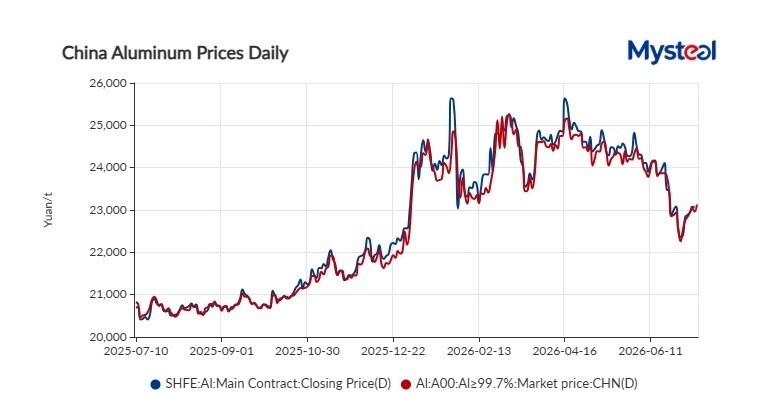
This image has been taken from Mysteel official website
H1 2026 overview
In the first half of 2026, SHFE aluminium traded in a wide range with the average price edging higher year-on-year, but the market performance was weaker relative to LME.
Early in the year, optimistic expectations of global macro liquidity lent some support to SHFE aluminium. In mid-March, escalating Middle East tensions disrupted some local aluminium smelting capacity, and the temporary closure of the Strait of Hormuz tightened raw material supply, triggering supply concerns. LME aluminium rose sharply, pulling SHFE prices higher.
Domestic fundamentals, however, remained relatively weak. Aluminium supply continued to grow, while demand from key sectors such as photovoltaics and construction fell short, keeping traders' inventories elevated. In addition, sustained inflows of Russian primary aluminium added further supply pressure, limiting SHFE upside and widening the LME-SHFE price spread.
Unlock key insights from leading companies and experts across the aluminium ecosystem with our e-Magazine - Mine to Market: ALuminium Producers & Manufacturers 2026
By June, prices retreated from their highs as Middle East risk premiums faded, and overseas supply recovery expectations strengthened. Furthermore, macro factors, including shifts in Fed rate-cut expectations and tariff policy uncertainty, weighed on the market sentiment. Overall, aluminium price movements in the first half were shaped by the interwind of macro policy expectations and geopolitical developments. Overseas supply disruptions provided phased support, while weak domestic fundamentals capped SHFE aluminium performance.
On the supply side, Mysteel's survey showed that, as of end-June, China's installed aluminium capacity stood at 46.10 million tonnes per year (+1.23 per cent Y-o-Y), with operating capacity at 45.31 million tonnes per year (+0.22 per cent M-o-M, +2.90 per cent Y-o-Y). And the production through the first half totalled around 22.44 million tonnes, up 3.0 per cent Y-o-Y. Domestic aluminium consumption in H1 is estimated at 23.18 million tonnes (+0.52 per cent Y-o-Y). After stripping out extrusion exports, domestic demand came in at 20.18 million tonnes (-0.6 per cent Y-o-Y). The widening SHFE-LME price spread provided a tailwind for extrusion exports, partially counterbalancing softness in the domestic market.
Domestically, with real estate and photovoltaic sectors underperforming, the construction and industrial aluminium demand performed poorly. In contrast, energy storage continued to grow strongly, becoming an important driver of aluminium consumption. As traditional sectors' share declines and emerging applications gain weight, the demand structure is undergoing a fundamental shift, weakening traditional seasonal patterns.
In summary, Mysteel estimates a theoretical aluminium surplus of 1.206 million tonnes in Q1, a deficit of 692,000 tonnes in Q2, and a net surplus of 514,000 tonnes for H1 as a whole.
H2 2026 outlook
With most new capacity and restarts concentrated in the first half, and the capacity ceiling policy remaining a rigid constraint, capacity changes in the second half will be primarily replacement-driven. Nevertheless, the industry operating rates are expected to remain high, and the full-year aluminium production is estimated at 45.40 million tonnes, up around 2.3 per cent Y-o-Y.
Domestic primary aluminium demand is expected to recover notably in H2.
While construction and real estate remain a drag, other sectors are showing signs of improvement. Automotive aluminium demand is likely to rise, supported by promotional policies, new model launches, and robust EV exports. Photovoltaic aluminium demand is expected to improve as project bidding and module output pick up.
Energy storage continues to be the most dynamic segment, with global installations and battery cell shipments growing rapidly. Leading producers are already running near full capacity, and demand for aluminium in this segment still has room to expand.
Exports of extrusion and finished aluminium products are expected to remain strong, though growth may moderate as SHFE-LME price spreads narrow. More importantly, with downstream inventories already low, any further price correction in H2 could trigger restocking, boosting apparent consumption.
Together with resilient emerging demand, export strength, and potential restocking, total demand in H2 is expected to improve marginally from the first half. Overall, with supply broadly stable and demand improving, the full-year balance is expected to shift to a deficit of around 50,000 tonnes.
The global aluminium casting usage is expected to reach 24.2 million tonnes in 2026. To learn about the future market trends, prebook our upcoming report “Global Aluminium Casting Market 2026-2032”
Overseas, despite accelerated new capacity and Middle Eastern restarts, supply is expected to remain tight in the near term, providing support to global aluminium prices. That said, aluminium prices remain heavily influenced by macro factors, and fundamentals alone may not fully translate into price strength in the near term.
Under a bearish macro environment, prices could stay under pressure; if macro risks ease, a recovery is likely. For H2 2026, SHFE aluminium is expected to trade in a range of RMB 21,000-25,000 per tonne, with macro policy-driven volatility as a key risk to monitor.
Note: This news is published under a content and exchange agreement with Mysteel
Intel, Ford, Dell warn Trump: New 12.5% tariffs may slow US domestic production aims
Next articleChina Hongqiao expects higher first-half profit on stronger aluminium alloy prices
Grow with
AL Circle