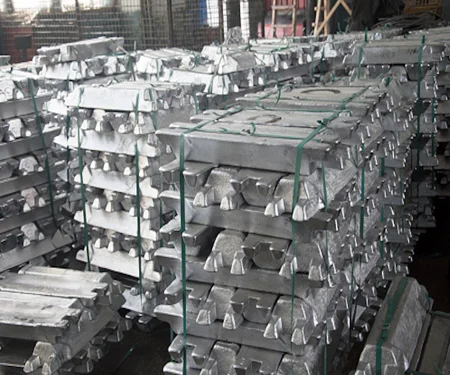
Russian scientists develop unique heat-resistant aluminium alloy, can replace copper conductors in air and rail transport

A unique heat-resistant aluminium alloy with improved durability have been produced by developing technology from the scientists of the National University of Science and Technology “MISiS” (NUST MISIS) in cooperation with their colleagues at the Siberian Federal University and the Research and Production Centre of Magnetic Hydrodynamics (Krasnoyarsk).
According to the research team: “This new alloy could replace more expensive and heavier copper conductors in aircraft and high-speed rail transport.”
The researchers have developed a process for producing a unique heat-resistant, high-strength wire, which is made from an aluminium alloy, initially cast as a long billet, about 10 mm in diameter, in an electromagnetic crystalliser.
They succeeded in deriving a thermally stable structure (up to and including 4000°C), which is considerably superior to known aluminium alloys with thermal stability, retaining their properties up to 250-3000°C.
Nikolay Belov, Chief Scientist and Professor of Materials Science and Light Alloys at National University of Science and Technology ‘MISiS’, detailed: “Before, alloys with such a structure were attempted to be produced using complicated and expensive technology involving ultra-fast melt crystallisation, pellet production and subsequent methods of powder metallurgy.”
The scientists have conducted direct deformation of a long billet – rolling and drawing – without using the traditional operations of homogenisation and hardening for aluminium alloys. The crucial feature of their proposed technology lies in the casting and annealing processes which produce a structure of thermally stable nano-particles containing copper (Cu), manganese (Mn) and zirconium (Zr).

Torgom Akopyan, Senior Researcher at NUST MISIS Department of Metal Forming said: “We have been able to produce a high-strength heat-resistant wire from this alloy. We are now determining its physical and mechanical properties, and the first results are already very impressive. We are planning to patent the method of producing this type of wire.”
According to the researchers, the unique and cost-saving technology could interest producers of wrought aluminium alloy semi-finished products.
Midhani’s aluminium alloy plant in Nellore concludes land compensation proceedings
Next articleAluminium downstream weekly recap: Sanjeev Gupta’s Liberty Aluminium Technologies seeks more time to track down buyers; Midhani’s aluminium alloy plant in Nellore concludes land compensation proceedings
Grow with
AL Circle