Europe’s aluminium scrap exports to the US have risen by 243 per cent, highlighting a growing concern over the continent’s access to strategic raw materials as it pursues recycling, decarbonisation and industrial competitiveness. Evangelos Mytilineos, Executive Chairman of METLEN, raised the issue, linking scrap outflows to the broader challenges facing European industry, energy security and strategic autonomy. Aluminium scrap outflows raise industrial concerns Mytilineos referred to the contrasting US tariff treatment of aluminium products, i.e., a 50 per cent tariff on primary aluminium, compared with zero tariff on scrap . With European aluminium scrap exports to the US increasing by 243 per cent, he questioned whether Europe could strengthen its industrial base while allowing valuable...
The US aluminium used beverage can (UBC) scrap price benchmark tracked by Argus recorded a mixed performance over the third quarter of 2026, declining in July before rising in August and September. The monthly average increased from USD 2,322.89 per tonne in July to USD 2,491.22 per tonne in August and USD 2,602.51 per tonne in September, indicating a sustained recovery in the benchmark over the three months. July: Prices decline despite a high opening The benchmark began July at USD 2,464.98 per tonne on July 1, before falling sharply to USD 2,270.76 per tonne on July 3. The price remained at that level on July 2 and July 6, the lowest recorded price for the month. It subsequently recovered gradually, reaching USD 2,319.86 per tonne on July 10 and USD 2,328.63 per tonne on July 22....
Grow with
AL Circle

Schupan Aluminum & Plastic Sales has promoted Matt Webster to vice president and Kevin Roschek to senior director of divisional operations, reinforcing its leadership team as the company continues to expand its aluminium and plastic distribution business. The appointments come as the Kalamazoo, Michigan-based company adds management capacity to support a larger and more complex operation while positioning itself for future growth. "As Aluminum & Plastic Sales has grown in size and complexity, we're adding senior leadership capacity to match the business's ambition for continued market growth while leveraging the momentum our team has built," said John Barry, president of Schupan Aluminum & Plastic Sales. "Both of these appointments reflect our commitment to developing the leaders within...

Germany's secondary aluminium industry occupies a unique position within the global metals landscape. In a country consuming approximately 2.1 million tonnes of aluminium annually, recycled metal has evolved from a supplementary feedstock into a fundamental pillar of industrial supply. The significance of secondary aluminium extends beyond resource efficiency. Producing aluminium from recycled scrap requires approximately 95 per cent less energy than primary smelting, while reducing associated carbon emissions by nearly 94 per cent. Yet despite these advantages, Germany's recycling ecosystem is going through a period of production volatility, tightening scrap availability and shifting downstream demand patterns. During the opening quarter of 2026, recycled aluminium output stood at...

The Baltic Exchange's Dry Bulk Index edged lower on Wednesday, ending a recent run of gains as weaker performance in the Capesize segment put pressure on freight rates. The main index, which tracks shipping costs for dry bulk commodities, fell 47 points, or 1.7 per cent, to 2,771 points. The decline was driven by the Capesize market, where rates softened during the session. Explore: The most comprehensive and forward-looking industry-focused report – Global Bauxite & Alumina Market Forecast to 2036: Supply–Demand, Trade Flows & Price Outlook The Capesize index dropped 140 points, or 3.2 per cent, to 4,301 points. Average daily earnings for Capesize vessels also declined, falling by USD 1,267 to USD 35,504 per day. Capesize ships are typically used to transport large volumes of commodities...

What began as a routine scrap movement operation at construction sites in Maharashtra has turned into a tale involving hidden sand compartments, manipulated weight records and 21 tonnes of missing aluminium scrap. Police in Thane have registered a case against three individuals, including the owner of a scrap firm, a supervisor and a vehicle driver, for allegedly orchestrating a scheme that diverted aluminium scrap worth INR 4.6 million (USD 54,000) from construction sites linked to a prominent real-estate developer. According to investigators, the alleged fraud revolved around a specially modified vehicle. “The vehicle's gross weight was recorded on the weighbridge with sand in the hidden compartment. The sand was later discharged through a hole beneath the box at an unknown location”...

In today's market, metal prices can shift sharply within days or even within hours, due to the rising uncertainty and market volatility. In this scenario, a recycler may purchase scrap at one price today, commit to a sales contract at another and then find margins being squeezed before the material is even processed. If this is compounded by currency fluctuations, inventory exposure, and delayed price fixation, the financial impact can become significant, and finding the right solution immediately would be required. The reality is that many recycling businesses still operate without a structured approach to managing these risks. Moreover, for many aluminium recyclers, success is measured by operational efficiency, procurement strength and sales performance. Yet one factor often remains...

CMR Green Technologies is expected to make a strong debut on the stock exchanges after its initial public offering (IPO) received an overwhelming response from investors. The company, which focuses on aluminium and non-ferrous metal recycling, is currently commanding a grey market premium (GMP) of around 36 per cent. Based on the issue price of INR 192 (USD 2.02) per share, market observers expect the stock to list near INR 261 (USD 2.74). The IPO, valued at INR 6.31 billion (USD 66.3 million), was entirely an offer for sale and was subscribed more than 127 times. There was strong demand among institutional investors, while non-institutional and retail investors also showed significant interest. Ahead of the issue, the company raised INR 1.88 billion (USD 19.7 million) from anchor...

German aluminium producer Trimet has outlined plans for investments at its recycling operations, including the construction of a new aluminium recycling facility in Hamm and capacity expansions at existing sites in Gelsenkirchen and Essen. At its recycling plant in Gelsenkirchen, the company has expanded production capacity through the installation of new melting units. The additional equipment is expected to increase recycled aluminium output by up to 80,000 tonnes per year. The site is also incorporating renewable energy measures, with solar panels installed on building rooftops to supply electricity for operations. From August 2026, the melting furnaces at the facility will begin operating with hydrogen-rich process gas. According to the company, the fuel generates lower carbon dioxide...
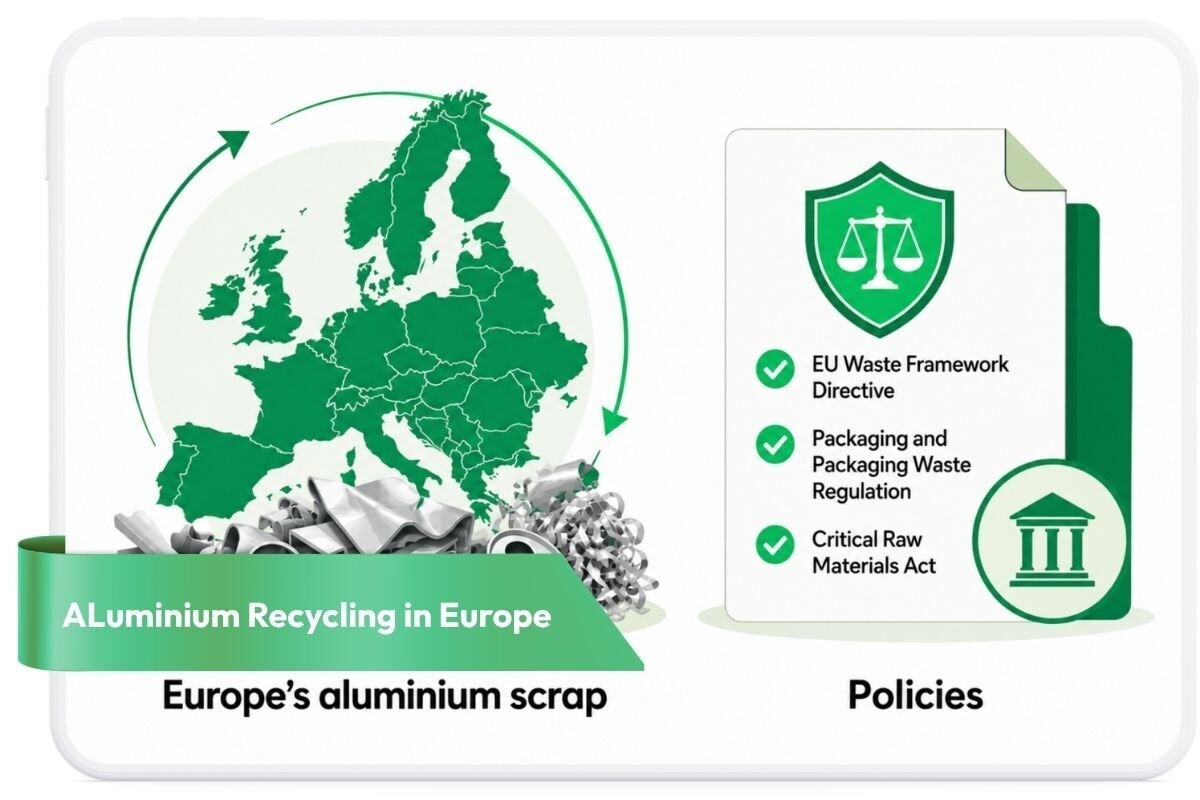
As the world is accelerating its shift from primary to recycled aluminium, Europe is finding itself at a difficult crossroads. Strong demand, advanced recycling technologies and clear sustainability ambitions are one part of the story, while tightened scrap availability is another part. More than a Europe-wide problem in equal measure, the pressure is most visible in the European Union, where scrap leakage, as what they call, has become a serious challenge due to the increased overseas exports to India, China, and Thailand. Scrap leakage becomes a risk As mentioned by Mario Conserva, Secretary General of FACE, in an exclusive interview with AL Circle , the current leakage of aluminium scrap is leading to 1.2 million tonnes of such strategic resource flowing out to third countries...

Toyota Motor Manufacturing UK has advanced its circular economy strategy by establishing a closed-loop aluminium recycling system at its Burnaston facility in Derbyshire, England. It has created what the company describes as a European-first process for recovering aluminium from end-of-life vehicles and reusing it in the production of new hybrid auto components. The Burnaston site is a pilot facility, set to develop operational standards and processes that could be replicated across future circular manufacturing centres in Europe. A second facility is scheduled to open in Poland later in 2026. Delve deeper into the recycled aluminium and secondary aluminium market with our World Recycled ALuminium Market Analysis Industry forecast to 2032 Aluminium returns to the production cycle A key...

Europe exports roughly 1 million tonnes of aluminium scrap every year, enough material to potentially reduce the region's primary aluminium imports by nearly 24 per cent if retained and recycled domestically. Yet despite recycled aluminium production already catching up with primary output, the automotive industry continues to include a higher percentage of virgin metal. All at the same time, the region’s automotive industry is entering a period where aluminium procurement strategies are becoming as important as vehicle design itself. Driven by electrification, lightweighting requirements and increasingly stringent sustainability targets, automotive manufacturers are consuming more aluminium than ever before. The transition is, though, far from straightforward. While recycled aluminium...

Aluminium is often described as the ultimate circular material, and in many respects that is true. In the UK, we have built a system over decades that is already highly effective. Collection rates are strong, recycling systems are established, and remelting capability exists across the supply chain. This is not a sector starting from scratch, nor is it one in need of fixing at a fundamental level. What is less well understood is that the real challenge facing aluminium in the UK is not about recycling performance. It is about value. More specifically, it is about where that value is captured, and whether the UK is in a position to retain it. Too often, aluminium is still framed as “scrap” and that language matters. It underplays the reality that secondary aluminium is one of the UK’s most...

CMR Green Technologies has moved ahead with its public listing at a time when several companies have delayed IPO plans due to volatile market conditions. The INR 6,300 million (USD 66.16 million) issue is a pure offer-for-sale (OFS), with no fresh issue component, and is also the first mainboard IPO to hit the market in more than a month. The launch comes at a time when investor sentiment toward OFS-heavy IPOs has remained cautious. Even so, Chairman and Managing Director Mohan Agarwal said the company remains confident about the business and the timing of the issue. The management also said roadshows with institutional investors gave the company confidence to proceed with the IPO despite ongoing market uncertainty. Explore our e-magazine “ Sustainability & Recycling: Aluminium's Dual...

For years, the global solar industry focused almost entirely on expansion. Massive solar farms were built across continents, installations surged and photovoltaic (PV) panels became one of the fastest-growing energy technologies in the world. Now, the industry is entering a very different phase - dealing with what happens when those panels begin reaching the end of their life, particularly the growing challenge of recovering valuable materials such as aluminium from ageing solar infrastructure. A growing number of ageing solar assets, combined with falling module efficiency and large-scale repowering projects, is creating a new stream of solar waste across global markets. Industry projections indicate that discarded PV modules could reach several million tonnes by 2050, turning...

Every year, millions of tonnes of aluminium scrap are collected, sorted and processed across Europe before being turned into new products. From used beverage cans and demolished buildings to end-of-life vehicles and industrial waste, recycled aluminium has become an important raw material in Europe’s shift towards a lower-carbon and more circular economy. Demand for recycled aluminium is also rising steadily. Europe’s aluminium scrap demand stood at around 6.6 million tonnes in 2021 and in 2025, it generated around 8 million tonnes - an increase of around 21.1 per cent - driven by stricter recycled-content targets, decarbonisation policies and growing demand from sectors such as automotive, construction and packaging. With demand for recycled aluminium continuing to rise, Europe’s scrap...

The global aluminium sector is witnessing a sharp transition as recycling, low-carbon technologies, trade tensions and supply chain disruptions reshape industry priorities. On the one hand, stronger earnings and recycling investments have been unlocked, while on the other hand, the impact of the Middle East conflict and Europe’s decarbonisation push continues to gain market attention. Producers and policymakers are striving to secure raw materials, improve the circular economy and protect industrial competitiveness amid mounting geopolitical and economic uncertainties. Europe’s recycling drive faces pressure due to trade tensions Italy achieved a 92.8 per cent aluminium beverage can recycling rate in 2025 and has left its imprint as a new global recycling leader. The high recovery rate...

European recycling companies and associations, coordinated by Recycling Europe, have asked the European Commission to review export restrictions on recycled aluminium scrap. Addressing the Executive Vice President Stéphane Séjourné and Commissioner Maroš Šefčovič in a joint letter on May 28, they expressed concerns regarding measures being built upon defective bases that might nullify the industrial objectives being promoted. Arguing that the region is not facing a structural shortage of recyclable material as claimed by policymakers, signatories stated that Europe’s recycling industry already generates high-quality secondary aluminium that frequently exceeds domestic demand while contributing positively to the EU’s trade balance. Although recyclers acknowledge the wider pressures...

Europe's aluminium recycling industry is undergoing a pivotal phase. With steep climate targets, policies, growing demand for low-carbon aluminium, and rapid advancements in recycling technologies, Europe has emerged as one of the most influential regions, shaping the future of aluminium. Developments in recycling, scrap availability, sustainability, and recycled aluminium production are increasingly affecting procurement strategies, investment decisions, trade flows, and manufacturing priorities across the global aluminium value chain. Considering the significance of these shifts, AL Circle is launching a month-long project throughout June 2026. Through a series of in-depth articles, expert interviews, opinion pieces, market analyses, webinars, and industry insights, this initiative will...

Rising aluminium prices are creating new opportunities for recycling and waste-sorting startups as global supply disruptions tighten the market. Aluminium prices have climbed sharply in recent months after conflict in the Gulf region disrupted supply from one of the world’s largest aluminium-producing hubs. Around 10 per cent of global aluminium production comes from the Gulf region, and the supply uncertainty has pushed aluminium prices to some of the highest levels seen in decades. The situation has also renewed interest in aluminium recycling, especially in the United States, where a significant share of aluminium demand is supplied from recycled material. Amp and Sortera are among the few companies that are using AI systems to improve aluminium recovery from waste streams. According...