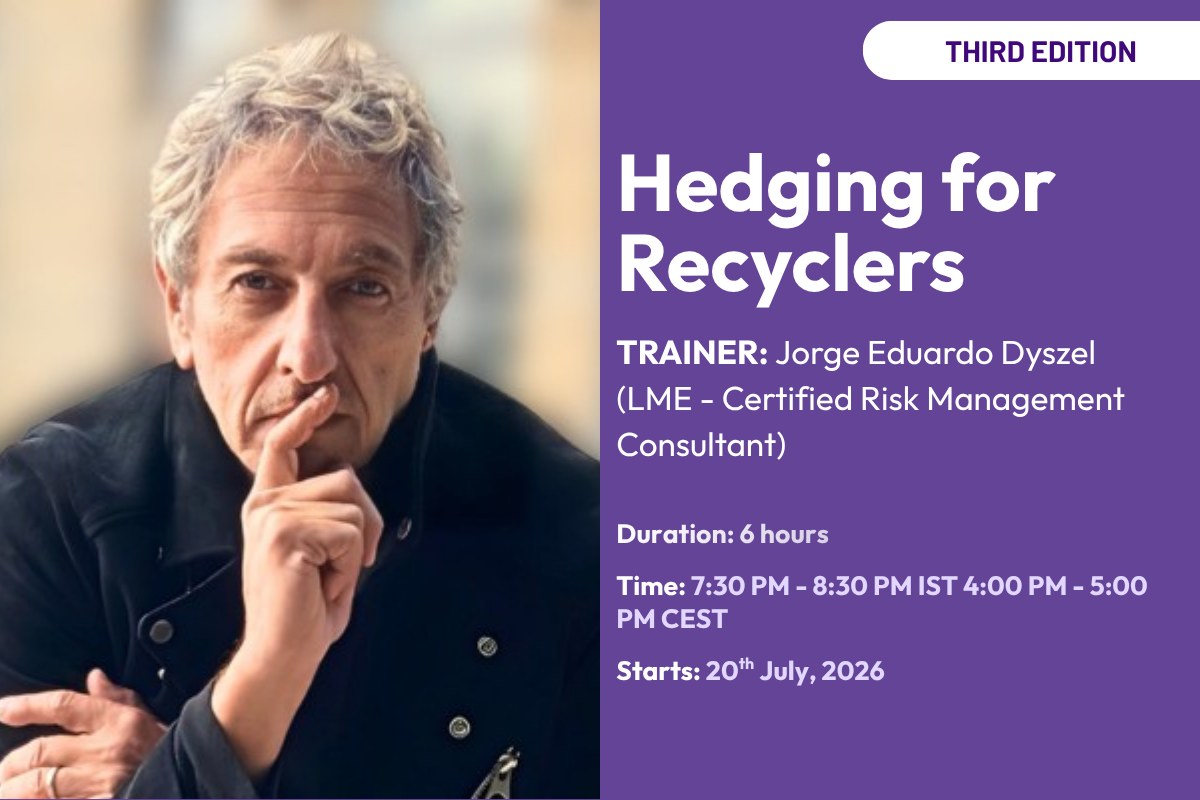
Hedging for Recyclers: Join this webinar by Jorge Eduardo Dyszel to manage price risk and safeguard profits
In today's market, metal prices can shift sharply within days or even within hours, due to the rising uncertainty and market volatility. In this scenario, a recycler may purchase scrap at one price today, commit to a sales contract at another and then find margins being squeezed before the material is even processed. If this is compounded by currency fluctuations, inventory exposure, and delayed price fixation, the financial impact can become significant, and finding the right solution immediately would be required.
The reality is that many recycling businesses still operate without a structured approach to managing these risks. Moreover, for many aluminium recyclers, success is measured by operational efficiency, procurement strength and sales performance. Yet one factor often remains outside direct control: Commodity price volatility.
Alongside this, the market volatility is not just a temporary phenomenon but rather a constant feature of global metals trading. Recyclers, scrap traders and commercial teams face exposure at multiple stages of their operations, from procurement and inventory holding to sales commitments and contract negotiations. While businesses invest heavily in equipment, technology and operational improvements, financial risk management often receives far less attention.
The consequence? Unexpected margin erosion, pricing uncertainty, inventory valuation challenges and commercial decisions made under pressure. In an increasingly competitive recycling market, companies that understand and manage price risk may gain a distinct advantage over those that simply react to market movements.
Recognising the growing need for effective price risk management, AL Circle and Jorge Eduardo Dyszel have developed “Hedging for Recyclers – Become an Expert in 6 Hours”, a specialised course designed for metals industry professionals.
A better solution to master the risk: HEDGING
Before delving into hedging strategies in this context, let's first understand why hedging is deemed to be the ultimate solution here. Hedging is a smart strategy that helps recyclers cushion the blow from fluctuating metal prices. By using tools like futures and options, businesses can lessen uncertainty, safeguard their profit margins, and make better-informed decisions in the marketplace.
What does it actually mean for aluminium recyclers? For them, hedging can really provide an edge by softening the blow of fluctuating commodity prices on their profit margins, stock levels and contractual obligations. It allows businesses to make informed, strategic choices based on a solid grasp of the market, rather than just scrambling to respond to sudden price changes. Additionally, understanding how prices are formed, where exposure exists and how futures and options can be applied allows businesses to make more informed commercial decisions.
In order to help industry professionals have a clear understanding and approach to hedging, be a part of a course, “Hedging for recyclers – Become an expert in 6 hours" designed by AL Circle x Jorge Eduardo Dyszel.
Designed specifically for metal recyclers, scrap traders, commercial managers, procurement professionals and industry executives, the course will focus on real-world business challenges rather than theoretical concepts. Participants will gain practical insights into price risk management, volatility, price fixation, currency exposure, futures hedging and options strategies applicable to aluminium, copper, lead and other base metals.
Learning directly from a global expert
With over forty years of experience in commodity risk management and metals trading, Jorge Eduardo Dyszel has trained thousands of industry professionals worldwide on how to effectively apply hedging strategies. As a certified trainer by the LME and a globally recognised consultant, he focuses on helping businesses grasp price volatility, pinpoint risk exposure and leverage futures and options to enhance their commercial decisions. For aluminium recyclers facing increasingly unpredictable markets, his insights provide a unique chance to learn directly from someone who has spent decades navigating the complexities of commodity risk.
What will participants learn?
In the span of six sessions, attendees will gain clarity on:
- How commodity prices are formed and why volatility persists
- The critical exposure points within the recycling business model
- Practical futures hedging techniques used in the metals industry
- How options can help protect margins while retaining upside potential
- Methods for developing an internal risk management framework
- Real-world examples, simulations and market scenarios relevant to recyclers
Fee structure and registration
The programme will be conducted online, starting from 20 July 2026 through six one-hour sessions. Participants can register individually or as part of a group. Early bird registrations receive a 20 per cent discount, while groups of three or more qualify for a 25 per cent discount. The offer is only valid for registrations done in June.
For professionals looking to build that expertise, this programme offers a practical starting point. Register and learn how leading aluminium recyclers approach risk before the next wave of volatility arrives.
_0_0.png)
CMR Green Technologies eyes strong IPO debut as 36% GMP fuels optimism
Next article21 tonnes of aluminium scrap vanish: The fraud that fooled weighbridges and cost INR 4.6 million
Grow with
AL Circle