Europe’s aluminium scrap exports to the US have risen by 243 per cent, highlighting a growing concern over the continent’s access to strategic raw materials as it pursues recycling, decarbonisation and industrial competitiveness. Evangelos Mytilineos, Executive Chairman of METLEN, raised the issue, linking scrap outflows to the broader challenges facing European industry, energy security and strategic autonomy. Aluminium scrap outflows raise industrial concerns Mytilineos referred to the contrasting US tariff treatment of aluminium products, i.e., a 50 per cent tariff on primary aluminium, compared with zero tariff on scrap . With European aluminium scrap exports to the US increasing by 243 per cent, he questioned whether Europe could strengthen its industrial base while allowing valuable...
The US aluminium used beverage can (UBC) scrap price benchmark tracked by Argus recorded a mixed performance over the third quarter of 2026, declining in July before rising in August and September. The monthly average increased from USD 2,322.89 per tonne in July to USD 2,491.22 per tonne in August and USD 2,602.51 per tonne in September, indicating a sustained recovery in the benchmark over the three months. July: Prices decline despite a high opening The benchmark began July at USD 2,464.98 per tonne on July 1, before falling sharply to USD 2,270.76 per tonne on July 3. The price remained at that level on July 2 and July 6, the lowest recorded price for the month. It subsequently recovered gradually, reaching USD 2,319.86 per tonne on July 10 and USD 2,328.63 per tonne on July 22....
Grow with
AL Circle

Western Hungary is going to position itself within the global industrial and political networks as it sets to host a new aluminium alloy facility. Backed by EUR 58 million ( USD 63 million) investment, the project introduces advanced US processing technology while anchoring production firmly within Central Europe. The plant is being developed by REMET Hungary Zrt., which plans to deploy a production model that merges domestic engineering capabilities with American technological systems. After being operational, the facility is likely to become one of the most modern aluminium alloy plants in the region, while being a key contributor to the European circular economy. The project is designed around technology transfer instead of exclusively focusing on capacity expansion. The processes...

The aluminium beverage cans linger to be one of the strongest proofs that the aluminium industry’s circularity is attainable at scale. Not in theory, but in practice. A recent white paper presented by Innoval at COP30 shows that the evidence lies purely in metallurgy, process control and measurable emissions outcomes. Image for reference only Explore- Most accurate data to drive business decisions with 50+ reports across the value chain An Innoval spokesperson has said, “Can-to-can recycling is not only a technical success but a critical climate solution. By optimising metallurgy and processing, we can unlock real environmental benefits while maintaining quality.” Cans are not made from generic aluminium. They rely on two engineered alloys. One where the can’s body stock uses AA3104 and...

Austria started a Deposit Return Scheme (DRS) on January 1, 2025, and it closed the first year with 1.2 billion PET bottles and aluminium cans returned by the end of November, showing strong public participation and early operational stability. Austria introduced a EUR 0.25 (USD 0.29) deposit on single-use beverage containers from 0.1 to 3 litres. The scheme is run by EWP Recycling Pfand Österreich and supported by its core technology partner Sensoneo. According to Sensoneo, 75 per cent of consumers support the system, driven by visible reductions in litter and improved recycling as key motivations. Weekly returns of aluminium cans and PET bottles rose gradually during the initial days and stabilised at 7–9 million units per week. Also read: Secondary aluminium on track to add 22 MT of...

We were all happy when we heard about the scrap exemption from the CBAM regime. But instead, it turned out to be a two-edged sword. If an EU business imports scrap and manufactures secondary aluminium, it will have to pay the tax for the secondary aluminium manufacturing, in accordance with the ETS system. If the business decides to import secondary aluminium, it still has to pay for CBAM. So, is shelter from tax a mere illusion for European aluminium businesses? Explore- Most accurate data to drive business decisions with 50+ reports across the value chain From January 1, 2026, Fastmarkets will include the European Union’s (EU’s) Carbon Border Adjustment Mechanism (CBAM) costs in its secondary aluminium billet premium, DDP Europe (MB-AL-0383) and primary 6063 extrusion billet premium,...

With demand rising for low carbon aluminium, producers in several regions are accelerating plans to increase their secondary capacity. Much of the new capacity scheduled is concentrated in billets, slabs and ingots, which are increasingly becoming the main focus of recycling investments. Between 2022 and 2026, secondary additions are dominated by billets, which make up 11 million tonnes of the 22-million-tonne total. Their growing importance mirrors the expansion of extrusion and construction activity, where demand has remained consistently strong. Slabs follow with 8.8 million tonnes of new capacity, supported by rolling demand and a sharp increase expected in 2025 tied to automotive and packaging needs. SFA (Ingot) capacity, at 2.2 million tonnes, reflects the maturity of the ingot...
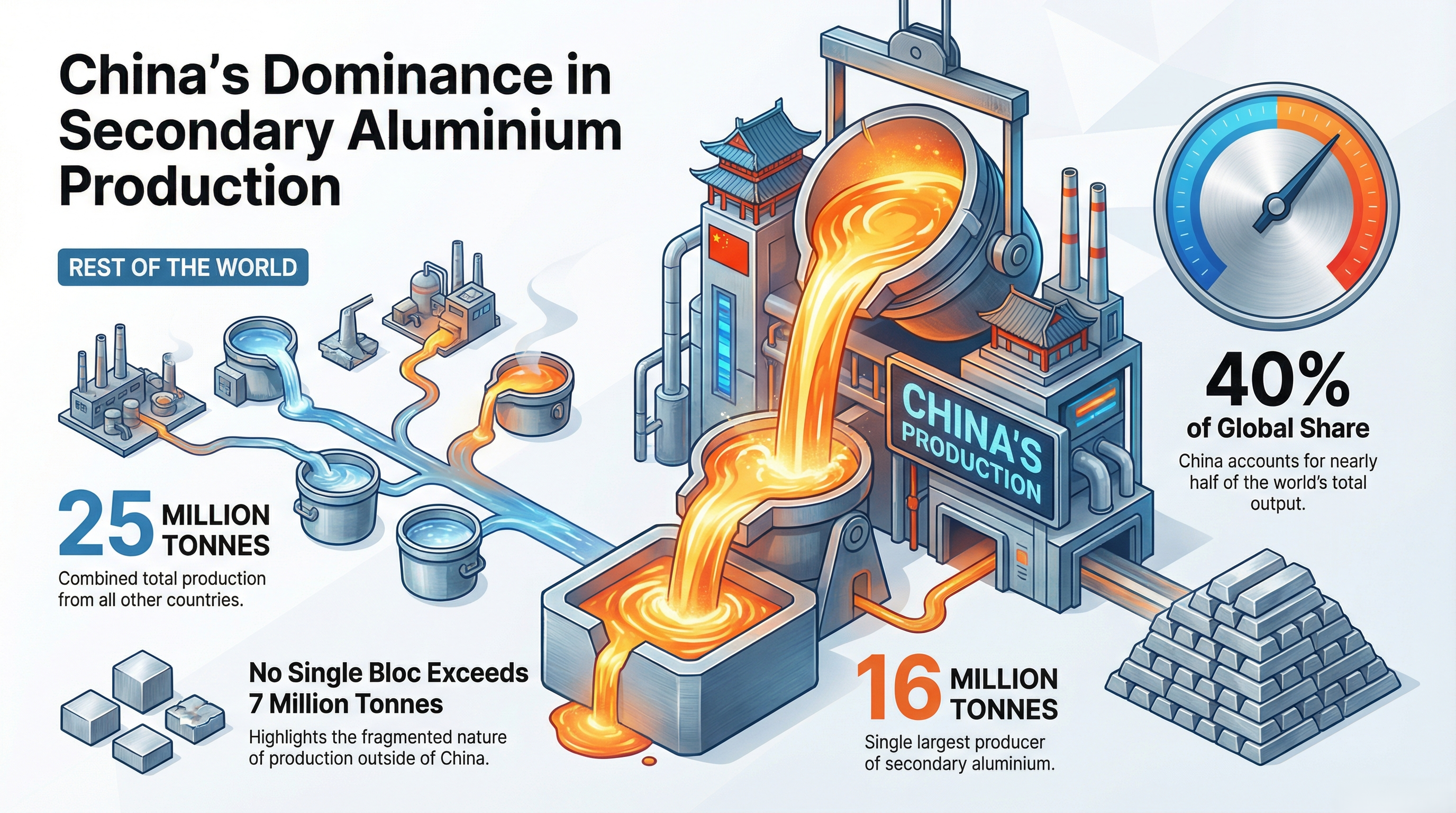
China and the United States have been vocal about shifting their focus to the recycled aluminium industry for quite some time. And why shouldn’t they? According to the International Aluminium Institute (IAI), rapid population and economic growth over the coming decades will push global aluminium demand to double by 2050, with 50-60 per cent of that demand expected to be met by recycled metal. The IAI also estimates that the global Recycling Efficiency Rate (RER) currently stands at 76 per cent, covering both new scrap and old scrap. The transportation sector leads aluminium recycling with an 86 per cent recovery rate, and among all end-use sectors, the automotive industry remains the single largest consumer of recycled aluminium. Having said that, at such a critical juncture for the...

Hydro has received prominent recognition at the Dezeen Awards in London, securing both “Material Innovation of the Year” and “Sustainability Project of the Year” for its progress in aluminium recycling. Hydro’s Hydro CIRCAL 100R, made solely from post-consumer aluminium through advanced recycling, earned the accolades after being used by global designers to create finished works. Hydro wins recognition for the 2024 debut of Hydro CIRCAL 100R and the 2025 R100 project.. Asle Forsbak, Marketing and Communication Director at Hydro Extrusions and project lead for both initiatives, describes the recognition as an important signal from the wider design community: “Following the Elle Decoration International Design Award for best Sustainable Achievement, which we received earlier this year, this...

The European Aluminium Foil Association (EAFA) is joining hands with Flexible Packaging Europe (FPE) to set up a European alliance aimed at one particular objective. This objective is to boost the recycling efficiency for small aluminium packaging, like coffee capsules. With this partnership and the initiative, creating the right conditions for effective collection, sorting and high-quality, scalable recycling of these packaging types throughout Europe is significantly possible. The requirements as set by the Packaging and Packaging Waste Regulation (PPWR) clarify the need for the industry to step up its game with clear actions. Aluminium is deemed to boast impressive recycling rates, but smaller aluminium packaging is still considered to be lagging. Small packaging may include coffee...

RUSAL, a global leader in aluminium production, has advanced to the second phase in the production of a batch of rolling slabs with a record-low carbon footprint. The figure came to less than 3t CO2/t of aluminium (Full Scope), which is the company’s lowest ever recorded within its ongoing production operations. These slabs will be delivered to partners for further rolling into strips and manufacturing Russia’s first low-carbon aluminium beverage cans. Building on the successful launch of the initiative in June 2025, this milestone confirms the full industrial-scale operation of the Company’s sustainable manufacturing solutions. This latest phase has yielded a new batch of can body sheet slabs with a record-low carbon footprint. RUSAL will supply these slabs to partners for rolling into...

Alused company has received the approval for building an enterprise in Nevinnomyssk, a city located in Stavropol Territory, Southern Russia. The aluminium recycling plant built with a capacity of 2 thousand tonnes of processing per annum, would be specially focusing on the aluminium recycling. Alused would be using all the recycled aluminium waste produced in the aluminium industry enterprises. The company is a Turkish private organisation that mainly focuses on the production of aluminium profiles. Read More: New Valencia–Nestlé pact aims to recover thousands of small aluminium items long lost in sorting The estimated cost of the project of this aluminium recycling plant is about 220 million rubles, and it is planned to be completed within two years. Moreover, at the meeting of the...

Aluminium scrap has quietly become one of the most protected raw materials in the world specially in United States and the European Union — not through restrictions, but through deliberate exemptions. Washington has carved scrap out of Section 232 tariffs even as it tightened duties on primary aluminium, lifting the tariff rate to 50 per cent by June 2025. The split treatment is intentional. The US has a domestic primary metal shortage of nearly four million tonnes a year, and secondary smelters can expand only if scrap continues to flow in duty-free. Europe has taken a parallel — but more climate-driven — route. Aluminium scrap is excluded from the EU’s Carbon Border Adjustment Mechanism, which places carbon prices on primary and semi-finished imports but assigns zero emissions to...

Instead of recycling, millions of worn-out coffee capsules and other minuscule aluminium items are deemed to pose crucial environmental challenges. Loss of these aluminium items mainly happens when they undergo the conventional sorting systems, which then ends up in the waste. For this, a new agreement between Nestlé-Nespresso and Generalitat Valenciana is drafted, which offers the long-awaited solutions, enabling the recovery of these problematic materials efficiently in Benidom. Outlining the agreement A signed agreement between the Generalitat Valenciana and Nestlé-Nespresso aims to identify and recover the small aluminium products, which previously went missing in the waste while sorting at the Light Packaging Sorting Plant in Benidorm, which is operated by Vaersa, a public company....

A refreshed version of the T7, with the Portable SSD T7 Resurrected, as introduced by Samsung, widens the firm’s sustainable approach whilst maintaining the same performance as the previous model. The body of the new drive is made of 100 per cent recycled aluminium, which is certified by TUV Rheinland. Use of recycled aluminium The sourcing of the recycled aluminium is done by using the leftover material from the production of the company’s Galaxy device series. While developing with the T7, Samsung has eliminated the colouring process, aiding in giving the SSD a natural finish as well as reducing the chemical usage. T7 Resurrected packaging is done by utilising 100 per cent recycled paper and ASA-certified soy ink. Implementation of these changes has ensured the firm to nurture a product...

ABx Group’s subsidiary ALCORE has secured full funding to go ahead with its hydrogen fluoride pilot plant in Tasmania. The plant, planned for the ALCORE Technology Centre beside Rio Tinto’s aluminium smelter in Bell Bay, will demonstrate a process to extract hydrogen fluoride from the by-products of aluminium smelting. This is indeed the next major step in ALCORE’s effort to commercialise a technology that has been under development for several years. ALCORE secured the lease for the Bell Bay facility in early 2025, giving it a 500 square meter industrial site directly adjacent to the smelter that will provide the by-product feedstock. The project’s financial base was further strengthened by a conditional loan from the Tasmanian Government and federal support through the Modern...

Alspec, Alspex, and Rio Tinto have recently come together to enhance a closed-loop aluminium recycling programme, aimed at supporting local industry with raw materials, help them reduce emissions, and strengthen low-carbon supply chain in Queensland. The initiative is called 20-13 as the aluminium content in the final product is supposed to be a minimum of 20 per cent. As part of the initiative, all the aluminium scrap generated from Alspec and Alspex would be collected and sent to Rio Tinto’s Boyne Smelters Limited (BSL) in Gladstone for the manufacture of aluminium billets with 20 per cent recycled content. These converted billets would then be destined to Alspex for being extruded into new aluminium profiles, and finally transported to local manufacturers for making windows, doors, and...

Recent UK research conducted by Every Can Count (ECC), a recycling not-for-profit organisation, has revealed a shocking generational divide in recycling awareness and support for the Deposit Return Scheme (DRS). Despite Gen Z’s (from the age group of 16 to 28) reputation for having a strong voice for environmental well-being, they are found to be less responsive to the DRS system. The survey, ahead of the launch of the UK’s own DRS system in 2027, shows only 59 per cent of Gen Z are supportive of Deposit Return Schemes (DRS), compared to 77 per cent of boomers, falling in the age group of 55 to 74. This finding is astonishing, especially at a time when Gen Z are considered to be the flag bearer of climate protection and sustainability. Moreover, they are the ones more willing to pay a...

Recycled Materials Association (ReMA), a sustainable recyclable advocacy group, has approved a new aluminium scrap grade called “vesper,” marking a notable shift in how the industry handles the wrought fraction found in end-of-life (EOL) vehicles and other complex scrap streams. The update to the ISRI specifications was developed with Novelis and key aluminium recycling partners. The goal behind approving this new scrap grade is to create a clean, high-value scrap stream that can return to sheet, extrusion, and plate applications without being contaminated by cast alloys. Rising demand for wrought aluminium, leading to a birth of Vesper Demand for aluminium across mobility, packaging, and infrastructure is rising fast. Automotive trends show the sharpest rise. Ducker Carlisle, a global...

The United States shares a deep, long, and almost personal bond with aluminium as the metal has played a pivotal role in shaping up the nation’s manufacturing base while contributing about USD 228.31 billion to the economy. But at the same time, the industry in the US has weather many highs and lows. The country was once responsible for contributing more than 50 per cent to the world's primary aluminium supply and now it accounts for less than 1 per cent. But has this shift hurt the nation's backbone in the aluminium industry, has it carved out new pathways to sustain its legacy in the sector? Here’s a look at the century-long evolution of America’s aluminium landscape and what's reshaping it. The journey of aluminium industry in the United States back to World War I (1914-1918) when...