The United States has long been targeting a reduction in carbon footprint across the industrial sectors, including automotive, packaging, energy, and consumer products, by sustainably producing low-carbon aluminium. However, due to limited renewable power generation, the region has primarily resorted to scrap recycling and using recycled metal in aluminium semi-finished and finished products.
With the help of advanced technology infrastructure, the United States has also developed new anode technologies to be able to emit direct emissions from the use of carbon anodes during smelting.
Recently, environmental consulting firm ICF, in collaboration with the Aluminum Association, has released a report titled Pathways to Decarbonization: A North American Aluminum Roadmap, highlighting all these potential strategies to curb carbon emissions in the North American aluminium industry. The report contains a judicious roadmap to achieve industrywide carbon emission reductions in line with the International Energy Agency’s (IEA) 2050 net zero goals.
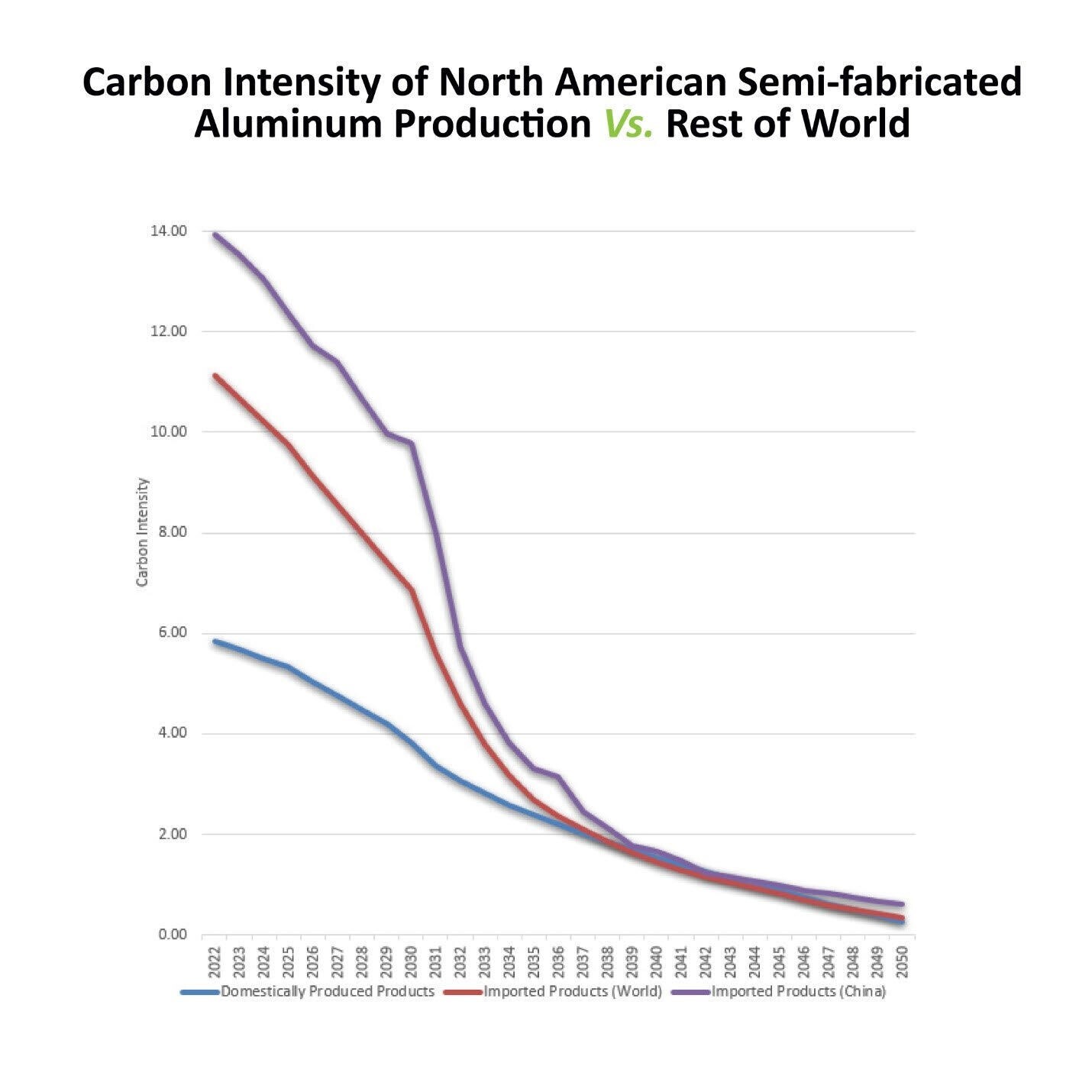
The report has noted that North America is one of the first movers in reducing carbon emissions, with a carbon footprint 50 per cent lower than global averages, attributed to the use of low-carbon primary aluminium in various industrial sectors, increased recycling practices, and growing efforts towards emissions reduction over the past several decades. However, to achieve the 2050 net zero goals by mid-century, a lot more efforts and investments will be required in both public and private sectors.
Charles Johnson, president & CEO of the Aluminum Association, asserted: “Our industry is proud of the vital role we play in the clean energy transition and the strides we’ve made to reduce carbon emissions over the last several decades. Average carbon emissions to produce a pound of aluminum in North America has dropped by more than half since 1991 giving us a significant head start over the rest of the world and an opportunity to lead the way producing lower carbon metal. But we know that much more must be done to meet net zero targets by 2050.”
As outlined in the report’s roadmap, 24 percent more carbon emissions should be reduced from aluminium production by 2030, followed by 63 per cent by 2040 and 92 per cent by 2050, compared to the emissions baseline in 2021. During this period, North America’s primary aluminium output is projected to increase by about 80 per cent, driven by growing demand for the metal to attain sustainability in various industrial sectors.
North America’s present primary aluminium output
North America’s primary aluminium production, contributed mainly by three significant producers—Alcoa, Century Aluminum, and Rio Tinto -stood at 1.329 million tonnes from January to April 2024, up by 5.56 per cent from 1.259 million tonnes during the corresponding period of the previous year and 6.15 per cent higher than 1.252 million tonnes in 2022.
The daily average output in the first four months of 2024 totalled 43,900 tonnes, reflecting an increase of 4.52 per cent from 42,000 tonnes a year ago and a rise of 5.02 per cent from 41,800 tonnes two years earlier.
Pathways to reach 2050 emissions reduction target
- The CIF and Aluminum Association report suggests that the development and deployment of more advanced technologies like inert anode smelting and chloride process would be required to remove direct emissions from aluminium production. Changes to current alumina production methods and improvements in energy efficiency are also advisable for the target meet.
- A transition to renewable energy sources like green hydrogen is a must, as is electrification of furnaces and the deployment of carbon capture and storage technologies.
- Increasing practices of recycling post-consumer aluminium goods would certainly be a viable way to speed up industry emissions reduction abiding by two popular models - the Constrained Scrap Utilization scenario (as a baseline) and the Optimal Scrap Utilization scenario. The latter will expectedly eliminate an additional 160 million tonnes of CO2e emissions by 20250 on top of the 127 million tonnes of reduced CO2e emissions assumed under the constrained scenario.
According to the report, about one-third of the 2050 net-zero emissions target can be achieved through aluminium production technology improvement, while the remaining two-thirds can come from recycling, clean energy transition, and infrastructure investments.
According to Charles Johnson, decarbonising the energy sector is a prerequisite for reducing carbon emissions in the aluminium industry and other heavy manufacturing sectors. So, to achieve the ambitious target by 2050, an off-of-society approach towards decarbonisation will be required.
Analysts estimate that approximately $1 trillion of investments will be required across the global primary aluminium value chain to meet net-zero climate goals by 2050. For North America, the estimated investment is $60 billion, considering the region accounts for 6 per cent of global production.
About Elysis, an inert anode technology
Traditionally, aluminium smelting generates carbon dioxide from the chemical process used to produce aluminium from alumina. In the United States, the biggest technological breakthrough in decarbonising aluminium production has been the development of an inert anode technology called Elysis by Alcoa in a joint venture with Rio Tinto.
Alcoa expects to complete the technology demonstration at 450 kA between 2024 and 2025 and subsequently make the technology commercially viable for deployment.
Elysis enables aluminium smelters to emit all greenhouse gas emissions and also oxygen as its by-product. In Canada alone, it has potentially eliminated 6.5 million tonnes of GHG emissions in a year. The technology is specially tailored to retrofit existing smelters.













_md.webp)








