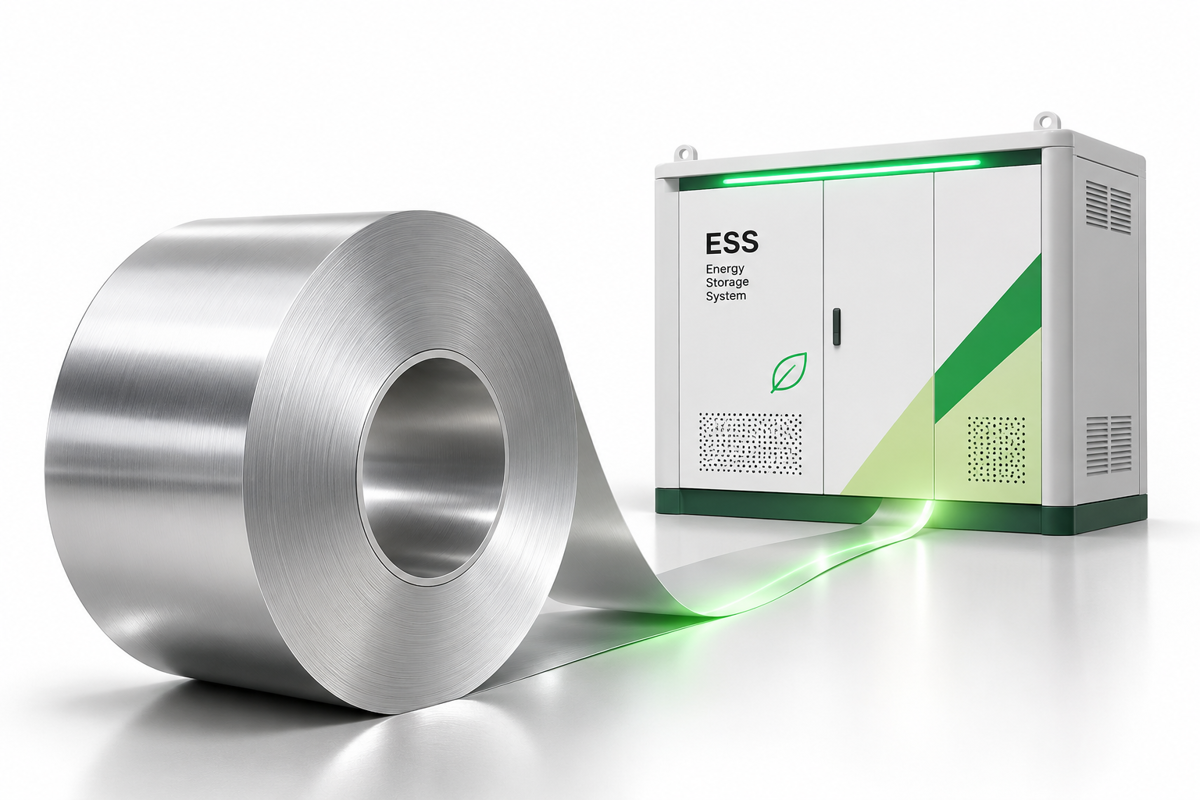
Korea's battery foil makers spent the first half of this decade building for an electric vehicle market that did not buy on their schedule. In 2026, energy storage systems (ESS) began to take up some of that capacity, and one listed producer has now reported two profitable quarters. Whether that becomes sustained earnings depends on more than rolling mills: strip supply upstream, carbon coating downstream, and customer approval for each product.
This article looks at four Korean makers of aluminium cathode foil, the current collector on the positive side of a lithium-ion cell [1]. Sam-A Aluminium rolls foil in Pyeongtaek [2]. DI Dong Il operates in Cheonan and is adding rolling capacity in Cheongju; it absorbed its foil subsidiary, Dongil Aluminium, on August 1, 2025 [3]. Lotte Infracell, Lotte Aluminium's battery foil business, produces in Ansan [4]. Dongwon Systems rolls foil in Asan [5].
Each expanded on its own timetable. Sam-A added two rolling lines in 2023 [2]. DI Dong Il is taking its foil lines from five to eight with the Cheongju plant [6].
Lotte has also built overseas. In December 2022, it described an 18,000-tonne plant in Hungary and a 36,000-tonne project in the United States [7]. KOTRA's October 2026 review treats the Kentucky figure as design capacity, with commissioning, sample supply and customer approval under way [8].
These figures do not add up to a national capacity total. Published figures mix battery foil with packaging foil, and some count lines that are still under construction. Design capacity is also different from qualified output, as Kentucky shows.
What the filings show for 2025
In the two listed companies' reports, utilisation is measured in machine hours and covers all foil, including packaging, so it is an imperfect gauge of battery demand. It still shows the shape of 2025. Sam-A's rolling division ran at 51.98 per cent in the first nine months of the year and 50.30 per cent for the full year [9][2]. DI Dong Il's Cheonan foil operation ran at 67.7 per cent over the same nine months [3].
The income statements diverged. Sam-A's operating loss widened from 9.59 billion won in 2024 to 17.65 billion won in 2025 [2]. DI Dong Il's aluminium segment stayed profitable, although its operating profit fell from 10.05 billion won to 4.67 billion won [10]. Lotte Aluminium is unlisted. In June 2026, NICE Investors Service cut its short-term credit rating from A2 to A2-, citing start-up yield problems at the Hungarian plant and raw material costs rising faster than selling prices [11].
Sam-A returned to an operating profit of 1.74 billion won in the second quarter of 2026 [12] and stayed profitable in the third, at 0.91 billion won, despite it remaining in an operating loss of 1.73 billion won for the first nine months [13].
The link to ESS comes from management commentary reported by SK Securities. Its July 2026 corporate day note describes ESS orders lifting the company’s volumes [14]. Two thin quarters are not yet a recovery. They do suggest that capacity built for EVs has found a second buyer.
Explore aluminium battery foil manufacturer on AL Biz
Lithium iron phosphate (LFP) cells are widely used in stationary storage, and LFP is where the next round of investment is going. In February 2026, DI Dong Il disclosed a 110.76 billion won investment in carbon-coated aluminium foil for LFP batteries, with an investment period running to the end of 2030 [15]. In September, it signed an investment agreement for a plant in Cheongju, with construction targeted for completion in the second half of 2027 [16].
Until domestic lines run, some Korean foil is coated in China. DI Dong Il has outsourced carbon coating to Chinese companies [6], and Sam-A has used coating services in China [14]. Domestic coating could shorten lead times to Korean cell makers, provided new lines reach the required quality and yield. It also adds another capital programme to balance sheets still recovering from 2024 and 2025.
Participate in AL Circle’s upcoming e-Magazine Smart ALuminium: Advancing Industrial Technologies in 2027 to showcase how advanced technologies drive sustainability across the aluminium value chain.
Foil rolling also depends on suitable aluminium strip, and the producers have taken different routes to secure it. Lotte announced a 1.04 trillion won strip supply contract with Choil Aluminium covering 2023 to 2027 [7]. Sam-A chose to invest in its own supply: its annual report records a 117 billion won raw material investment that includes a cold rolling line [2].
Both routes carry risk. A long-term contract leaves a foil maker exposed to one supplier’s quality and schedule. In-house strip ties up capital and has to be qualified for each battery application. Not everyone agrees that strip is the binding constraint: SK Securities argues that foil rolling mills themselves are the scarce equipment [17]. There may be no single bottleneck. Feedstock, rolling capability, coating yield and customer approval can each limit what a producer is able to sell, and their weight will differ by company and product.
Four things will show whether the ESS turn is durable. First, whether DI Dong Il’s Cheongju investments reach commercial production; second, whether Sam-A’s quarterly profit holds through a full year; third, whether Lotte’s Kentucky plant moves from samples to qualified shipments; and fourth, how quickly domestic coating replaces Chinese coating for Korean cell makers.
The first wave of Korean foil investment was timed to the EV forecast. The second, built around LFP and coating, is timed to energy storage. Whether it is better timed than the first is still an open question.
[1] Newspim, "DI Dong Il expands aluminium foil lines", 29 November 2021. https://newspim.com/news/view/20211129000716
[2] Sam-A Aluminium, business report for 2025, filed 18 March 2026 (KIND). https://kind.krx.co.kr/external/2026/03/18/001146/20260318005349/11011.htm
[3] DI Dong Il, quarterly report for the nine months to 30 September 2025, filed 14 November 2025 (KIND). https://kind.krx.co.kr/external/2025/11/14/003297/20251114007630/11013.htm
[4] Lotte Group magazine, October 2020, on the Ansan cathode foil line. https://www.lotte.co.kr/upload/post/magazine/201014130912447.pdf
[7] Lotte Group, announcement of the Choil Aluminium strip supply contract, 16 December 2022. https://blog.lotte.co.kr/42608
[9] Sam-A Aluminium, quarterly report for the nine months to 30 September 2025, filed 14 November 2025 (KIND). https://kind.krx.co.kr/external/2025/11/14/002739/20251114006301/11013.htm
[11] Edaily, on NICE Investors Service's short-term rating action on Lotte Aluminium, 29 June 2026. https://www.edaily.co.kr/News/Read?mediaCodeNo=257&newsId=05051206645486640
[12] Sam-A Aluminium, half-year report to 30 June 2026, filed 14 August 2026 (DART; full text via Samara). https://samara.kr/disclosure/20260814003238
[13] Sam-A Aluminium, quarterly report for the nine months to 30 September 2026, filed 16 November 2026 (DART; full text via Samara). https://samara.kr/disclosure/20261116001404
[15] DI Dong Il, disclosure of new facility investment, 11 February 2026 (KIND). https://kind.krx.co.kr/external/2026/02/11/000520/20260126002527/61361.htm
[16] Korea Economic Daily (Hankyung), on the Cheongju investment agreement with DI Dong Il, 16 September 2026. https://www.hankyung.com/article/2026091691581
Note 1: This is an exclusive AL Circle coverage and may not be reproduced, republished or shared without prior permission.













_md.webp)
_md.webp)