India’s bauxite exports today look very different from where they stood just a few years ago. This change in picture is due to higher production at home and a gradual easing of import dependence. In 2023, exports over the nine-month period (January to September) totalled 60.968 thousand tonnes, worth USD 0.79 million. Volumes were small, and overseas shipments were not a priority. A year later, that balance had shifted. Exports in January–September 2024 rose to 241.771 thousand tonnes, with value climbing to USD 5.76 million. That worked out to a 296.6 per cent increase in volume and a 629.1 per cent rise in value year on year.
By 2025, the move was even more visible. Ministry of Commerce and Industry data shows exports of 405.232 thousand tonnes between January and September, generating USD 13.34 million. Compared with 2024, volumes were higher by 67.6 per cent, while export earnings rose 131.6 per cent. The rise came alongside higher domestic output and the early impact of new and planned mining capacity.
More production, less need to import
As domestic production increased, more bauxite was available after local requirements were met. That extra material increasingly moved into export channels. At the same time, the need to bring in ore from overseas began to ease.
This shift helped explain why exports and imports moved in opposite directions. Higher output created room for exports, while reducing dependence on foreign supply. Imports fell year on year even as exports expanded.
Imports declined as exports rose. India imported 4,365.5 thousand tonnes of bauxite in FY2024. In FY2025, that figure fell to 3,008.45 thousand tonnes, a year-on-year decline of 31.1 per cent. The drop mirrors the increase in domestic output and the gradual commissioning of new capacity.
Month-to-month export data
The annual growth in 2025 hides how uneven exports were through the year. Shipments rose and fell sharply, often without warning. January set the tone for the year’s inconsistency. Export value rose 88 per cent from a year earlier to USD 2.08 million, yet volumes edged lower to 53,001 tonnes. February appeared stronger, at least at first glance, with export earnings up 255 per cent to USD 1.21 million and shipments jumping 526 per cent to 53,245 tonnes.
March marked the high point. Volumes climbed to 107,387 tonnes and export value reached USD 3.34 million, a 664 per cent increase year on year. The surge proved short-lived. In April, exports fell away sharply, with value sliding 98 per cent to USD 0.03 million and shipments dropping to just 1,092 tonnes, down from 64,754 tonnes in the same month a year earlier.
May swung the pendulum back again. Export value surged more than 1,700 per cent to USD 5.92 million, while volumes jumped to 160,877 tonnes. That burst of activity faded quickly. By June, export value had fallen 81.83 per cent to USD 0.23 million, and shipments were down 83 per cent at 10,038 tonnes. The third quarter was quieter and more contained, with July exports at 10.062 thousand tonnes worth USD 0.20 million, followed by 4.601 thousand tonnes in August valued at USD 0.24 million and 4.930 thousand tonnes in September worth USD 0.09 million.
Production edges up, exports leap ahead
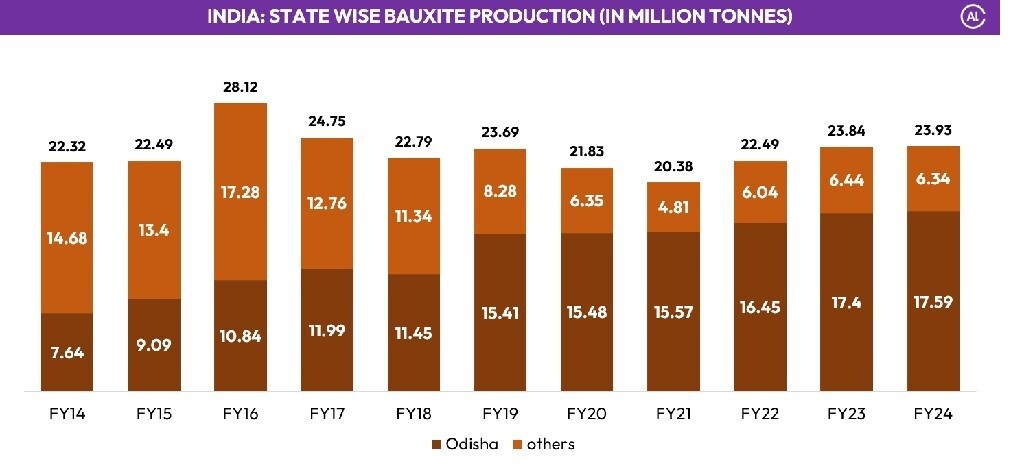
The production backdrop was far more stable than the export data. India produced 23.84 million tonnes of bauxite in 2023. Output rose to 24 million tonnes in 2024 and edged up again to 24.07 million tonnes in 2025. In 2026 the production is estimated at 25.01 million tonnes as per AL Circle data.
Within those totals, exports of natural, non-calcined bauxite grew sharply. Shipments increased from 51.226 thousand tonnes in FY2024 to 352.664 thousand tonnes in FY2025. The contrast underlines how relatively modest production growth can still lead to a large change in trade flows when surplus material becomes available.
Auctions and operational changes unlock supply
Much of the production increase in 2025 can be traced back to mining reforms. Since 2021, more than 281 mineral blocks have been auctioned under amendments to the Mines and Minerals (Development and Regulation) Act. Among them were major bauxite deposits such as Karlapat and Nunapaimali in Odisha.
These auctions helped bring stalled projects back into operation, particularly in Odisha, which accounts for around 60 per cent of India’s bauxite output. Additional supply also came from Gujarat and Jharkhand. Producers including Vedanta and NALCO were able to raise output as a result.
Operational improvements played a role as well. Technology upgrades, better overburden removal and post-monsoon optimisation lifted production at sites such as Utkal D&E, contributing to April 2025 output rising 13.9 per cent to 2.13 million tonnes. Infrastructure upgrades, including new rail links and port expansions, reduced logistics costs and supported FY2024–25 production of around 24.7 million tonnes, up 2.9 per cent year on year, even as India continued to import about 4.5 million tonnes to meet alumina feedstock needs.
More capacity is already in the pipeline
Further additions are planned beyond the current cycle. NALCO’s Pottangi bauxite mines in Odisha are expected to start operations by June 2026 under a 50-year lease covering 698 hectares. The mines will support the expansion of the Damanjodi refinery to 3.28 MTPA of alumina.
The Odisha Mining Corporation is aiming to raise output from 3.6 million tonnes in 2025 to 6 million tonnes in 2026. Private producers are also planning ramp-ups at Utkal D&E and other auctioned assets. In parallel, 35 stalled bauxite mines across the country are being prepared for operation under Ministry of Mines directives. Outside India, Ashapura Minechem plans to scale up exports from its Guinea operations fivefold by FY2028, indirectly strengthening supply chains linked to India.
Where India’s bauxite is headed
On the export side, demand remained concentrated. China is the largest buyer in 2025, importing 204.315 thousand tonnes valued at USD 8.895 million, mainly for use in alumina refining. Even so, India accounted for less than 1 per cent of China’s total bauxite imports, which reached 103 million tonnes in the first half of 2025, largely sourced from Guinea and Australia. Kuwait followed with imports of 150.788 thousand tonnes worth USD 3.075 million, primarily for cement and construction use.
Smaller volumes went to Nepal, which imported 32.177 thousand tonnes valued at USD 192.17 thousand, mainly for cement-grade applications, and to Slovenia, which imported 2.934 thousand tonnes worth USD 605.017 thousand, largely as calcined bauxite for use in refractories and abrasives in metallurgical operations.
Taken together, the data suggests that while India’s bauxite exports remain volatile on a month-to-month basis, rising domestic output and new mining capacity are steadily reshaping trade flows and reducing reliance on imports.














_md.webp)
_md.webp)







