Adv
LANGUAGES
English
Hindi
Spanish
French
German
Chinese_Simplified
Chinese_Traditional
Japanese
Russian
Arabic
Portuguese
Bengali
Italian
Dutch
Greek
Korean
Turkish
Vietnamese
Hebrew
Polish
Ukrainian
Indonesian
Thai
Swedish
Romanian
Hungarian
Czech
Finnish
Danish
Filipino
Malay
Swahili
Tamil
Telugu
Gujarati
Marathi
Kannada
Malayalam
Punjabi
Urdu
11 JUNE 2026 AL CIRCLE

India: The next big Asian aluminium hub
EDITED BY : DR SUBODH DAS 9MINS READ

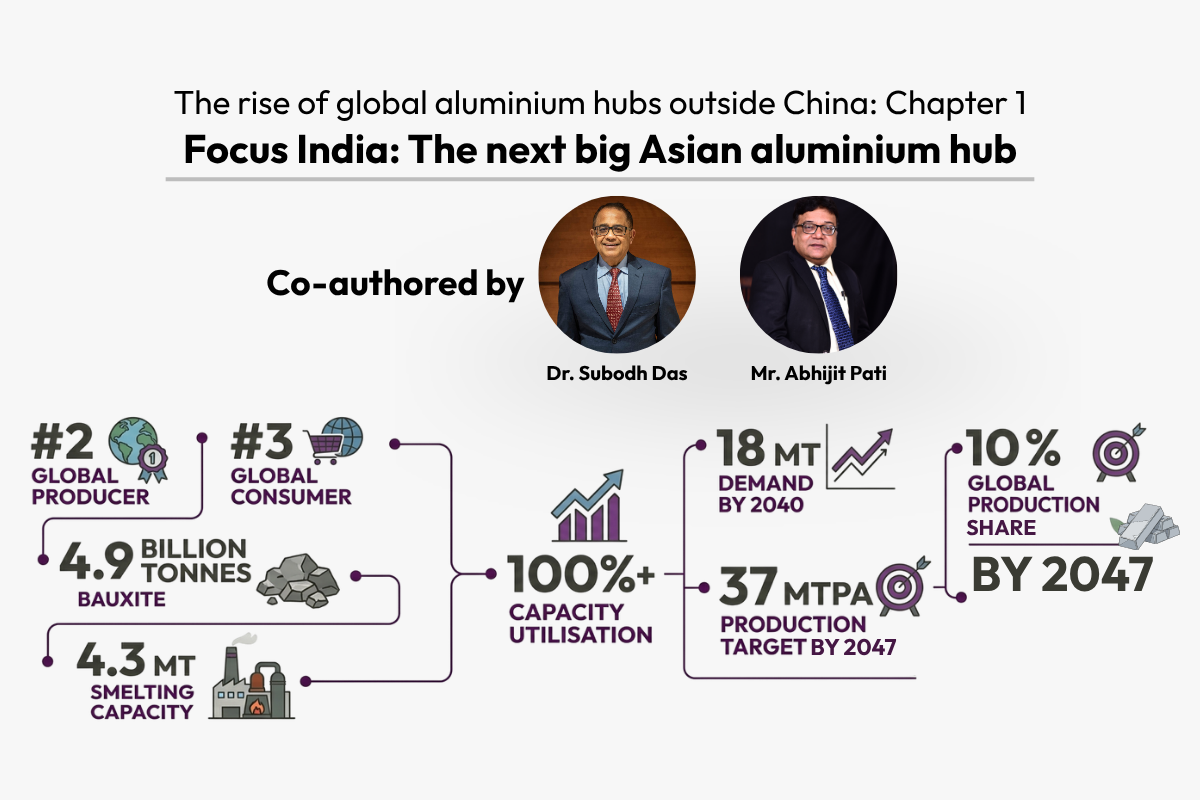
As part of the series, “The Rise of Global Aluminium Hubs Outside China”, the first chapter explores India’s emergence as a key player in the global aluminium landscape. Co-authored by two industry experts, Dr. Subodh Das and Mr. Abhijit Pati, the article provides an in-depth assessment of the country’s current status, pressing challenges, and future growth prospects.

Indian Aluminium Industry

{alcircleadd}

India stands as the world’s second-largest producer of primary aluminium, contributing roughly 5.5% to 8% of global output, backed by an industrial framework of fully integrated domestic producers and specialised downstream manufacturers. The primary aluminium ecosystem is anchored by national champions NALCO, Hindalco, Vedanta, and BALCO, which command a combined primary smelting capacity of approximately 4.3 million tonnes (MT).

Driven by rapid urbanisation, infrastructure development, and a clean energy transition, India's annual aluminium consumption has climbed to 4.5-5 MT, making it the third-largest consumer globally. However, the domestic market is highly unequal: per capita consumption rests at just 3.4kg, vastly lagging the global average of 8-12 kg. Consequently, India routes 60% (approx. 2.6 MT) of its current primary aluminium output to international export markets. Backed by expanding capabilities, India is uniquely positioned to transition into a major global supply and downstream consumption hub.

The structural paradox:

Domestically, around 48% of aluminium is consumed by the power transmission sector. Because primary producers price their metal at "import-parity" levels (inflated by a 7.5% import protection duty), the domestic market is expensive for local downstream manufacturers. Consequently, India exports massive volumes of raw, primary aluminium while importing finished downstream goods and aluminium scrap (over 2MT of scrap imported annually). 

Supply-side dynamics:

Over the last few decades, India’s aluminium production ecosystem has transitioned from a localised domestic setup into a globally competitive powerhouse. This strategic positioning has gained a stronger international momentum due to the shifts in Western policy, trade redirections, and sanctions on major alternative hubs like China and Russia.

Raw material base:

India holds the world's 8th largest bauxite repository, counting roughly 4.9 billion tonnes of resources, which includes 646 MT of proven reserves and 4.3 billion tonnes of remaining resources. Metallurgical-grade bauxite comprises nearly 79% of these resources, providing an intrinsic competitive edge for local primary refining. Backed by the Ministry of Mines' progressive operationalisation of auctioned mineral blocks, domestic bauxite excavation hit record operational highs in FY2025-26.

Smelting capacity and production trends:

While the addition of brand-new greenfield smelting complexes has been steady rather than sudden, domestic plants have achieved exceptional capacity utilisation. Average operational utilisation rates surged from 59% in FY2015-16 to cross 100% by FY2024-25, fuelled by deep order books across the power, infrastructure, and automotive segments.

Indian primary aluminium production by companies

The verified data of the primary aluminium capacity and output by the Indian producers

Supply and decarbonisation forecast:

The Government of India's official Aluminium Vision Document 2047 charts a clear path to scale total national output sixfold, aiming to ramp up current operational capacities to 37 MTPA by 2047 to claim a 10% share of global production.

Medium-term supply projections:

Total annual aluminium supply in India (combining primary and secondary) is forecasted to expand at a CAGR of 3.3%. Supplies are projected to rise from ~6 MTPA in 2025 to 9 MTPA by 2030, and hit 18 MTPA by 2040.

Primary vs. secondary aluminium mix shifts:

To foster a circular metal economy and alleviate reliance on imported scrap, the government has integrated policy frameworks targeting formalised scrap collection alongside mandated recycling thresholds for finished products by FY2030.

Indian aluminium indistry primary and secondary

Unlike the highly fragmented domestic steel industry, primary aluminium capacity additions remain concentrated among existing major players due to steep capital requirements. Vedanta leads the near-term expansion charts with major ongoing clean-energy powered capacity expansions underway in Odisha, targeting a progression toward a 3 MTPA footprint.

Supply-side bottlenecks:

  • Capital and energy intensity: Primary smelting requires continuous, substantial capital outlays per tonne of capacity and demands an uncompromised, high-load energy infrastructure.
  • Carbon footprint realities: Coal-fired captive power setups mean Indian primary production carries an average emission intensity of 20–21 $tCO_2/t$, which is higher than the global primary average of ~15 $tCO_2/t$. Conversely, secondary/recycled aluminium creates a mere 0.4– 0.6 $tCO_2/t$, representing a key lever for carbon mitigation.
  • Bauxite access hurdles: Despite vast deposits, environmental clearances, local protests, and regulatory restrictions in tribal-dominated areas continue to delay major greenfield bauxite mine operationalisation.
  • Underdeveloped downstream ecosystems: While downstream demand is rising, deep-tier structural consumption inside high-value sectors (such as aerospace, advanced packaging, and structural automotive lightweighting) remains low relative to international mature markets.

Demand prospects and drivers:

India’s aluminium demand is likely to multiply, driven by initiatives such as “Make in India”, Urbanisation, Smart cities, housing for all and large-scale infrastructure development. According to projections by the Ministry of Mines, India’s domestic aluminium demand is on track to grow dramatically:

   [FY2024] 4.9 MT  ──►  [FY2030] 8.5 MT  ──►  [FY2040] 18 MT  ──►  [FY2047] 28-37 MT

This structural demand acceleration is underpinned by a broader macroeconomic goal: supporting India’s long-term trajectory toward a multi-trillion dollar economy by 2047.

Key demand segments:

India's aspiration to become a USD 30 trillion economy by 2047 outlines a highly ambitious growth trajectory. Achieving this vision requires a sustained and accelerated economic expansion, which is expected to significantly boost aluminium demand in key sectors such as infrastructure, transportation, power, and manufacturing.

India aluminium consumption by sectors

  • Electrical & power grid infrastructure: Continues to be the single largest consumer segment, driven by large-scale grid modernisations and green energy transmission pipelines.
  • Transportation & automotive: Spurred by automotive lightweighting, systemic railway modernisation (including high-speed rolling stock), and the rapid domestic expansion of Electric Vehicles (EVs).
  • Construction & smart cities: Flagship infrastructure initiatives, such as the National Infrastructure Pipeline and the Smart Cities Mission, are driving high-volume consumption of architectural extrusions and structural panels.
  • Packaging, aerospace, and defence: Rising urban incomes have steadily accelerated the adoption of sustainable aluminium packaging, aided by governmental crackdowns on single-use plastics. Concurrently, the 'Make in India' mandate is driving localised demand for high-grade plates, components, and alloys in military hardware and aerospace manufacturing.

Aluminium is also widely used in extrusions, plates, and components across industries. Under Make-In-India initiatives, growing air travel & defence modernisation, aluminium demand in aircraft & military hardware is likely to see a potential boost in the coming decade.

Strategic and macro challenges:

Geopolitical & shipping Risk:

Earlier, the war in Ukraine and now the West Asian conflicts have proved that geopolitical risks can disrupt the industry dynamics across the globe. India’s aluminium and raw material trade remains exposed to geopolitical conflicts due to shared shipping routes and import dependency for crucial input materials. The disruptions in the Strait of Hormuz shot up the freight costs and negatively affected imports of key input material of calcined petroleum coke (CPC) for aluminium smelting, along with gas.

Meanwhile, for the secondary raw materials (aluminium scrap), the war in the Middle East has worsened the availability of imported scrap, as the UAE and Saudi Arabia remain two key suppliers of aluminium scrap to India. Meanwhile, the same impacted India’s exports of alumina to the Middle East and that of primary aluminium to the EU and the US.

Raw material import dependency:

Although India's local bauxite base could technically support a primary output capacity of up to 20 MTPA under ideal operating conditions, the industry faces severe structural shortages. Bauxite mining in India remains a complicated issue with a large volume of reserves remaining inaccessible due to community rights and other regulations. India is heavily reliant on imports for critical inputs, including high-grade coal, CPC, caustic soda, and Aluminium Fluoride ($AlF_3$).

Hence, the planned capacity expansion will need additional secondary production. Furthermore, due to an underdeveloped domestic scrap recycling infrastructure, the secondary aluminium industry imports 1.5 to 2 million tonnes of scrap annually, primarily sourced from the US, UK, Middle East, and ASEAN nations, to meet the rising demand of secondary aluminium from the auto and electronics sectors. India’s per capita aluminium consumption remains low, and the generation of end-of-life recyclable aluminium remains limited. This calls for increasing the volume of domestic scrap, especially from auto recycling.

Round-the-clock renewable energy (RTC-RE):

The availability of round-the-clock renewable power remains a challenge for the aluminium producers in India. The primary producers have set out their carbon emission targets, but there is a long way to go before they secure uninterrupted renewable power. Aluminium smelting has several operational challenges due to its very high energy requirements and the need for a constant, uninterrupted power supply. A shift to renewable energy can further create issues with intermittent power and the stability of operation.

Hence, they are producing small volumes of low-carbon aluminium, simultaneously powered by renewable energy. The government has set a target of transitioning to a Renewable-Energy-Round-the-Clock (RERTC) power and Grid connection by 2030. The implementation of renewables in the aluminium sector will need enhanced collaboration, close industry-government partnership, and policy support. This should go hand in hand with the integration of renewable energy, efficient recycling, and low-carbon production methodologies.

CBAM compliance and carbon tariffs:

The European Union's Carbon Border Adjustment Mechanism (CBAM) entered its fully operational compliance phase on January 1, 2026, penalising high-emission metal imports. Given that the EU purchases roughly 27% of India's total exported aluminium, CBAM presents a major commercial challenge.

CBAM effect on Indian aluminium industry

The early effects of these regulations are already apparent in trade data: year-to-date (YTD) volumes of unwrought Indian aluminium shipped to the EU fell from 18,653.8 tonnes as of January 2025 to 10,874.72 tonnes by YTD January 2026, a sharp 41.7% drop.

CALCULATE CBAM 

To cushion these carbon tariff penalties, local exporters may face price reductions of 15–20%. This has accelerated domestic efforts to reduce emissions, backed by the implementation of the national Carbon Credit Trading Scheme (CCTS) to reduce GHG emission intensity by 45% by 2030 (relative to 2005 baselines). This is one of the key reasons India is recalibrating its supply strategy by focusing on emission reduction.

Resource disconnect & regulatory clearances:

While India possesses the fifth largest bauxite reserve globally, large swathes of high-quality deposits remain locked or underutilised due to complex land acquisition hurdles, environmental/forest clearances & a lack of railway infrastructure in remote, mineral-rich regions.

Vulnerability of MSMEs:

The downstream ecosystem is driven by over 3500 MSMEs operating at an average capacity utilisation of 50%. They are squeezed by high domestic primary metal prices and a global scrap market.

Conclusion

Despite facing bauxite mining delays, import dependencies, and strict new international carbon tariffs, India's aluminium industry is entering a resilient growth phase. High domestic capacity utilisation, comprehensive corporate brownfield expansions, and robust state planning position the country well in the sector. As strict output caps limit China's expansion and trade restrictions alter Russian supply routes, India is strategically positioned to step up as the next premier global hub for aluminium production and export.


Reference:

1) https://mines.gov.in/admin/storage/ckeditor/Monthly_Summary_on_Minerals_and_Non-ferrous_Metals_1778049884.pdf

2) https://ibm.gov.in/writereaddata/files/170987945265eab09cd2f82Bauxite_2022.pdf

3) Roadmap for aluminium sector decarbonization by NITI Aayog

Vision Document on Aluminium Sector:

4) https://mines.gov.in/webportal/content/vision-document

5) https://mines.gov.in/admin/storage/ckeditor/n-25_1751560198.pdf

Google Preferred Source

Last updated on : 11 JUNE 2026

Adv
Adv
Adv
Adv
Adv
Adv
Adv
EDITED BY : DR SUBODH DAS 9MINS READ

Responses

Adv
Adv
Adv
Loading...
Adv
Adv
Adv
Loading...
Reports VIEW ALL
Loading...
Loading...
Business Leads VIEW ON AL BIZ
Loading...
Adv
Adv
Would you like to be
featured with us?
Loading...

AL Circle: Aluminium Ecosystem App

A proud
ASI member
© 2026 AL Circle. All rights reserved. AL Circle is not responsible for content from external sources.