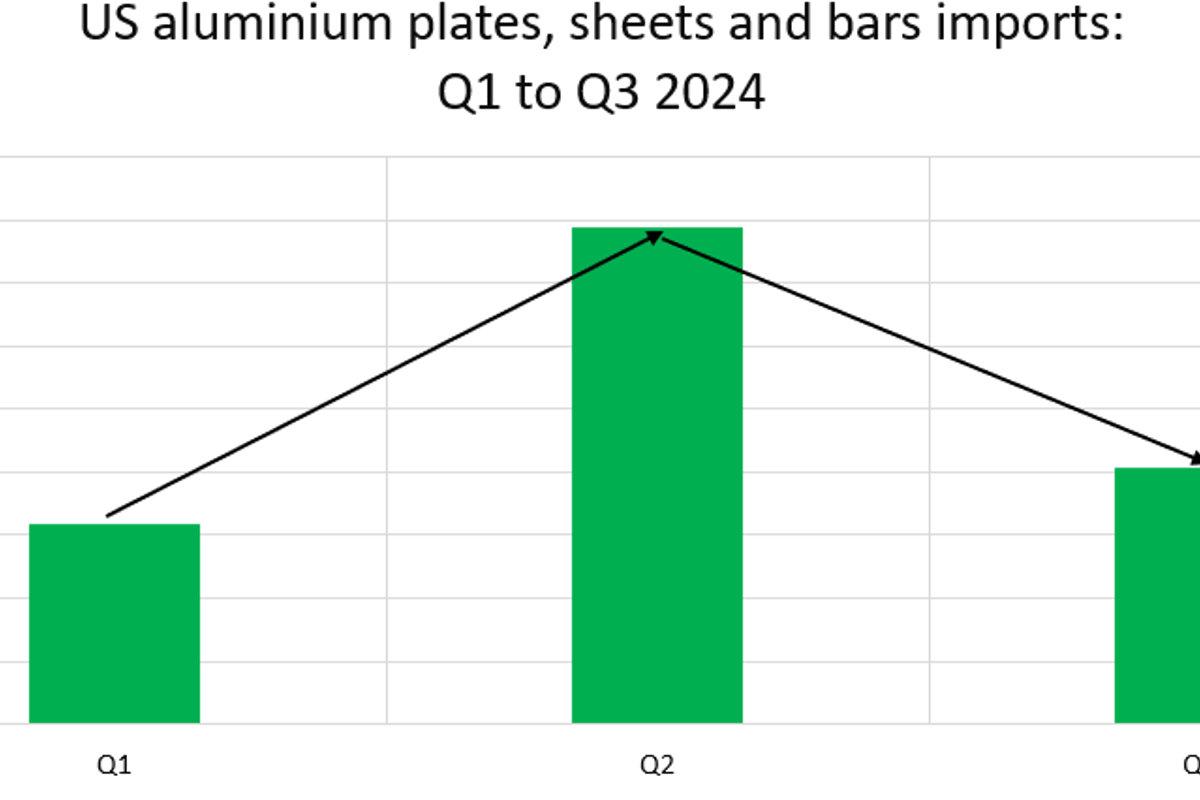
The United States imports of aluminium plates, sheets and bars stood below 100,000 tonnes for the two consecutive months in the third quarter of 2024, resulting in a dip in the total import volume through Q3. According to the US Geological Survey, the imports of aluminium plates, sheets and bars totalled 300,600 tonnes, significantly down by 11.33 per cent from 339,000 tonnes in Q2 2024.
However, annually, imports in Q3 2024 showed a rise of 25.25 per cent from 240,000 tonnes. Also from the first quarter of this year, the import volume stood 3 per cent higher than 291,800 tonnes.
It is to be noted that despite the sequential fall in Q3, the import volume stood above the mark of 300,000 tonnes.
In September 2024, the country imported 94,100 tonnes of aluminium plates, sheets and bars versus 93,500 tonnes in August 2024 and 73,900 tonnes in September 2023. That reflected a month-on-month increase of 0.64 per cent and a year-on-year hike of 27.33 per cent.
Why did the Q3 import volume decrease over three months?
The downfall in Q3 import volume was primarily due to the reduced shipment from China. In August, China's aluminium plates, sheets and bars exports amounted to 7,830 tonnes, reflecting a sharp fall of 50.75 per cent M-o-M from 15,900 tonnes. In the subsequent month, the export volume further decreased by 19.41 per cent to 6,310 tonnes.
The fall in the United States aluminium plates, sheets and bars imports from China could primarily be attributed to the increase of Section 301 tariff on Chinese products like aluminium and steel, electric vehicles, electric vehicle batteries, battery parts and many more following its original proposal in May 2024. The increased tariffs range between 25 per cent and 100 per cent.
However, the United States' total import volume of aluminium plates, sheets and bars from China during January-September demonstrated a Y-o-Y hike of 21 per cent from 99,000 tonnes to 120,000 tonnes.
Canada and South Korea, the two other major exporters of aluminium plates, sheets and bars to the United States, supplied 17,600 tonnes and 15,500 tonnes, respectively, accounting for 18.7 per cent and 16.47 per cent of the latter's total imports. While the former demonstrated a monthly hike of 8 per cent from 16,300 tonnes, the latter showed a decline of 14 per cent from 18,000 tonnes.












_md.webp)
_md.webp)
_md.webp)