您想继续阅读英文文章还
是切换到中文?
是切换到中文?

THINK ALUMINIUM THINK AL CIRCLE

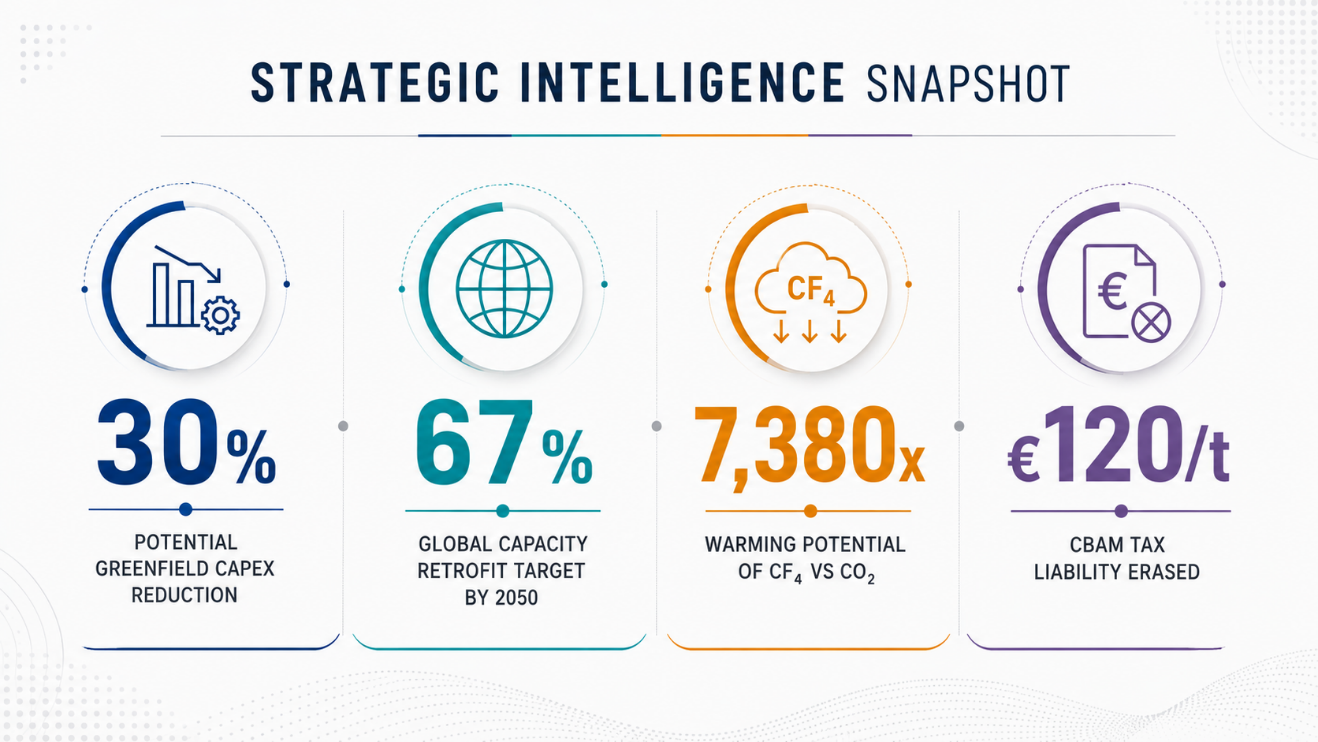
The image used in this article is generated with an AI tool and does not depict any real-time moment
The global transition to inert anodes is not an environmental charity project. It is a fundamental rewiring of aluminium economics. This technology will render traditional carbon paste plants obsolete, slash greenfield capital expenditures, and instantly erase massive cross-border carbon taxes.
{alcircleadd}The primary production of aluminium has been governed by a single chemical reality since its independent co-discovery in 1886. To strip oxygen from alumina, you must burn carbon.
When Charles Martin Hall first experimented with electrolytic reduction, his initial ambition was actually to use copper anodes. Unfortunately, the rapid dissolution of copper in the violently corrosive cryolite electrolyte forced a massive compromise. Carbon became the only practical industrial material. Over the last century, the industry evolved from dirty Söderberg paste technology to highly optimised prebaked carbon blocks. However, even the most advanced prebaked carbon cell natively produces roughly 1.5 tonnes of direct CO₂ per tonne of aluminium.
Today, the global imperative to achieve net zero emissions has transformed Hall's century-old compromise into a severe financial liability. The carbon anode is no longer just a consumable part of the supply chain. It is a tax liability waiting to detonate.
[You are reading an exclusive metallurgical briefing. This article covers interactive tracking data on CAPEX savings, global adoption trajectories, and the specific Ni-Cu alloy chemistries driving the inert anode revolution. Must read for aluminium smelter executives, plant managers, metallurgists, process engineers, R&D teams, project development teams, and decarbonisation leaders]
It is impossible to overstate the financial urgency of this transition. An exhaustive inventory published in Nature Climate Change evaluated 249 global aluminium smelters alongside 280 fossil fuel captive power units. The data reveals a brutal technological reality.
Between 2012 and 2021, the share of aluminium production powered by fossil fuels actually increased from 37 per cent to 49 per cent. The researchers found that retiring fossil fuel captive power plants a decade early reduces emissions intensity by 5.0 to 10.5 tCO₂e per tonne of aluminium. However, early retirement alone completely fails to hit the 1.5°C target.
Furthermore, legacy carbon anodes trigger anode effects that release highly potent perfluorocarbons (PFCs). Specifically, CF₄ carries a global warming potential 7,380 times higher than CO₂. Furthermore, C2F6 is an astonishing 12,400 times higher. Inert anodes eliminate this toxic liability completely.
To know the production, demand and consumption forecasts on bauxite and alumina, explore the report "Global Bauxite & Alumina Market Forecast to 2036: Supply–Demand, Trade Flows & Price Outlook"
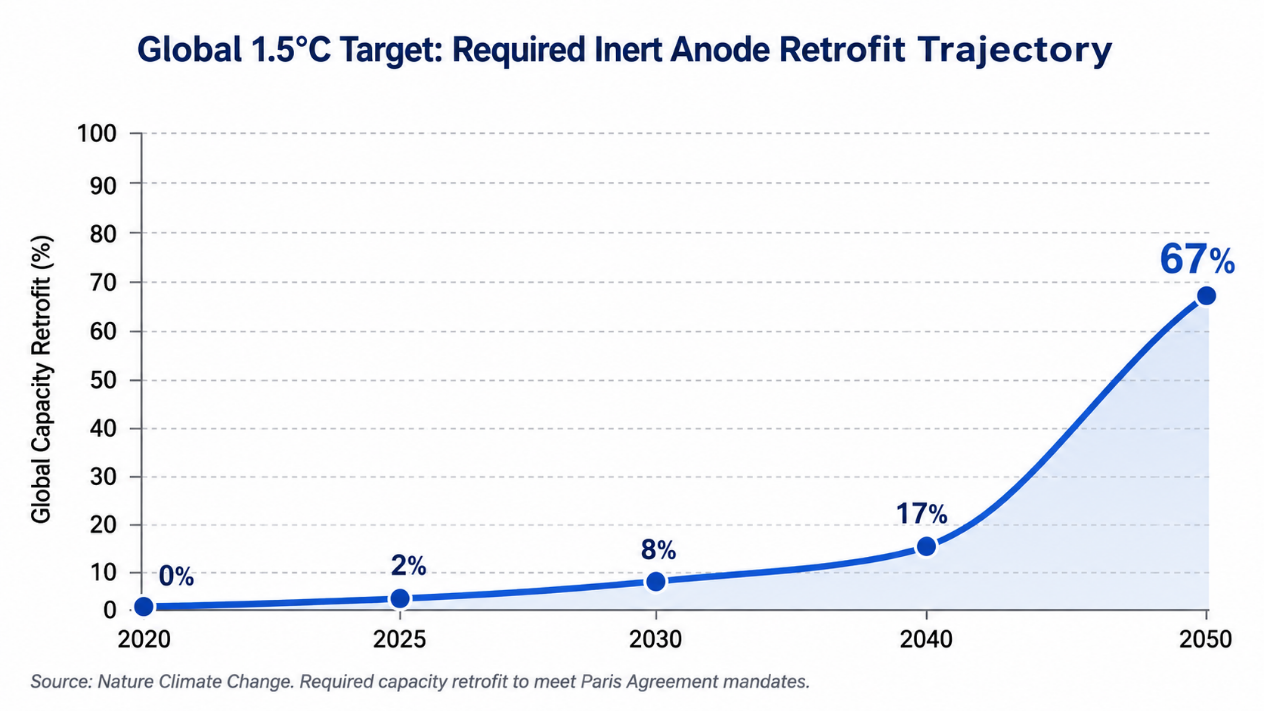
Evaluating this transition through the lens of carbon adjusted cost efficiency changes the entire boardroom conversation. For greenfield investments, inert anodes completely rewrite the financial model.
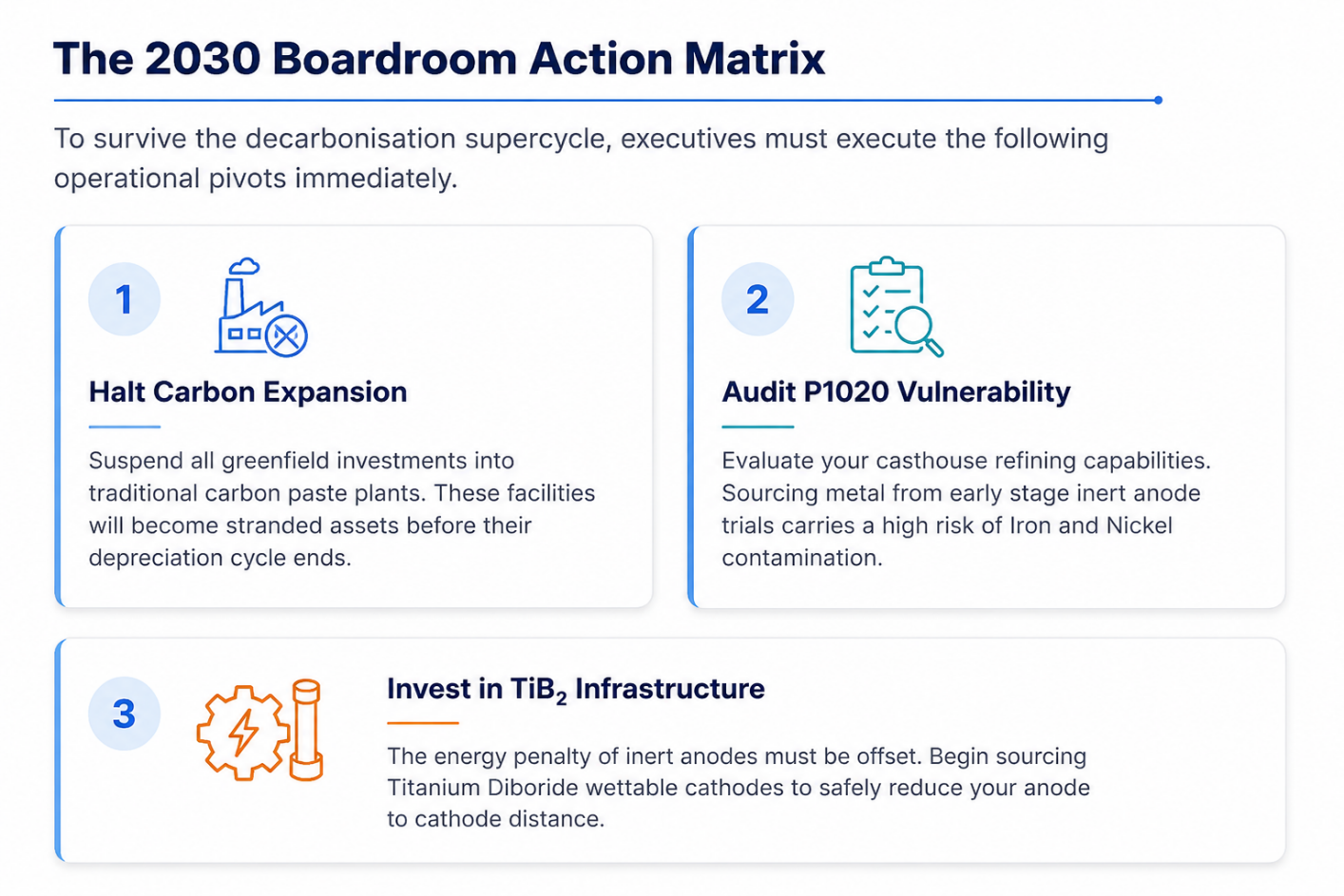
Building a traditional carbon paste plant in 2026 is financial suicide. Inert anodes transform these legacy facilities into stranded assets overnight.
By eliminating the consumable carbon block, a new facility can entirely forgo the construction of paste plants, ring baking furnaces, and rodding rooms. This architectural shift reduces total smelter CAPEX by roughly 25 to 30 per cent.
On the operational expenditure (OPEX) side, it completely shields the business from volatile commodity pricing. Historically, procuring calcined petroleum coke and coal tar pitch dictates 15 to 20 per cent of total production costs. Furthermore, with European Carbon Border Adjustment Mechanism (CBAM) certificates projected to remain prohibitively expensive, a legacy smelter faces an immediate border tax penalty. Inert anodes instantly erase that tax liability.
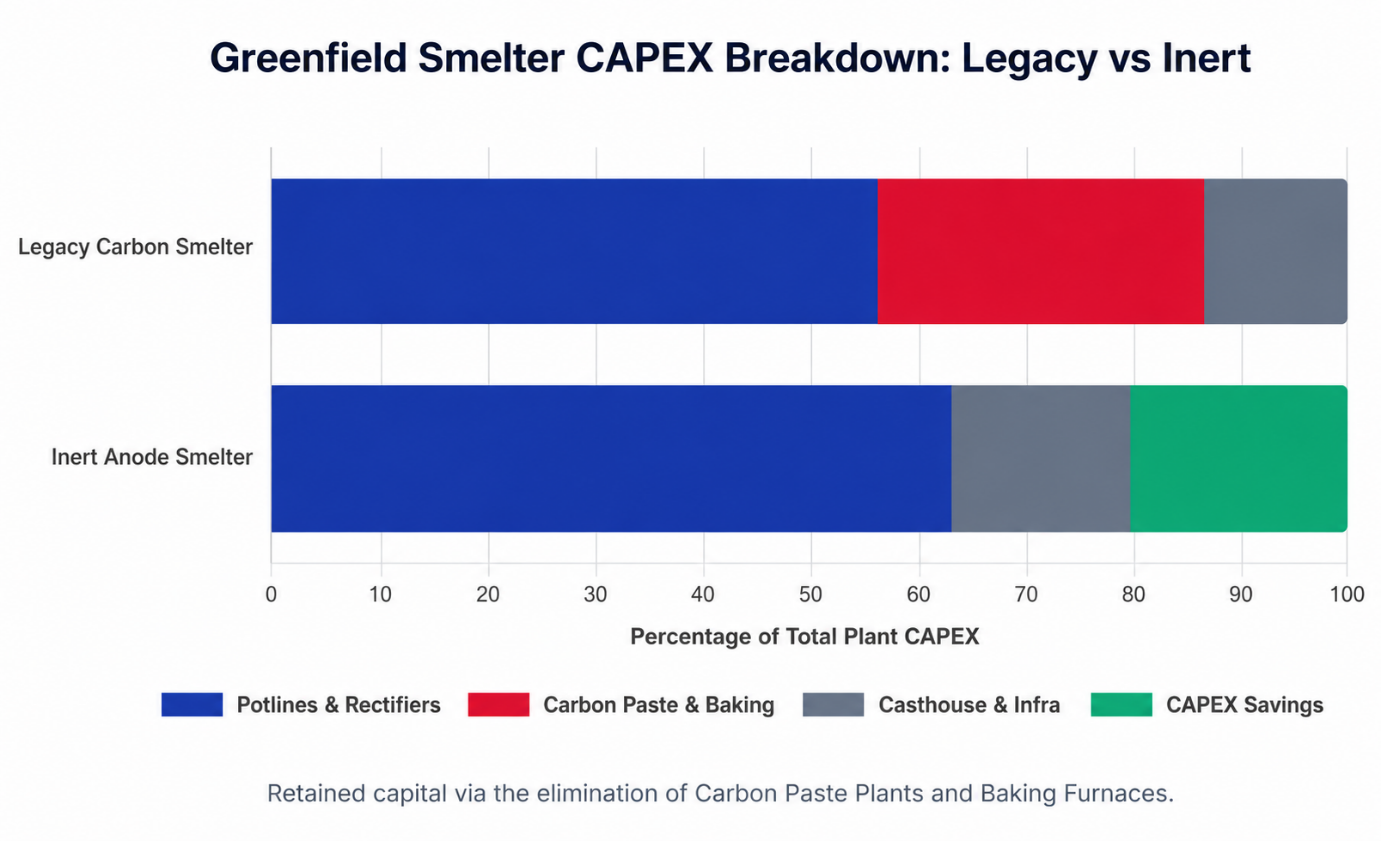
Deploying a permanent piece of metal into a molten fluoride bath remains one of the hardest problems in modern engineering. According to corrosion behaviour analysis published in the new article, Nickel-Copper (Ni-Cu) alloys hold immense commercial potential.
By shifting the traditional cell to a low-temperature molten salt system comprising 15 KF, 50 AlF3, and 5 Al2O3 by weight percentage operating at 800°C, engineers can drastically reduce the corrosion rate. Under these specific conditions, Ni-Cu alloys form complex oxide films that conduct electricity while resisting the aggressive fluoride melt.
However, this introduces a severe commercial risk known as the P1020 Purity Trap. The London Metal Exchange P1020 benchmark strictly limits iron to 0.20 per cent. If the dynamic oxide layer on an inert anode degrades, the underlying transition metals undergo catastrophic fluoridation. The anode leaches iron and nickel directly into the liquid aluminium. If a smelter produces off-spec metal, it faces crippling fractional crystallisation refining costs. Avoiding this contamination trap is the only way exporters can secure the Green Premium in Western markets.
Explore primary aluminium suppliers, product listings and trade opportunities on AL Biz
There is a vital engineering reality we must address. Evolving oxygen from an inert anode is endothermic. This imposes a thermodynamic penalty that requires up to 3.0 kWh of additional electricity per kilogram of aluminium. If an operator ignores this, their electricity costs will soar.
The only physical way to offset this massive energy penalty is to drastically shrink the distance between the anode and the cathode. This requires coating the carbon pot linings with titanium diboride (TiB₂). TiB₂ creates a "wettable" cathode surface. Instead of forming a deep, unstable pool of waving liquid metal, the aluminium forms a thin, stable film. This eliminates magnetic instability and allows engineers to reduce the anode to cathode distance to mere millimetres. Combining inert anodes with TiB₂ wettable cathodes is not optional. It is the only way to make the physics work at scale.
The commercial reality of inert anodes is heavily dictated by regional geography. Regions with locked-in renewable energy are the natural homes for this technology. The major players driving this vanguard include ELYSIS and UC RUSAL.
ELYSIS (North America): A powerhouse joint venture between Alcoa and Rio Tinto, backed by Apple and the governments of Canada and Quebec. ELYSIS is already operating commercial size 450 kA inert anode cells. This proves the technology can withstand the brutal magnetic fields of modern mega smelters.
UC RUSAL (Russia): The Russian giant has successfully operated new generation 140 kA inert anode pilot pots at the Krasnoyarsk Aluminium Plant. These cells are powered exclusively by clean Siberian hydro energy.
For smelters operating on coal-heavy grids in Asia and the Middle East, installing an endothermic inert anode simply shifts process emissions to electrical emissions. As outlined in a JOM analysis on CO₂ capture , these facilities must focus instead on Carbon Capture, Utilisation, and Storage (CCUS). The industry is seeing massive investments from consortiums involving Fives, Trimet, and Rio Tinto to capture process gases. The research specifically highlights Verdox electrochemical carbon capture technology as a highly viable pathway for existing Hall-Héroult cells.
Furthermore, as proposed in Advanced Energy Materials , combining CCUS with aluminium steam oxidation pathways allows coal-heavy regions to reinvent their output. Aluminium transforms from a simple construction material into a highly dense, long-term energy storage vector.
Strategic verdict
The 130-year monopoly of carbon smelting is entering its twilight. Driven by strict global climate mandates and the lucrative promise of the Green Premium, the primary aluminium sector is experiencing its greatest technological leap in over a century.
Corporate boards must move decisively. Exporters situated in renewable energy hubs must aggressively pursue inert anode retrofits paired with TiB₂ cathodes while fiercely guarding against the P1020 purity trap. Those in fossil fuel-dependent regions must rapidly scale electrochemical CCUS technologies to protect their margins from border tariffs. The decarbonisation Supercycle is no longer a future concept. It is the active reality of global metals trading.
Unlock key insights from leading companies and experts across the aluminium ecosystem with our e-Magazine
Note: This is exclusive coverage by AL Circle and may not be reproduced, republished or shared without prior permission.
Disclaimer: The opinions, information, claims, references, and images presented here are those of the author alone and AL Circle holds no responsibility. -
Responses


A proud
ASI member
AL Circle Private Limited | CIN: U72200WB2017PTC221175
Registered Office: Ecospace Business Park, Block 3A, Unit 401A, New Town, Rajarhat, Kolkata, WB 700160
Corporate Office: Ecospace Business Park, Block 3A, Unit 401A, New Town, Rajarhat, Kolkata, WB 700160
© 2026 AL Circle. All rights reserved. AL Circle is not responsible for content from external sources.