Europe's aluminium future: Novelis backs “policy framework” to boost recycling, meet the 52Mt demand
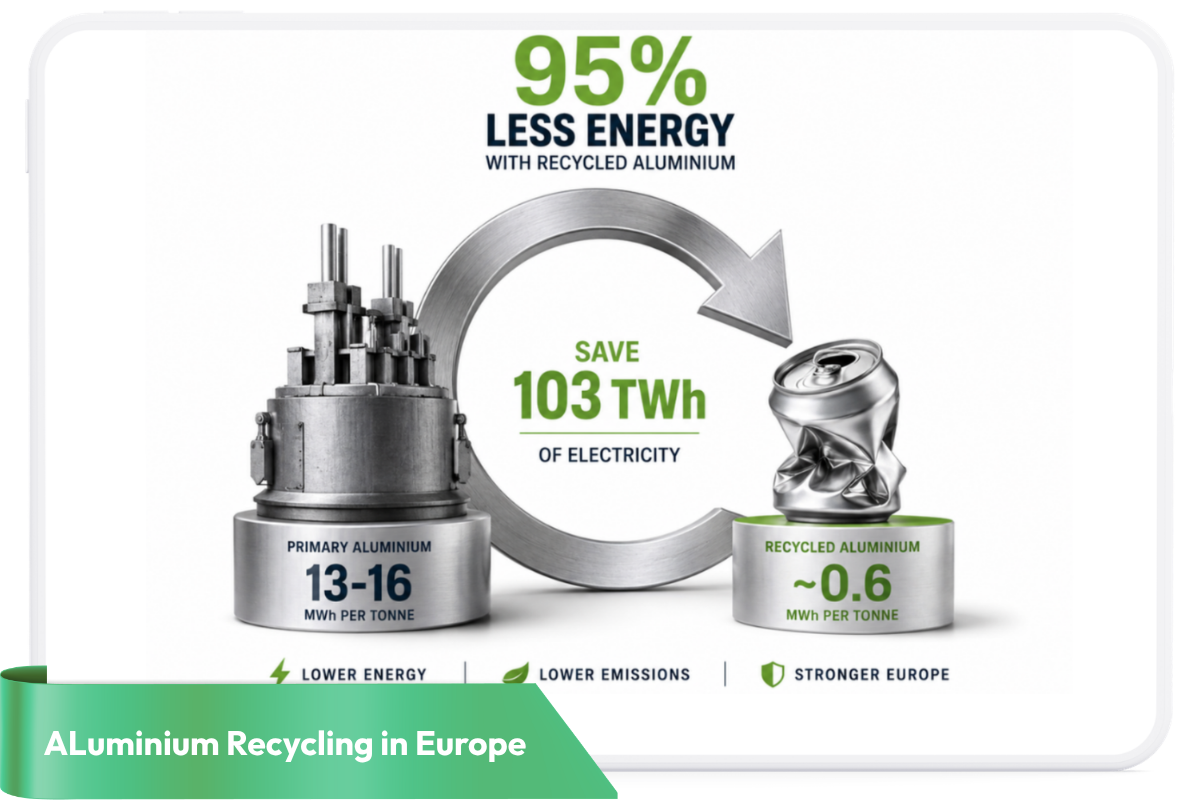
The image used in this article is generated with an AI tool and does not depict any real-time moment
The global aluminium industry is entering a decade of unprecedented demand, and so is the European aluminium sector. Global aluminium demand is set to surge, driven by electric vehicles, renewable energy, construction and sustainable packaging. A similar situation is noted in Europe, as demand is forecast to jump to 52 million tonnes by 2030. For Europe, however, meeting this demand is challenging. As primary aluminium production declines rapidly amid high energy costs, recycling is gaining momentum, aiming to strengthen supply security, lower energy consumption, and maintain a competitive edge. But will recycling alone be enough?
The answer can be found in the white paper published by Novelis, a leading provider of sustainable aluminium solutions and the world's largest aluminium recycler.
Melanie Lambelet, Director Government Affairs, Novelis Europe, noted, “Europe already has the foundation for a world-leading circular aluminium industry. The priority now is to create a policy framework that rewards investment in recycling capacity, supports access to scrap and enables manufacturers to compete globally.”
Likewise, in 'A True Industrial Recycling Strategy for Europe', Novelis has examined the European aluminium industry from a critical perspective, identifying the challenges and opportunities faced by the region over the years. Unveil key insights shared in the white paper at the end of the article.
Aluminium demand enters a new era: World and Europe
Global aluminium demand surpassed 116 million tonnes in 2024, of which nearly 74 million tonnes or 64 per cent came from primary production, while around 42 million tonnes or 36 per cent was supplied through recycled, or secondary aluminium.
According to the forecast, by 2030, EV production is expected to increase aluminium demand to 31.7 million tonnes, up from 19.9 million tonnes in 2020. Aluminium used in solar panels and power transmission and distribution may need 5.2 million tonnes, while the construction sector might require another 4.6 million tonnes.
Additionally, demand from food and beverage packaging is also expected to increase from 7.2 million tonnes in 2020 to 10.5 million tonnes in 2030, backed by aluminium cans gaining preference among users.
Delve deeper into the recycled aluminium and secondary aluminium market with our World Recycled ALuminium Market Analysis Industry forecast to 2032
Estimates drawn up by the International Aluminium Institute (IAI) depict that global aluminium consumption is projected to surge by around 40 per cent between 2020 and 2030, creating demand for an additional 33.3 million tonnes across industries.
Throughout the same period, the volume of secondary aluminium contributed to the global supply is expected to increase from 29 per cent in 2020 to 36 per cent by 2030, indicating the growing importance of recycling in meeting future demand.
Europe is expected to follow a similar trajectory. The region's energy transition alone could lift annual aluminium demand by around 5 million tonnes by 2040, representing growth of about 30 per cent.
However, how Europe will meet this additional demand remains an open question.
Primary aluminium: Europe's growing energy challenge
Among energy-intensive industries, primary aluminium production stands out due to the high electricity demand of electrolysis, using 13–16 Megawatt-hours (MWh) for every tonne produced. Hence, electricity remains the industry's highest operating cost, accounting for about 40 per cent of the same.
Escalating energy prices have reshaped Europe's aluminium sector since 2021. Almost 50 per cent of primary smelting capacity has been either reduced or taken offline, while secondary producers continue to grapple with higher operating costs as gas-fired furnaces and electricity-intensive rolling processes become more expensive.
Europe produced 4.9 million tonnes of primary aluminium in 2002 while importing 2.6 million tonnes to bridge the supply gap. By 2025, however, the situation seemed to reverse. Domestic primary output fell to 3.4 million tonnes, whereas imports jumped to 4.4 million tonnes, highlighting an increasing reliance on overseas supply.
The situation within the European Union (EU) is even more pronounced. In 2025, primary aluminium production stood at around 1.2 million tonnes, dropping by almost 60 per cent from 2.9 million tonnes since 2005. The energy crisis further compounded this decline, with production cut by almost 50 per cent between 2021 and 2023.
Eurostat calculations depict Europe's average industrial energy consumption around 4,000 Terawatt-hours (TWh). Out of this, per IAI data, 2.75 per cent or 108,446 Gigawatt-hours (GWh) were consumed for the production of about 6.99 million tonnes of primary aluminium.
On a year-on-year basis, the total industrial energy consumption of the EU was broadly stable in 2024, settling around 8,835 Petajoules (PJ), with only a marginal 0.1 per cent increase compared to 2023. Out of this, 36.76–45.25 TWh contributed to the production of primary aluminium across Western and Central Europe.
Europe’s secondary aluminium scenario
In contrast, secondary aluminium production has continued to expand. Output increased from 3.9 million tonnes in 2002 to 4.8 million tonnes in 2024, overtaking primary production from 2012 onwards and reinforcing recycling's growing role in Europe's aluminium supply chain.
Today, Europe's aluminium industry generates approximately EUR 40 billion in annual revenue and directly employs around 250,000 people. Around 90 per cent of these jobs are concentrated in downstream activities, including recycling and semi-finished product manufacturing, while the broader aluminium value chain supports an additional one million indirect jobs.
In light of the point, Lambelet observed, “The future of European aluminium will not be determined solely by what we import, but by how effectively we recover, retain and reuse the materials already available within our borders.”
The energy advantage is even more striking. Given the 95 per cent reduction in energy consumption, producing 6.99 million tonnes of secondary aluminium at approximately 600–800 kWh per tonne would require only about 5,422 GWh of electricity, preserving more than 103,000 GWh compared to primary production.
In a region where energy costs continue to shape industrial competitiveness, the potential savings are difficult to ignore.
Greater reliance on recycled aluminium could also strengthen Europe's downstream industry, support employment and reduce dependence on imported primary metal.
Policy measures to bolster the secondary industry
According to the EU industry body European Aluminium, the region has invested around EUR 700 million in strengthening its recycling ecosystem through new recycling plants, capacity expansions and advanced processing technologies. Alongside these investments, several EU policy measures have helped reinforce circularity across the aluminium value chain.
The EU Waste Framework Directive promotes waste prevention and resource efficiency by moving Europe away from the traditional take-make-dispose model towards a circular economy.
Complementing this, the Packaging and Packaging Waste Regulation (PPWR) requires all packaging placed on the EU market to be recyclable and obliges member states to implement Deposit Return Schemes (DRS), boosting the separate collection of aluminium beverage cans.
Additionally, the Waste Shipment Regulation (WSR) is a framework that could restrict the flow of recyclable materials, including aluminium scrap, to non-OECD countries.
Meanwhile, the Critical Raw Materials Act (CRMA) aims to strengthen domestic supply chains while encouraging investment in recycling infrastructure.
New circularity rules for vehicles are also expected to improve the recovery of aluminium from end-of-life vehicles by promoting vehicle designs that simplify dismantling and material recovery.
Explore the position of aluminium at the intersection of sustainability and strategy in Sustainability & Recycling: Aluminium's Dual Commitment
Recycling alone cannot carry the load
While recycling has become central to Europe's aluminium strategy, it cannot fully replace primary production. High-performance applications such as aerospace, electrical systems and certain automotive alloys will continue to require primary aluminium, while growing demand means that recycled material alone is unlikely to bridge the supply gap.
Europe's aluminium future, therefore, is unlikely to hinge on a choice between primary and secondary production. Instead, it will require a balanced strategy, i.e., maximising recycled aluminium wherever technically possible while maintaining competitive low-carbon primary production for sectors where recycled metal cannot yet serve as a complete substitute.
Nonetheless, keeping in mind the employment opportunities, circularity and sustainability goals, Lambelet concluded, “As policymakers seek solutions to Europe's competitiveness and resource security challenges, industrial recycling deserves a central place in the discussion. Every tonne of aluminium successfully recycled in Europe reduces dependence on imports while supporting jobs, investment and decarbonisation.”
To gain an in-depth understanding of the aluminium recycling scenario in Europe, download the white paper, 'A True Industrial Recycling Strategy for Europe' by Novelis here.

China's aluminium scrap sector squeezed by tax crackdown, shrinking aluminium scraps margins
Next articleWhy scrap is becoming central to the aluminium industry: the past fortnight’s updates
Grow with
AL Circle