Japan’s economic engine, though sputtering, is not stalling just yet. Revised data from the Cabinet Office show that Japan’s GDP shrank by only 0.2 per cent annualised in Q1 2025, sharply better than the earlier estimate of 0.7 per cent, and just enough to keep recessionary panic at bay. The improvement was primarily driven by a surprise uptick in private consumption, which accounts for over half the nation’s GDP. From restaurants to gaming, updated spending data lifted consumption growth to 0.1 per cent, reversing the earlier flat-line reading.
Image for representational purposes only
What’s more, domestic demand contributed 0.8 percentage point to growth, effectively offsetting the 0.8 percentage point drag from net exports. However, the modest rebound is unlikely to shift the Bank of Japan’s cautious stance, especially as tariff pressures from the US loom large. While inventories and capital expenditure offered some cushion, Japan’s forward momentum remains hostage to export dynamics—and, by extension, to aluminium-intensive sectors under direct tariff fire.
Despite periodic trade spats, Japan and the US remain deeply intertwined — militarily through the alliance, economically through integrated supply chains, and diplomatically through shared values in the Indo-Pacific. It is a relationship built not just on mutual interest but also on mutual necessity.
At the heart of the unease is a 25 per cent tariff on Japanese automobiles and auto parts, implemented under Section 232 of the US Trade Act in April 2025. This was followed swiftly by a 10 per cent baseline tariff on nearly all Japanese imports and a looming 14 per cent country-specific surcharge set to kick in from July unless negotiations manage a de-escalation. In short, Japan’s trade engine, long fuelled by high-value exports, is now running into geopolitical headwinds.
Aluminium leads not by volume, but by value
Aluminium may account for a modest share of Japan, with the US trade of just USD 500-700 million worth of Japanese aluminium products entering the US in 2024. Still, its industrial and strategic weight is outsized. From electric vehicles to semiconductors and aircraft components, aluminium is embedded deep within the global value chains that power both nations’ clean-tech and defence ambitions.
Japan primarily exports semi-fabricated aluminium goods: coils, foils, precision forgings, and high-performance alloys. In return, it imports downstream aluminium products like rolled plates, billets, and speciality scrap from the US, amounting to USD 200-300 million annually. Neither nation depends on the other for primary aluminium, but the two are deeply interlocked at the value-added stage. The 25 per cent auto tariff thus doesn’t just hit car exports—it indirectly taxes aluminium integration in EVs and hybrid vehicles.
A trade deficit widening on tariff-torn tracks
In 2024, the US imported USD 148.37 billion worth of Japanese goods while exporting just USD 78.98 billion, resulting in a trade deficit of USD 69.39 billion. The first quarter of 2025 shows no relief: Japanese exports to the US touched USD 38.3 billion, compared to USD 19.7 billion in US exports to Japan, sustaining a quarterly trade gap of nearly USD 18.7 billion. As trade tensions escalate, aluminium finds itself in the crosshairs, not because it dominates trade flows but because it reinforces industrial trust.
Japan’s automotive sector alone, responsible for roughly 28 per cent of exports to the US, sits atop a JPY 21 trillion (USD 140 billion) annual pipeline that is now threatened by tariffs. These vehicles increasingly rely on aluminium to meet fuel efficiency and weight-reduction standards. The aluminium inside a Lexus or a Subaru may weigh only a few hundred kilograms but carries tonnes of diplomatic baggage.
Green aluminium, blue-sky diplomacy
Beyond trade volumes lies a greener vision: both nations are courting decarbonisation pathways, and aluminium’s carbon footprint is becoming as relevant as its conductivity. Japan’s push for low-carbon aluminium, driven by its net-zero targets, aligns with US efforts under the (currently stalled) Global Arrangement on Sustainable Steel and Aluminium (GASSA). Japan wants in. The US and EU remain non-committal.
Still, producers like Alcoa and Century Aluminium see Japan as a future-ready partner for green aluminium cooperation. With carbon-adjusted border mechanisms such as CBAM in the EU and GASSA in the air, aluminium isn’t just a trade good anymore; it’s a climate instrument.
A Legacy of allies, now at economic odds
Japan and the US share a post-WWII alliance that evolved from an occupation to one of Asia’s strongest strategic partnerships. Military ties remain ironclad, with the US-Japan Security Treaty anchoring Indo-Pacific stability. However, the relationship has often oscillated economically, from fierce trade tensions in the 1980s to digital-age cooperation in semiconductors and green tech.
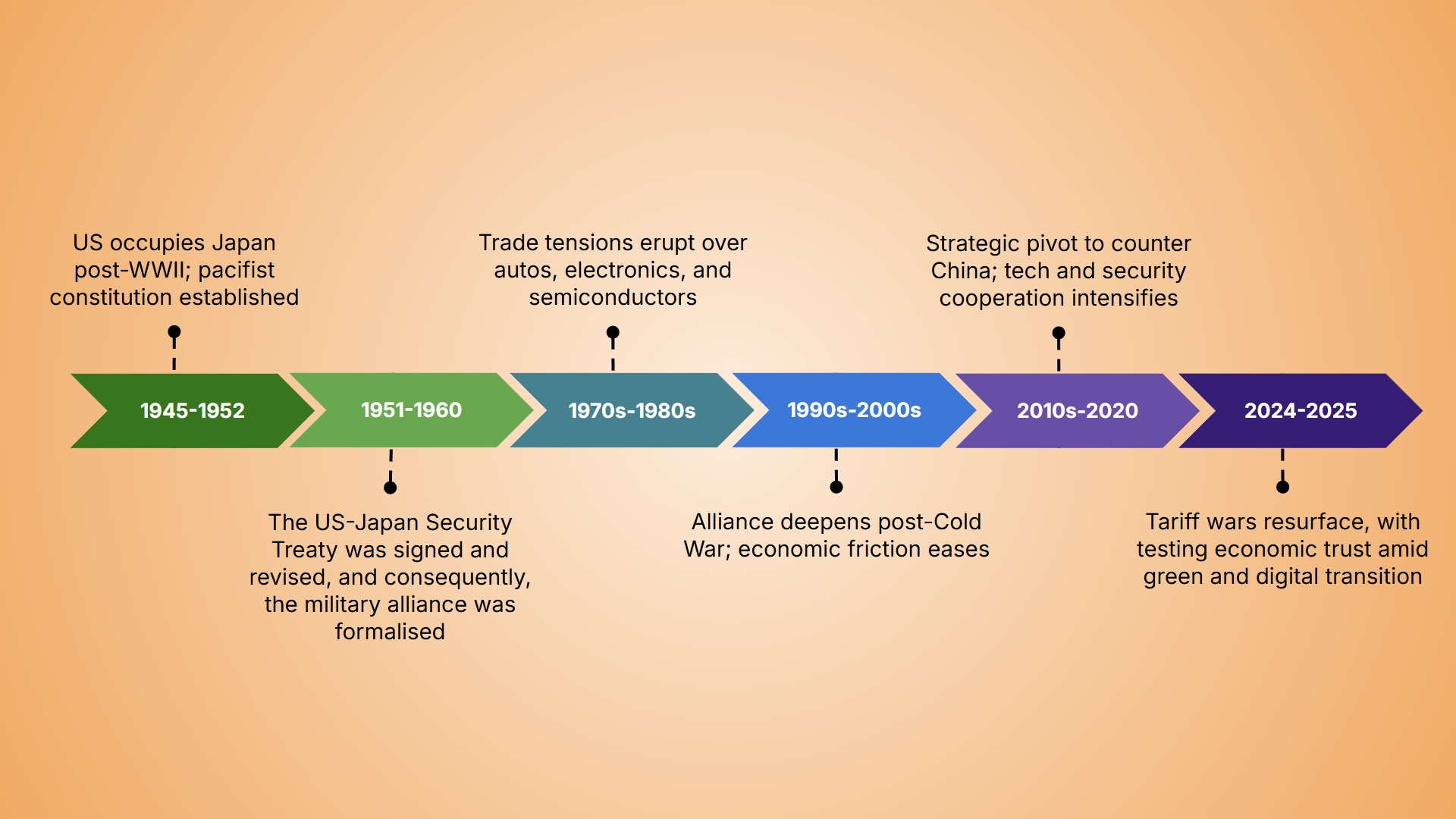
- 1945–1952: US occupies Japan post-WWII; pacifist constitution established.
- 1951-1960: The US-Japan Security Treaty was signed and revised, and consequently, the military alliance was formalised.
- 1970s-1980s: Trade tensions erupt over autos, electronics, and semiconductors.
- 1990s-2000s: Alliance deepens post-Cold War; economic friction eases.
- 2010s-2020: Strategic pivot to counter China; tech and security cooperation intensifies.
- 2024-2025: Tariff wars resurface, with testing economic trust amid green and digital transition
Today, aluminium tariffs and auto duties revive old fault lines. While security interests bind the two nations, their economic paths—shaped by tariffs, supply chain resilience, and climate policy—are increasingly at crosscurrents. The challenge now is aligning strategic friendship with economic fairness.
Consumer goods: Precision, premium, and export-ready
Japan also ships aluminium-made finished products with high commercial and design value. From Balmuda’s sleek aluminium laptop stands to Sugatsune’s precision-engineered architectural hardware, these goods find customers across the US, EU, and Asia. In 2024 alone, Japan exported USD 2.35 billion worth of aluminium products globally. While bulk materials go to regional smelters in China, Vietnam, and South Korea, value-added goods flow steadily into North America, including automotive coils, architectural extrusions, and high-tech foil.
Policy flashpoints: Tariffs, talks, and trade-offs
- Section 232 tariffs: Japan was exempted from the 10 per cent aluminium tariff under Trump’s first wave in 2018–2021. That grace is now uncertain.
- Auto tariffs (25 per cent): Already active, these squeeze Japanese automakers’ profitability in the US and indirectly inflate aluminium-linked costs.
- July 2025 surcharge threat: A 14 per cent hike on top of existing 10 per cent baseline tariffs would escalate pressure—unless diplomacy prevails.
- GASSA and CBAM: Japan wants alignment with the US and EU on carbon-based trade standards to avoid fragmented markets.
While aluminium won’t tilt Japan’s GDP graph on its own, it could influence something far more crucial: policy perception. In an era where every tonne of traded metal reflects a tonne of strategic alignment, aluminium is becoming the quiet diplomat in the Japan-US economic narrative.
As the BOJ prepares for its next monetary policy meet, it won’t possibly be GDP revisions that weigh heavily. There potentially will be tariff deadlines and aluminium-intensive exports sailing across Pacific fault lines.













_md.webp)
_md.webp)