Beyond coal: Can batteries, hydrogen, critical minerals power India's aluminium future?
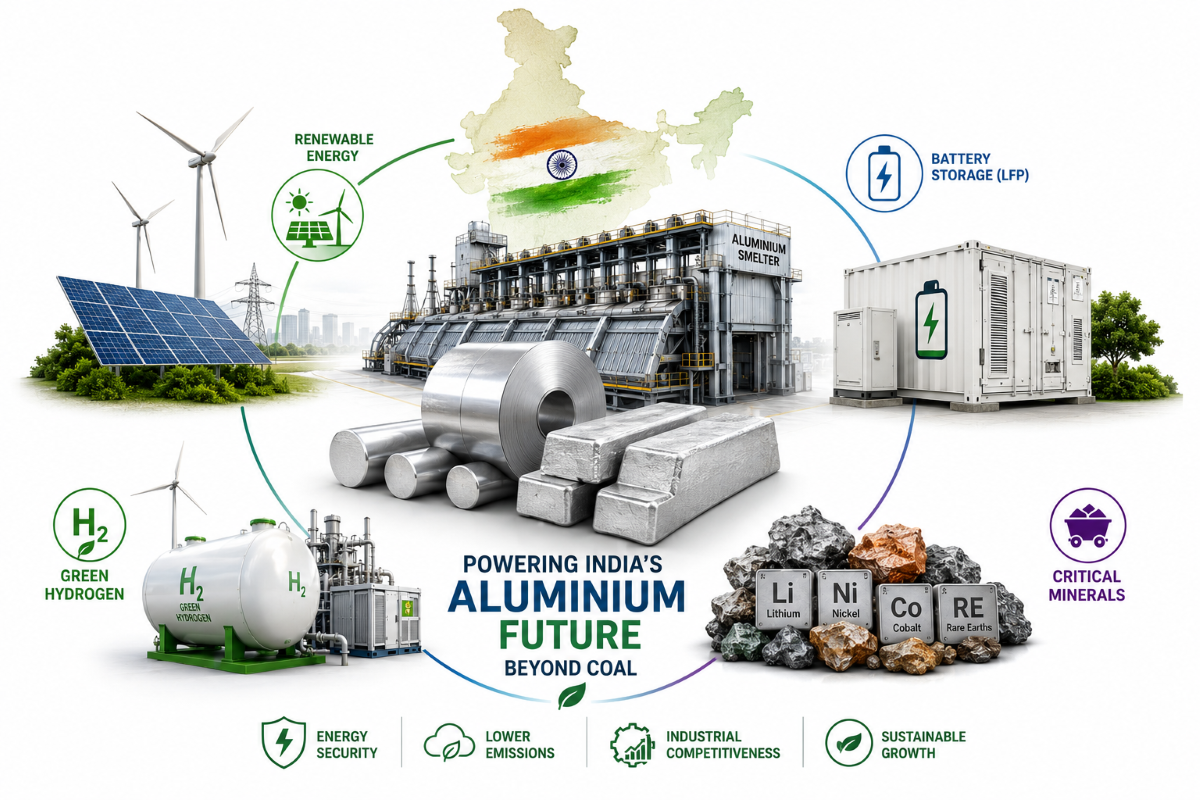
The image used in this article is generated with an AI tool and does not depict any real-time moment
Electricity is the backbone of aluminium production, with the Hall-Héroult process ranking among the world's most electricity-intensive industrial activities. Even brief power disruptions can damage electrolytic cells and interrupt production, resulting in long-term financial losses, as the molten metal cools and begins freezing rapidly, halting production for months.
To minimise dependence on unstable grids, aluminium producers traditionally invested in captive thermal power plants. Recently, growing decarbonisation commitments have encouraged companies like Vedanta Limited, Hindalco, National Aluminium Company (NALCO), Norsk Hydro and Emirates Global Aluminium (EGA) to solidify a renewable energy base alongside captive generation.
Renewable energy’s contribution to meeting India’s power demand marks a year-on-year rise, climbing from 15.1 per cent in 2024 to 15.4 per cent in 2025.
As of FY2024, the aluminium industry's total installed renewable energy capacity exceeded 642 MW. Solar power accounted for over 50 per cent of the overall capacity. Vedanta leads this with 395 MW, NALCO accounts for 198 MW, and Hindalco for 49 MW.
Yet neither approach fully guarantees round-the-clock energy availability. Captive coal-fired plants remain exposed to fuel shortages, maintenance shutdowns and equipment failures, while solar and wind generation fluctuate with weather conditions.
Against this backdrop, energy storage and alternative fuels are emerging as complementary solutions rather than competing technologies. India's expanding lithium iron phosphate (LFP) battery ecosystem and green hydrogen ambitions are increasingly viewed as strategic assets that can strengthen industrial energy security.
Discover: The Gulf aluminium market risks, China impact, alumina supply, carbon costs, and logistics disruptions shaping pricing and trade in Gulf Disruption Roadmap
LFP batteries could make renewable power more dependable
Battery Energy Storage Systems (BESS), especially those based on LFP chemistry, are expected to bridge this gap by storing surplus renewable electricity and supplying it when demand remains high.
The policy environment is also moving in the same direction. India's Production-Linked Incentive (PLI) scheme for Advanced Chemistry Cell (ACC), launched in 2021 with an outlay of INR 181 billion (USD 1.89 billion), aims to establish 50 GWh of battery manufacturing capacity.
Encouraging local production of advanced batteries, the programme is expected to reduce import dependence while strengthening the country's energy storage ecosystem, an important development for energy-intensive industries seeking greater renewable power reliability.
Mourya Sunkavalli, Founder and Managing Director of Altmin, believes the country's battery ecosystem is approaching a commercial turning point.
“The Gigafactory is slated to begin production at 10,000 MTPA for FY26-27, which translates to 4 GWh,” with an ultimate goal of reaching 100,000 MTPA of LFP cathode active material, catering to “nearly 30 per cent of India's projected demand.”
The significance for aluminium producers extends beyond battery manufacturing. As India's LFP ecosystem matures, large-scale energy storage could allow renewable electricity to be dispatched more consistently, reducing reliance on coal-based captive generation while improving operational flexibility.
While India gears up for a decarbonised domestic as well as industrial setup, the transition from exhaustible to stable renewable sources will take time.
Hydrogen addresses the industry's thermal energy challenge
The importance of green hydrogen “in replacing the heat supplied by fossil fuels, such as natural gas, in aluminium production” is pointed out by Sachin Chugh, Vice President at Arup and Vice President of the Hydrogen Association of India.
“For processes that rely on direct electricity, approximately 13 to 15 megawatt-hours of electricity are required to produce one tonne of aluminium,” he noted, emphasising that “hydrogen will not replace electricity.” Instead, “renewable energy can replace fossil-based or grid-supplied electricity.”
He regarded hydrogen’s prominent role in “secondary aluminium production, particularly in recycling furnaces, where aluminium scrap is melted using high-temperature thermal energy.”
Storage will determine the success of industrial decarbonisation
Renewable electricity alone cannot meet the continuous energy requirements of energy-intensive industries. Chugh believes the solution lies in integrating multiple storage technologies with renewable generation rather than relying on a single source of power.
India's renewable energy expansion is already creating the foundation for such integration. Rajasthan and Gujarat lead in solar and wind energy, respectively, while Tamil Nadu and Karnataka continue expanding wind and solar capacity. Maharashtra is simultaneously expanding bio-energy and green industrial infrastructure.
Despite these additions, renewable energy intermittency reiterates the need for large-scale energy storage for industries like aluminium.
“Technologies such as pumped hydro storage and battery energy storage systems” and policy initiatives such as Renewable Energy Around the Clock (RE-RTC) and Firm and Dispatchable Renewable Energy (FDRE), specifically designed to deliver reliable renewable electricity for heavy industries, are being explored.
Combined, batteries and hydrogen are becoming increasingly complementary. While battery storage strengthens the reliability of renewable electricity required for electrolysis, hydrogen offers a pathway to replacing fossil fuels wherever industrial heat remains indispensable.
Seamless critical mineral supply for seamless power generation
The success of this transition, however, also requires secure supplies of the critical minerals that enable batteries, hydrogen systems, electric motors and renewable infrastructure.
Recognising this, the Government of India has introduced new policy interventions to strengthen the domestic critical minerals ecosystem. The National Critical Mineral Mission (NCMM), supporting exploration, mining, and processing, seeks to secure long-term supplies of strategic minerals essential for batteries, renewable energy technologies and advanced manufacturing.
Complementing this, amendments to the Mines and Minerals (Development and Regulation) Act and the introduction of exploration licence auctions are intended to accelerate mineral discovery while encouraging greater private investment in the sector.
Rajnish Khale, Executive Director (Technical) at IREL (India) Limited, believes India has made progress in producing rare earth oxides.
However, “The value chain beyond the oxides is absent, while there is an end-user industry. For example, RE permanent magnets, catalysts and polishing powders—the midstream supply chain is absent.”
He described rare earth elements as performance enhancers that are indispensable to clean energy technologies, forming “the backbone for e-mobility, wind energy, robotics and other industrial applications; are about 50 times stronger than ordinary ferrite magnets.”
While even duty exemptions on critical minerals and the recent Rare Earth Corridors might strengthen domestic capabilities, Khale believes the ecosystem is still evolving.
But since “India has only recently initiated the process of bridging the value chain gap,” Khale remains confident that “…in the next three to five years we will see visible progress towards meeting our requirements of rare earth end products.”
Demand for critical minerals will accelerate sharply
As India's energy transition gathers pace, demand for critical minerals is expected to expand rapidly.
Dr Deependra Singh, former Chairman and Managing Director of IREL (India) Limited, estimates that by 2040, “India is likely to witness a 4–6x increase in critical mineral consumption.”
He attributes this growth primarily to electric mobility, battery energy storage, renewable energy expansion and broader industrial electrification, with electric vehicles and storage expected to account for nearly 60-65 per cent of future demand.
To support that, recent amendments to India's mining concession rules represent “a structurally significant shift from a restrictive licensing regime to a more facilitative, production-oriented framework for critical minerals.”
The government’s revised mining rules, allowing lease expansion by up to 10 per cent for mining leases and 30 per cent for composite licences, are expected to accelerate project development.
Nonetheless, domestic production is unlikely to keep pace with future consumption. Hence, expansion and acceleration in processing, refining and recycling become essential factors in India's long-term critical minerals strategy.
In a nutshell, the aluminium industry’s transition towards cleaner production exceeds the limits of replacing coal with renewable electricity. Reliable renewable power, grid-scale battery storage, green hydrogen, and secure critical mineral supply chains gain increasing prominence as interdependent components of the same industrial ecosystem.
Rather than replacing conventional energy systems overnight, these parallel developments are expected to shape a more resilient, flexible and lower-carbon aluminium value chain, one capable of supporting India's Net Zero ambitions without compromising the continuous energy supply that aluminium production demands.
Unlock key insights from leading companies and experts across the aluminium ecosystem with our e-Magazine - Mine to Market: ALuminium Producers & Manufacturers 2026
China prebaked anode prices set to trade sideways in H2 on ample supply, firm demand
Next articleUSA Rare Earth produces commercial-grade rare earth oxides from recycled magnet scrap
Grow with
AL Circle