Aluminium extrusions: Quenching the thirst for ‘Green Metal’ among manufacturing sectors
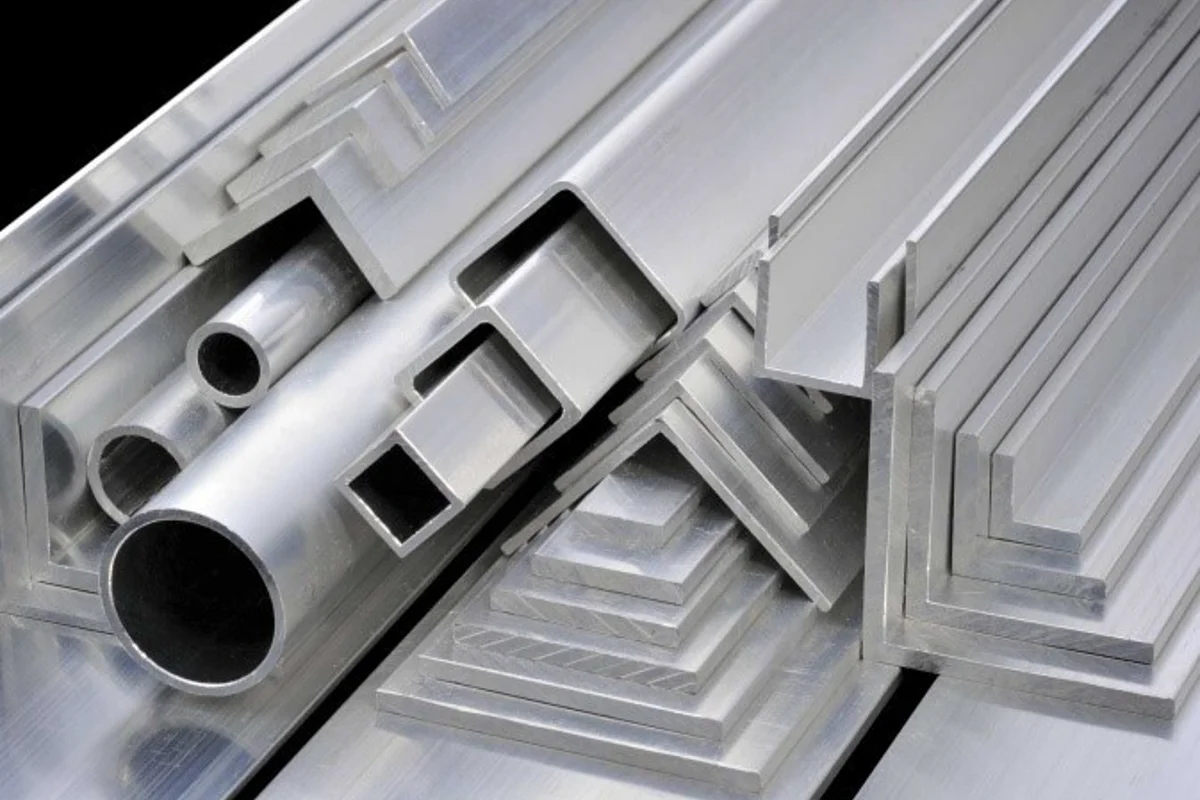
It is no secret that aluminium is now a popular choice of metal in architectural, automotive, electronics, aerospace, energy, and other industries. But do you know which form of aluminium is used in these industrial sectors? Yes, aluminium extrusions, which are created by extruding aluminium through a die to create complex shapes, making the metal versatile for numerous applications.
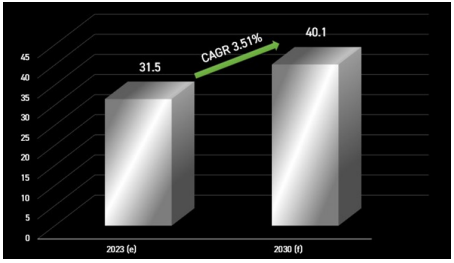
Driven by a deliberate transition towards a 100% recyclable metal to promote sustainability, the demand and use of aluminium extrusions in end-user products is on a steady rise. In 2023, the estimated usage of aluminium extrusions stood at 31.5 million tonnes, and with the growth projection, it is expected to reach 40.1 million tonnes by 2030, marking a CAGR of 3.51 per cent.
World aluminium extrusions usage, 2023-2030 (in million tonnes)
Source: AL Circle research estimate
Interestingly, extrusion stands out as the most widely used form of semi-finished aluminium globally, representing 32.12 per cent of usage in 2023. It is followed closely by flat-rolled products at 31.8 per cent, castings at 22.73 per cent, and wire rod at 8.25 per cent.
The building & construction sector primarily drives the usage of aluminium extrusions worldwide, contributing 55 per cent to the global usage, followed by transportation, accounting for 18 per cent. With the shift in market dynamics, aluminium extrusions usage in the building & construction sector is expected to reduce by 1 per cent, reaching 54 per cent by 2030, followed by transportation (19 per cent).
The industrial sector also consumes a substantial volume of aluminium extrusions, accounting for 10 per cent of the worldwide usage. In the industrial sector, particularly solar industry, contributes to the maximum usage of aluminium extrusions. On average, manufacturing 1 MW of photovoltaic capacity necessitates 21 tonnes of aluminium. So, for manufacturing 1 GW of photovoltaic capacity necessitates 21,000 tonnes of aluminium. As of 2012, concentrated solar power systems used approximately 55,000 tonnes of aluminium per one Gigawatt generated energy, while photovoltaic cells used about 45,000 tonnes of aluminium per Gigawatt generated energy.
Aluminum extrusion usage by regions & product types
The popularity of aluminum extrusions has reached globally and across innumerable industrial sectors. China, popularly the world's largest market of aluminum, is the highest consumer of aluminum extrusions, accounting for 66 per cent, followed by Europe, Rest of Asia Pacific, North America, Middle East & Africa, and South America. Significant growth in China’s economy, particularly in the infrastructure, construction, and renewable energy sectors, and its exports has been the driving force. In line with the anticipated rising demand and consumption in the next few years, China's usage of aluminum extrusions will grow, accounting for 69 per cent.
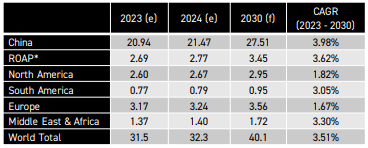
According to AL Circle’s comprehensive report titled “The World of Aluminium Extrusions – Industry Forecast to 2030”, China’s estimated aluminium extrusion sector consumption in 2023 stood at 20.94 million tonnes. In 2024, it is poised to grow to 21.47 million tonnes and by 2030 to 27.51 million tonnes, reflecting a compound growth rate of 3.98 percent. Europe used approximately 3.17 million tonnes of extrusions in 2023, and is expected to use 3.56 million tonnes in 2030, which is an increase at a CAGR of 1.67 per cent. In the Rest of Asia Pacific and North America, aluminium extrusion usage is expected to stand at 3.45 million tonnes and 2.95 million tonnes, growing at a CAGR of 3.62 per cent and 1.82 per cent, respectively.
World aluminium extrusions usage and forecast by region, 2023-2030 (in million tonnes)
Source: AL Circle research estimate
Among the application areas, aluminium extrusion finds its most extensive usage in the building & construction. In 2023, this specific industry accounted for 55 per cent of the total usage of aluminium extrusions across various other sectors, followed by transportation contributing 18 per cent. Other sectors utilising aluminium extrusions include renewable energy, electrical & electronics, industrial, and consumer durables. By 2030, with the expected shift in market dynamics, the usage of aluminium extrusions in the transportation sector is likely to grow by 1 per cent, while in the building and construction sector is estimated to drop by 1 per cent.
World aluminium extrusions usage
As of 2023, amid huge demand for aluminium extrusions worldwide, the usage stood at around 31.5 million tonnes. Of this, China’s aluminium extrusion usage accounted for 66 per cent, equating to about 20.94 million tonnes. There are more than 1,600 extrusion companies across the world. Among them, the names that stand out are China Zhongwang Holdings Limited, Guangdong Fenglu Aluminium, Guangdong Xingfa Aluminium, Nanshan Industrial Aluminium Material, Hydro Extrusion, Constellium, , Kaiser Aluminum, Hindalco,, Arconic, Alumil S.A., Jindal Aluminium, Press Metal, Hulamin, Gulf Extrusions, and many others.
Selected major aluminium extrusion companies across the world
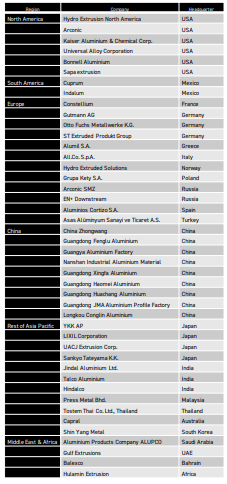
Note: some of the above companies have plants at multiple locations across the world
Source: Industry publication
World aluminium extrusions capacity and production
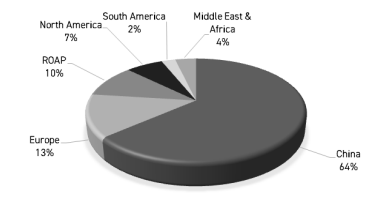
In 2023, aluminium extrusions capacity across the world stood at around 49 million tonnes per annum. Of this, Chinese extruders accounted for about 64%, equating to about 31.07 million tonnes. Aluminium extruders around the world are beginning to show preference for billets made from “cleaner” energy (“green billets”) and billets produced using post-consumer scrap. Extruders are also installing larger extrusions presses.
In 2022, China added 1.1 million tonnes of aluminium extrusion capacity, and projections indicate that an additional 0.8-1 million tonnes were online in 2023.
According to the Shanghai Metals Market, China’s aluminium extrusion exports amounted to 990,800 tonnes in 2023, registering an increase of 42,800 tonnes year-on-year.
World aluminium extrusions capacity across regions, 2023
Source: Industry publications / company annual reports
Aluminium usage by end-user sectors: Region-wise
China
There are more than 500 aluminium extrusion companies in China. Aluminium extrusion usage in China is estimated at 20.94 million tonnes in 2023, and demand is expected to grow in the coming years. China's largest manufacturer, Zhongwang, produces around 850,000 tonnes annually. The usage of aluminium extrusions in China is likely to grow at a CAGR rate of 3.98 per cent, reaching close to 27.5 million tonnes by 2030.
China: Forecast of aluminium extrusions usage, 2023-2030 (000 tonnes)

Source: AL Circle estimate
The building & construction sector is the major end-user of aluminium extrusions in China, accounting for about 57% - 60% of the total extrusions usage, followed distantly by the transportation sector at 15% - 16%. In 2024, China’s building & construction sector is anticipated to consume 12.454 million tonnes of aluminium extrusions, and it is likely to grow to 15.408 million tonnes. In the transportation sector, the usage of aluminium extrusions is expected to reach 4.677 million tonnes by 2030, from an estimated usage of 3.436 million tonnes in 2024.
North America
In 2023, North America’s usage of aluminium extrusion reached an estimated 2.60 million tonnes. Around 160 aluminium extrusion companies are operating in North America. The market is dominated by Hydro Extrusion North America, followed by Arconic, and Kaiser Aluminum. Some extrusion companies across North America have either recently undergone expansion or have imminent plans for growth. In recent times, there has been a noticeable surge in attention to producing and utilising recycled aluminium billets.
North America: Forecast of aluminium extrusions usage, 2023-2030 (000 tonnes)

Source: AL Circle estimate
The transportation industry leads the usage of aluminium extrusions in North America, poised to grow at a CAGR of 2.71 percent from 2023 to 2030 to reach 1.03 million tonnes. The building and construction sector is the second largest consumer of aluminium extrusions in North America, with usage expected to grow to 910,000 tonnes at a CAGR of 1.12 per cent, followed by industrial, which will stand at 328,000 tonnes at a CAGR of 1.38 per cent.
Europe
Usage of aluminium extrusions in the European region is estimated at around 3.17 million tonnes in 2023 which is expected to reach 3.56 million tonnes by 2030. EU’s strict targets towards carbon emissions will be the key driver for aluminium extrusion demand in the coming years. While the current geopolitical tensions in the region may impact the aluminium extrusions demand in the short run (due to supply chain, fuel, and other issues), the region’s move towards energy independence is likely to accelerate the demand for extrusions in the mid to long run.
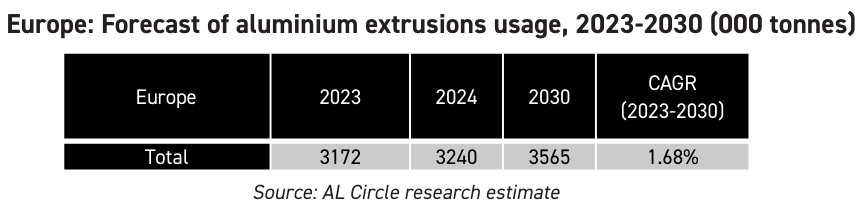
Aluminium extrusions usage in the building & construction sector in the European region accounted for about 46% of the total usage in the region followed by the transportation sector at 29%.
Rest of Asia Pacific (ROAP)
The Rest of the Asia Pacific region accounts for about 8.54% of the global aluminium extrusions usage, equating to a volume of 2.69 million tonnes in 2023. The usage is forecast to reach 3.45 million tonnes by 2030 growing at a CAGR of 3.61%.
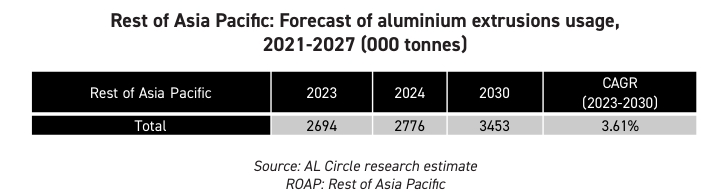
Building & construction is the major end-use sector for aluminium extrusion applications in the Rest of the Asia Pacific, accounting for about 57% of the region’s usage, followed distantly by the transportation and industrial sectors. By 2030, aluminium extrusions usage in the building & construction sector is expected to climb to 1.898 million tonnes at a CAGR of 3.07 per cent and that in transportation is anticipated to elevate to 614,000 tonnes at a CAGR of 5.18 per cent.
Middle East & Africa
Aluminium extrusions usage in the Middle East & African region is estimated at around 1.37 million tonnes in 2023 which is forecast to grow at around CAGR of 3.30% to reach more than 1.72 million tonnes by 2030.
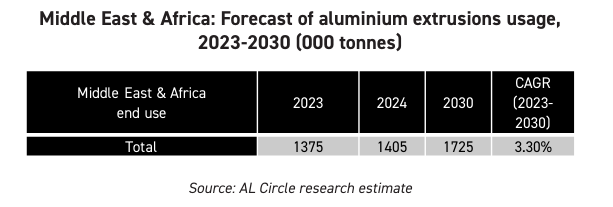
With leading construction markets including Saudi Arabia and UAE in its fold, the construction sector accounts for the bulk of the aluminium extrusions usage in the region. By 2030, aluminium extrusions usage in the MEA’s construction sector is estimated to reach 1.397 million tonnes. In recent years, usage of aluminium extrusions in MEA’s electrical and industrial sectors has picked up the pace with increasing investments in solar power and diversified investments in various manufacturing sectors, driving the usage to 70,000 tonnes and 98,000 tonnes, respectively.
In the dynamic and ever-evolving landscape of the aluminium extrusion industry, technology plays a pivotal role, remaining at the forefront of innovation. Some groundbreaking advancement in extrusion technologies is pushing the boundaries of what’s possible, unlocking new potentials in design, efficiency, and sustainability.
Spotlight on extrusion technologies
Nano-coating technologies: There have been some recent developments in nano-coating technologies that have revolutionised the durability of aluminium extruded profiles. Ultra-thin coatings of aluminium profiles provide an extra layer of protection against corrosion and abrasion, significantly extending the lifespan of extruded products.
Precision control through artificial intelligence: The integration of artificial intelligence (AI) has brought in a new method of precision control. With the help of AI algorithms, real-time data of extrusion machinery is monitored, allowing for immediate intervention if required to ensure each profile meets exact specifications. This not only enhances product quality but also contributes to resource efficiency.
Hybrid extrusion techniques: Hybrid extrusion techniques have been developed to address the demand for aluminium profiles with enhanced strength and formability. The techniques optimise extrusions’ properties, opening up new possibilities for applications in aerospace, automotive, and other industries where strength and malleability is critical.
Customisation through 3D printing: The implementation of 3D printing technology in aluminium extrusion process allows customisation and tailored designs, allowing architects, engineers, and designers to turn their visions into reality.
The rapid advancement of technology has brought a great evolution in aluminium extrusions in terms of design and efficiency, driven by a commitment to excellence, sustainability, and innovation.
Note: This report utilises data meticulously reviewed and corroborated from various sources, including company websites, financial reports, research agencies, industry leaders' predictions, relevant industry journals, and news. Additionally, estimates were calculated by AL Circle research based on the mentioned comprehensive information.
Unlock full access – sign up for FREE.
Key benefits
Crystal IS achieves milestone with 100 mm single-crystal AlN substrates for UVC LEDs
Next articleEurozone industrial growth stalls amid rising tariff concerns
Grow with
AL Circle