AI in aluminium smelters: Is your smelter’s digital twin about to fail?
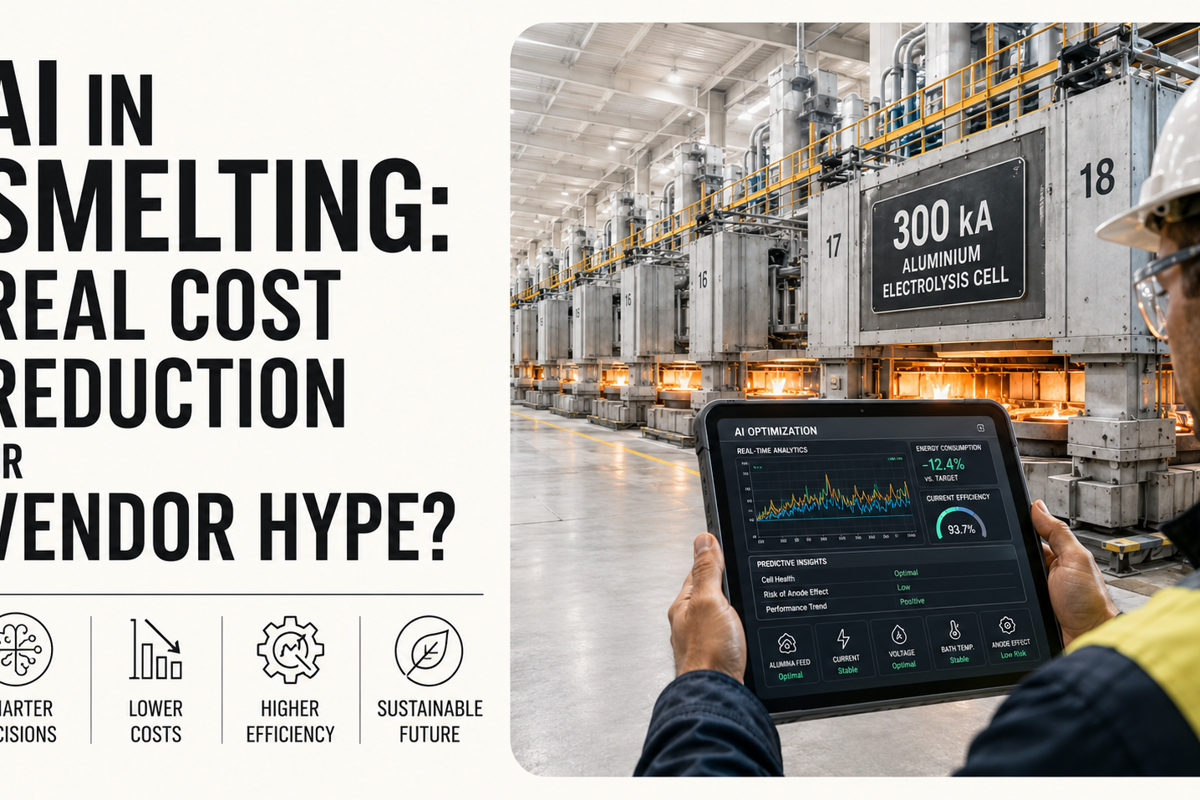
The image used in this article is generated with an AI tool and does not depict any real-time moment
EXECUTIVE SUMMARY:
- The financial reality: In an industry where electricity constitutes 35 per cent of total operating costs, a mere 1 per cent AI-driven reduction in specific power consumption yields an immediate USD 4 million to USD 5 million in annual savings for a one-million-tonne smelter.
- The "Black Box" trap: Relying on opaque deep-learning algorithms is dangerous. The industry is pivoting to "Explainable AI" (XAI), which provides transparent reasoning for predictive maintenance, achieving verifiable ROI in under 3 months.
- The vendor hype: Software vendors routinely underestimate the brutal physical realities of the potroom. Digital twins will suffer from catastrophic model drift and hardware failure if sensors are not engineered to survive 950°C temperatures, corrosive alumina dust, and 800 Gauss magnetic fields.
The primary aluminium industry is currently navigating a severe macroeconomic margin trap. Squeezed between the escalating demands of the global energy transition, volatile alumina prices, and punitive carbon taxation regimes like the European Union Carbon Border Adjustment Mechanism (CBAM), plant managers are desperate for cost reductions.
Consequently, the industry is being bombarded with marketing pitches for Artificial Intelligence (AI), machine learning, and "Digital Twins." Software vendors promise double-digit efficiency gains and the complete eradication of unplanned downtime.
However, translating these algorithmic promises into factory-floor reality requires separating the genuine metallurgical breakthroughs from the Silicon Valley hype. To understand exactly how much cost reduction is real, we must first examine the unyielding thermodynamic boundaries of the Hall-Héroult process and the specific, data-backed deployments currently running in modern smelters.
The thermodynamic margin trap
The primary production of aluminium involves dissolving alumina in a molten cryolite bath (Na₃AlF₆) at temperatures approaching 980°C. A massive electrical current is passed through consumable carbon anodes, electrolytically reducing the alumina into liquid aluminium.
The theoretical thermodynamic minimum energy required for this reduction is approximately 6.2 kWh/kg. However, the physical realities of the smelter dictate a different story. Ohmic resistance in the bath, busbar losses, and electrode overpotential push the global industry average significantly higher, typically ranging between 13.5 and 15.0 kwh/kg.
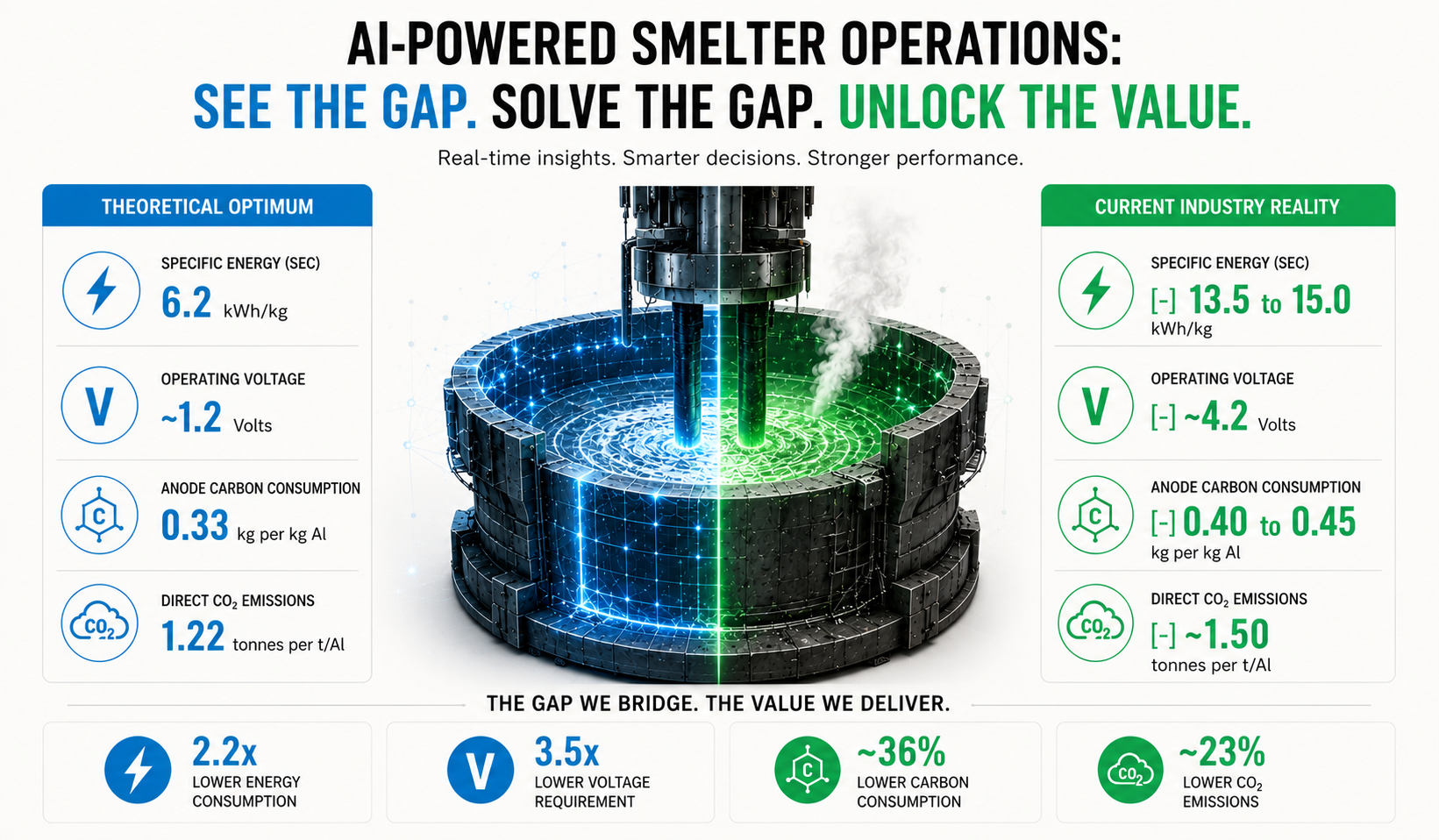 The image used in this article is generated with an AI tool and does not depict any real-time moment
Because electricity accounts for roughly 35 per cent of total production costs, macroscopic profitability hinges entirely on microscopic improvements in current efficiency. This is where AI ceases to be a buzzword and becomes a financial lifeline.
The verifiable ROI: Explainable AI and Pot control
The fundamental architecture of a smelter potline makes it exceptionally vulnerable to cascading inefficiencies. A single malfunctioning cell degrades the efficiency of the entire line, often manifesting as an "anode effect", which spikes voltage and evolves highly potent perfluorocarbon (PFC) greenhouse gases like tetrafluoromethane (CF₄) and hexafluoroethane (C₂F₆).
To combat this, the industry is moving beyond standard "black-box" deep learning models, which fail to provide engineers with the logical reasoning behind their predictions. Instead, smelters are successfully deploying rule-based explainable AI (XAI) approaches to optimise the electrolysis process.
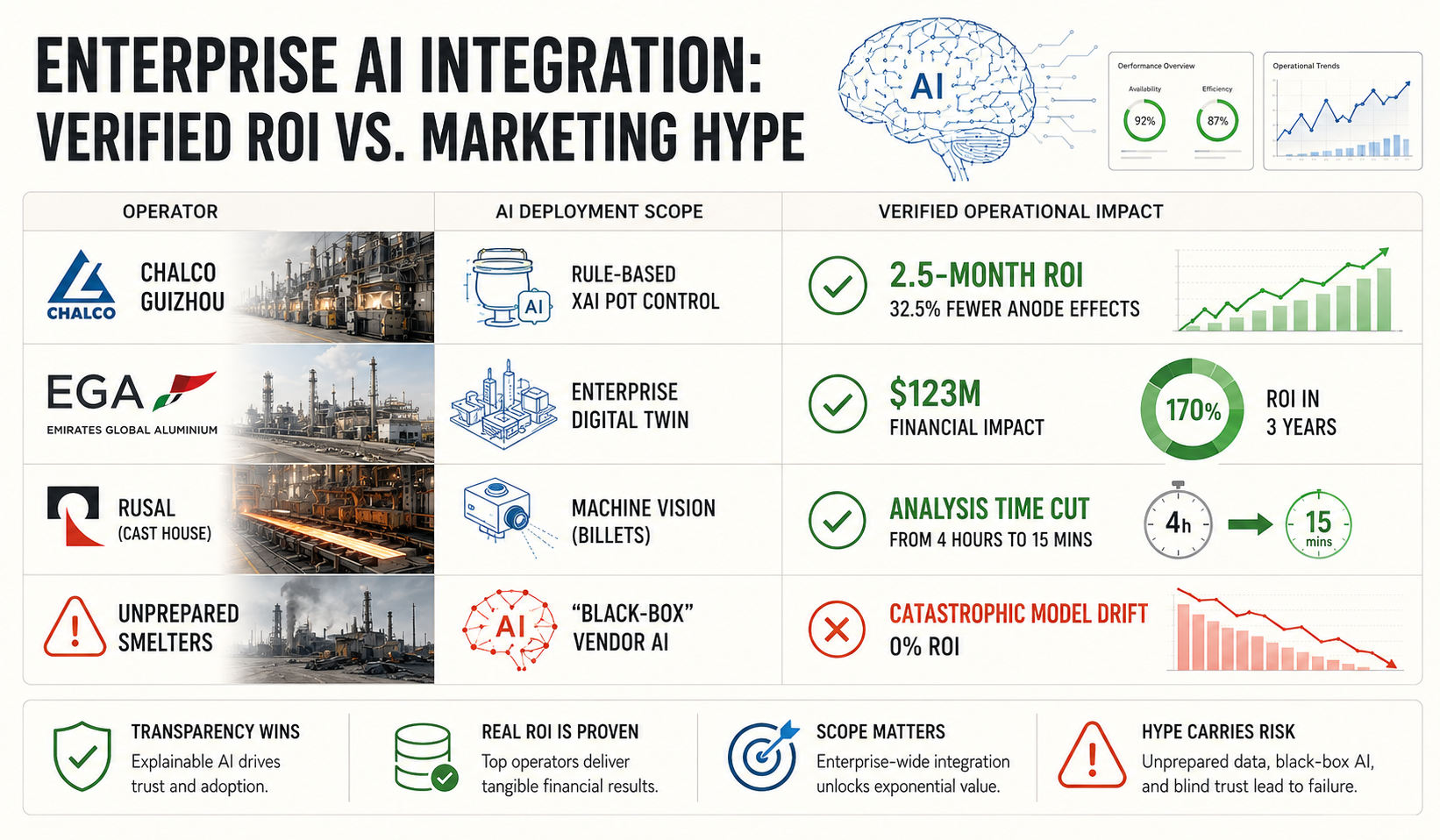
A landmark field implementation of an expert diagnostic system on 230kA reduction cells at the Chalco Guizhou Branch proved the immense value of XAI. By utilising hybrid knowledge representation operating over OPC UA and Modbus TCP protocols, the system achieved a 94.2 per cent diagnostic accuracy. During six months of continuous operation, this system delivered sustained energy savings of 137kWh/t and reduced anode effect frequency by 32.5 per cent. Financially, this translated to comprehensive annual benefits of 333,714 CNY per cell, achieving a total return on investment (ROI) in a mere 2.5 months.
Unlock key insights from leading companies and experts across the aluminium ecosystem with our e-Magazine - Mine to Market: ALuminium Producers & Manufacturers 2026
The computer vision revolution: inspecting the anode
Cost reduction via AI is not limited to thermal modelling; it is actively reshaping hardware inspection. Ensuring that the consumable carbon anode fits perfectly into the cell is critical for maintaining current distribution.
If an anode rod contains severe toe-in, missing stubs, or retained thimbles, it will not fit the stub holes of a new carbon block. The traditional manual detection method is time-consuming, highly subjective, and frequently leads to severe production bottlenecks.
To solve this, advanced smelters are now deploying deep-learning algorithms, specifically the Fast Region-based Convolutional Network (Fast R-CNN) model, for automatic anode rod inspection. These computer vision models are trained to simultaneously detect multi-class shape defects in near real-time. By automatically flagging defective rods before they reach the rodding room, smelters eradicate the costly downtime associated with assembly mismatch.
Overcoming the sensor survival challenge
While algorithms like Fast R-CNN and XAI are highly advanced, their efficacy relies entirely on the continuous ingestion of high-fidelity telemetry. In an aluminium smelter, acquiring this data is a monumental physical challenge.
Ambient upper-structure temperatures reach 70℃, and the electrolysis process generates massive electromagnetic fields exceeding 800 Gauss near the anode busbars. These fields warp traditional electronic signals, rendering standard wired sensors virtually useless.
To circumvent electromagnetic interference and monitor the critical temperature of cathode steel bars (where abnormal heat spikes often precede catastrophic furnace leakage), operators are deploying Distributed Optical Fiber Sensors (DOFS) integrated with Stacking Ensemble Learning. Using algorithms like CatBoost, LightGBM, and Random Forest, this system achieves continuous temperature data acquisition with an error margin of less than 2.1℃. Crucially, by utilising light rather than electricity for data transmission, the system is entirely immune to the 800 Gauss magnetic field, allowing it to proactively identify abnormal temperature rises and reduce early-warning times by 85 per cent compared to manual inspections.
Enterprise scale and cast house automation
The profound financial impacts of automation multiply when scaled into an enterprise-wide digital fabric, connecting the smelting potline directly to downstream processing.
Recent analyses of energy efficiency using Manufacturing Execution Systems (MES) and IoT architecture confirm that continuous, automated data collection is the only way to establish accurate regression analyses between production output and energy consumption.
This automation is now entering the cast house. RUSAL’s Engineering and Technology Center recently revolutionised billet quality assessment by implementing AI-driven machine vision. Extrusion billets made from 6xxx series alloys require rigorous microstructural assessment. Traditional manual analysis methods can take up to four hours. RUSAL’s new neural network model cuts this analysis time down to just 15 minutes while eliminating human error.
The image used in this article is generated with an AI tool and does not depict any real-time moment
By integrating these disparate systems, operators like Emirates Global Aluminium (EGA) and Vedanta are realising massive returns. EGA’s deployment of over 80 customised AI use cases generated more than USD 123 million in value, while comprehensive state-of-the-art reviews on AI in metallurgical operations continuously confirm that AI-driven process optimisation and predictive maintenance fundamentally reshape the carbon footprint and profitability of the modern plant.
The vendor hype: Model drift and technostress
Despite these verifiable successes, the narrative surrounding AI in heavy metallurgy suffers from intense vendor hype.
The most insidious hidden cost is model drift. A digital twin is an executable mathematical model. However, physical assets degrade; carbon anodes erode, and thermal insulation fails. If the digital twin is not continuously recalibrated by skilled data scientists to reflect these microscopic physical changes, the virtual model drifts out of synchronisation with reality, triggering false alarms and prescribing incorrect dosing rates.
Furthermore, introducing complex autonomous systems frequently causes "technostress" among frontline workers. AI platforms imposed on a potroom without a corresponding investment in human change management and retraining routinely fail to generate their projected ROI.
Automation is no longer a theoretical exercise for the aluminium industry; it is a competitive prerequisite for survival. The digital infrastructure being deployed today to manage incremental efficiency gains inspects anode rods, and monitor cathode temperatures will serve as the mandatory operating system for the zero-carbon smelters of tomorrow.
Note: This is exclusive coverage by AL Circle and may not be reproduced, republished or shared without prior permission.
Disclaimer: The opinions, information, claims, references, and images presented here are those of the author alone and AL Circle holds no responsibility.
Trump warns of up to 200% import tariffs, highlights Oklahoma aluminium plant project
Next articleCrisis-risk rates near 3% as US-Iran conflict puts 6.16 Mt GCC aluminium industry back on Hormuz watch
Grow with
AL Circle