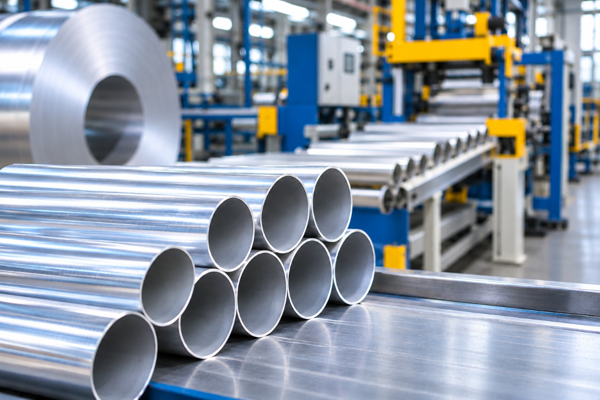
Egyptian aluminium tubes manufacturer National Company for Aluminium Tubes Manufacturing (TUBE) is set to expand its production capacity and strengthen its export operations with financing of up to EGP 500 million (USD 9.3 million) from the European Bank for Reconstruction and Development (EBRD) and Emirates NBD Egypt. The senior secured loan will fund the purchase and installation of new machinery and equipment, allowing the company to increase output, diversify its product portfolio and improve its environmental performance. The investment is also expected to support the manufacturer's export growth and strengthen its position in the packaging sector. The financing marks the EBRD's first investment in Egypt under a USD 25 million risk-sharing facility signed with Emirates NBD Egypt in...
LME aluminium cash prices increased on November 18, 2026, while three-month and December 27 contracts recorded declines compared with the previous trading day, November 17. The cash bid price rose by 1.11 per cent to USD 3,094 per tonne , from USD 3,060 per tonne, while the cash offer price increased by 1.13 per cent to USD 3,095 per tonne from USD 3,060.5 per tonne. In contrast, LME aluminium three-month prices moved lower. The three-month bid price declined by 2.52 per cent to USD 2,864 per tonne on November 18, compared with USD 2,938 per tonne on November 17. Similarly, the three-month offer price fell by 2.55 per cent to USD 2,865 per tonne from USD 2,940 per tonne. The December 27 contract also registered a decline. Its bid price decreased by 1.59 per cent to USD 2,793 per tonne...
Grow with
AL Circle

Alcoa Corporation expects alumina shipments from its Pinjarra refinery in Australia to decline by about 120,000 tonnes in the second quarter compared with the first quarter, following disruptions caused by Cyclone Narelle. Speaking at the Wells Fargo Industrials & Materials Conference in Chicago, Alcoa Chief Financial Officer Molly Beerman said the cyclone, which struck Australia in March, disrupted liquefied natural gas supplies to the company's Pinjarra alumina refinery. The Pinjarra facility has an annual alumina production capacity of 4.7 million tonnes. According to Beerman, the disruption is expected to increase second-quarter production costs at the refinery by about USD 30 million. Alcoa is also facing higher costs at its Sao Luis alumina refinery in Brazil. Beerman said the...

Novelis has commissioned an electric pusher furnace at its aluminium plant in Sierre, Switzerland, marking a new step in the company's decarbonisation plans. The furnace is used to heat aluminium ingots before they are rolled into finished products. Until now, the process relied on natural gas, but the new system runs on electricity supplied through Switzerland's power network. According to the company, the switch is expected to cut carbon emissions by around 4,500 tonnes per year. Novelis also expects the furnace to use about 25 per cent less energy than the gas-fired equipment it replaces. The project grew out of the Net Zero Lab Valais initiative, which Novelis launched in 2022 with local energy company OIKEN, HES-SO Valais-Wallis and EPFL. The programme focuses on finding ways to...

The Baltic Exchange's Dry Bulk Index edged lower on Wednesday, ending a recent run of gains as weaker performance in the Capesize segment put pressure on freight rates. The main index, which tracks shipping costs for dry bulk commodities, fell 47 points, or 1.7 per cent, to 2,771 points. The decline was driven by the Capesize market, where rates softened during the session. Explore: The most comprehensive and forward-looking industry-focused report – Global Bauxite & Alumina Market Forecast to 2036: Supply–Demand, Trade Flows & Price Outlook The Capesize index dropped 140 points, or 3.2 per cent, to 4,301 points. Average daily earnings for Capesize vessels also declined, falling by USD 1,267 to USD 35,504 per day. Capesize ships are typically used to transport large volumes of commodities...

Irish authorities are reviewing reports that alumina exports from the Russian-owned Aughinish Alumina refinery could have indirectly reached entities linked to Russia's defence industry, adding to calls for tighter oversight of strategic material supply chains. The issue has also brought renewed attention to official trade data. Earlier this month, The Irish Times reported that 83 per cent of Irish alumina exports in the first quarter of 2026 were shipped to Russia, citing figures from the Central Statistics Office (CSO). However, Ireland's Enterprise Minister Peter Burke later said the data was inaccurate, explaining that the actual distribution was closer to 45 per cent of exports going to Russia and around 45 per cent to the EU and other international markets. Explore: The most...

What began as a routine scrap movement operation at construction sites in Maharashtra has turned into a tale involving hidden sand compartments, manipulated weight records and 21 tonnes of missing aluminium scrap. Police in Thane have registered a case against three individuals, including the owner of a scrap firm, a supervisor and a vehicle driver, for allegedly orchestrating a scheme that diverted aluminium scrap worth INR 4.6 million (USD 54,000) from construction sites linked to a prominent real-estate developer. According to investigators, the alleged fraud revolved around a specially modified vehicle. “The vehicle's gross weight was recorded on the weighbridge with sand in the hidden compartment. The sand was later discharged through a hole beneath the box at an unknown location”...

The European aluminium industry has renewed its call for stronger safeguards to protect aluminium scrap and shield Europe from the incomplete framework of the Carbon Border Adjustment Mechanism (CBAM). As the European Union finance ministers prepare to finalise their position on revisions to the CBAM, European Aluminium strongly warns that the existing framework still falls short of protecting the sector from carbon leakage. The industry body European Aluminium welcomed recent progress in the draft Council General Approach, especially the proposals to broaden CBAM coverage to additional downstream aluminium products and strengthen anti-circumvention provisions under Article 27a. However, it cautioned that key weaknesses remain unresolved and could undermine the mechanism’s effectiveness...

A rise in energy costs and disruption to one of the world’s most important shipping routes are creating fresh challenges for Alcoa, with the company warning that the impact will be felt in its results for the current quarter. The concern centres on the alumina business, which supplies the raw material used to produce aluminium. Speaking at the Wells Fargo Industrials & Materials Conference, Chief Financial Officer Molly Beerman said the division is facing significant pressure and is expected to remain unprofitable during the quarter. Her comments unsettled investors, sending Alcoa shares lower. The financial impact is already becoming clear. Alcoa estimates that its São Luís refinery in Brazil will incur around USD 15 million in additional fuel costs. The production expenses are expected...

In today's market, metal prices can shift sharply within days or even within hours, due to the rising uncertainty and market volatility. In this scenario, a recycler may purchase scrap at one price today, commit to a sales contract at another and then find margins being squeezed before the material is even processed. If this is compounded by currency fluctuations, inventory exposure, and delayed price fixation, the financial impact can become significant, and finding the right solution immediately would be required. The reality is that many recycling businesses still operate without a structured approach to managing these risks. Moreover, for many aluminium recyclers, success is measured by operational efficiency, procurement strength and sales performance. Yet one factor often remains...

In the foundational article of this AL Circle exclusive series, we showcased the financial reality awaiting downstream aluminium exporters in 2028 . We established that the European Union Carbon Border Adjustment Mechanism (CBAM) will permanently erase the comfortable illusion of the corporate veil. We concluded with the remark: survival requires tracking and verifying the embedded carbon inherited from every upstream supplier. Today, we confront the exact mechanics of that legacy. During the initial CBAM rollout, regulatory attention focused heavily on the importation of basic upstream commodities. The compliance model for simple goods, like unwrought aluminium, was administratively demanding but fundamentally linear. Importers calculated the emissions of a distinct metallurgical process...

China's alumina industry has been expanding steadily over the past six years. Production has increased from 71 million tonnes in 2020 to around 92.9–94.5 million tonnes in 2025, an overall rise of about 31–33 per cent. But behind every new tonne of alumina lies another, less visible story that begins in the bauxite mines and after the refining process leaves behind a highly alkaline by-product known as red mud. To understand why this residue is becoming an increasingly important issue, it is necessary to look at the raw material that feeds China's refineries. It all starts with the ore Every tonne of alumina begins with bauxite, but the quality of that bauxite determines how efficiently it can be refined and how much waste is left behind. Here, China faces a structural challenge. Only 25...

After Turkey’s move to guard its domestic aluminium foil industry from Chinese dumping , India has decided to extend the anti-dumping duty on aluminium foil imports from China, Indonesia, Malaysia and Thailand until December 15, 2026. The decision was passed as domestic producers like Hindalco Industries Limited and SRF Altech sought the continuation of the levy to safeguard local manufacturers from unfairly priced imports. The move aims to ensure that current trade protection measures remain active while the Directorate General of Trade Remedies (DGTR) under the Ministry of Commerce continues its Sunset Review investigation into imports of "aluminium foil 80 micron and below" originating in, or exported from, the four countries. Explore the accurate insights and forecasts for the...

Russian aluminium strengthened its grip on London Metal Exchange (LME) warehouses in May, with its share of available stocks rising to 93 per cent from 72 per cent in April, according to exchange data. The increase was mainly due to traders withdrawing Indian-origin metal from LME warehouses. Total available, or on-warrant, aluminium stocks on the LME fell 23 per cent during May to 254,625 tonnes and now stand at 250,525 tonnes, the lowest level since May 2025. The decline comes as production and logistical problems in the Middle East continue to tighten global supply. Although Russian aluminium's share increased sharply, the actual volume of Russian metal in LME warehouses fell by 3,950 tonnes to 237,175 tonnes during the month. The bigger change was in Indian-origin aluminium, where...

India's aluminium producers are building smelters, expanding refineries, opening mines and writing investment cheques worth more than INR 640 billion. Yet despite all that activity, the industry faces a rather uncomfortable question: what happens when demand grows faster than capacity can be built? The timing of that question is hard to ignore as domestic aluminium demand is projected to climb from 4.5 million tonnes to 8.3 million tonnes by 2030, while the country is already importing close to 3 million tonnes of aluminium products every year to bridge supply gaps. Industry projections suggest imports could account for nearly 55 per cent of India's requirements in FY2025-26, contributing to a metals trade deficit of roughly USD 3.4 billion, or about INR 300 billion. At first glance, the...

As part of the series, “ The Rise of Global Aluminium Hubs Outside China ”, the first chapter explores India’s emergence as a key player in the global aluminium landscape. Co-authored by two industry experts, Dr. Subodh Das and Mr. Abhijit Pati, the article provides an in-depth assessment of the country’s current status, pressing challenges, and future growth prospects. India stands as the world’s second-largest producer of primary aluminium, contributing roughly 5.5% to 8% of global output, backed by an industrial framework of fully integrated domestic producers and specialised downstream manufacturers. The primary aluminium ecosystem is anchored by national champions NALCO, Hindalco, Vedanta, and BALCO, which command a combined primary smelting capacity of approximately 4.3 million...

Novelis, a globally prominent sustainable aluminium solutions provider and aluminium rolling and recycling firm, has officially announced the restart of its hot mill at its Oswego facility in New York. The earlier-than-expected recovery helped ease concerns over material shortages and production losses across the automotive sector. Following the outage in late 2025, Novelis leveraged its global network of hot rolling and finishing facilities to minimise disruptions and support customer requirements. Cross-team collaborations with customers and industry stakeholders helped sustain supply flows and maintain operational continuity. Commenting on the resumption of operations, Steve Fisher, President and CEO, Novelis, stated, “Restarting the Oswego hot mill is an important step forward for our...

The LME aluminium price graph showed a broadly weaker trend on June 10, with cash, three-month and December 2027 contracts all recording declines compared to the last date. The LME aluminium cash bid price fell to USD 3,488 per tonne on June 10 from USD 3,607 per tonne on June 9, marking a decline of around 3.30 per cent. The LME aluminium cash offer price also decreased by 3.30 per cent to USD 3,489 per tonne on June 10 from USD 3,608 per tonne in the previous session. In the three-month contract, the LME aluminium 3-month bid price stood at USD 3,480.5 per tonne on June 10, down 2.92 per cent from USD 3,585 per tonne recorded on June 9. The 3-month offer price slipped 2.93 per cent to USD 3,481 per tonne from USD 3,586 per tonne. Meanwhile, the December 2027 aluminium contract also...

Europe's aluminium market is facing fresh pressure as higher energy costs and tightening global supply combine to create a more challenging environment for producers and consumers alike. The disruption to shipping through the Strait of Hormuz has raised concerns over energy security, while reduced aluminium availability outside China has kept physical markets tight and premiums elevated. The Strait of Hormuz is one of the world's most important trade routes for oil and liquefied natural gas (LNG). Any disruption to traffic through the waterway quickly feeds into global energy markets, and Europe is already feeling the effects through higher gas and electricity prices. For aluminium smelters, where power is one of the largest operating costs, that creates an additional burden at a time...

The ongoing conflict in West Asia is beginning to raise the cost of India's clean energy transition, with industry executives warning that higher raw material prices and supply chain disruptions are making solar projects more expensive. According to industry estimates, rising prices of aluminium and copper, along with supply constraints affecting key petrochemical raw materials, have pushed up costs across the solar power industry by around 20 per cent. The increase in input costs is putting pressure on project economics, reducing expected returns and increasing financing costs for solar developers, industry executives said. Solar cells have seen some of the steepest price increases. Locally manufactured solar cells are currently priced at around INR 12-14 (USD 0.13-0.15) per watt peak,...