If India's aluminium volume is booked for the next 5 years, will planned expansions change the scenario?
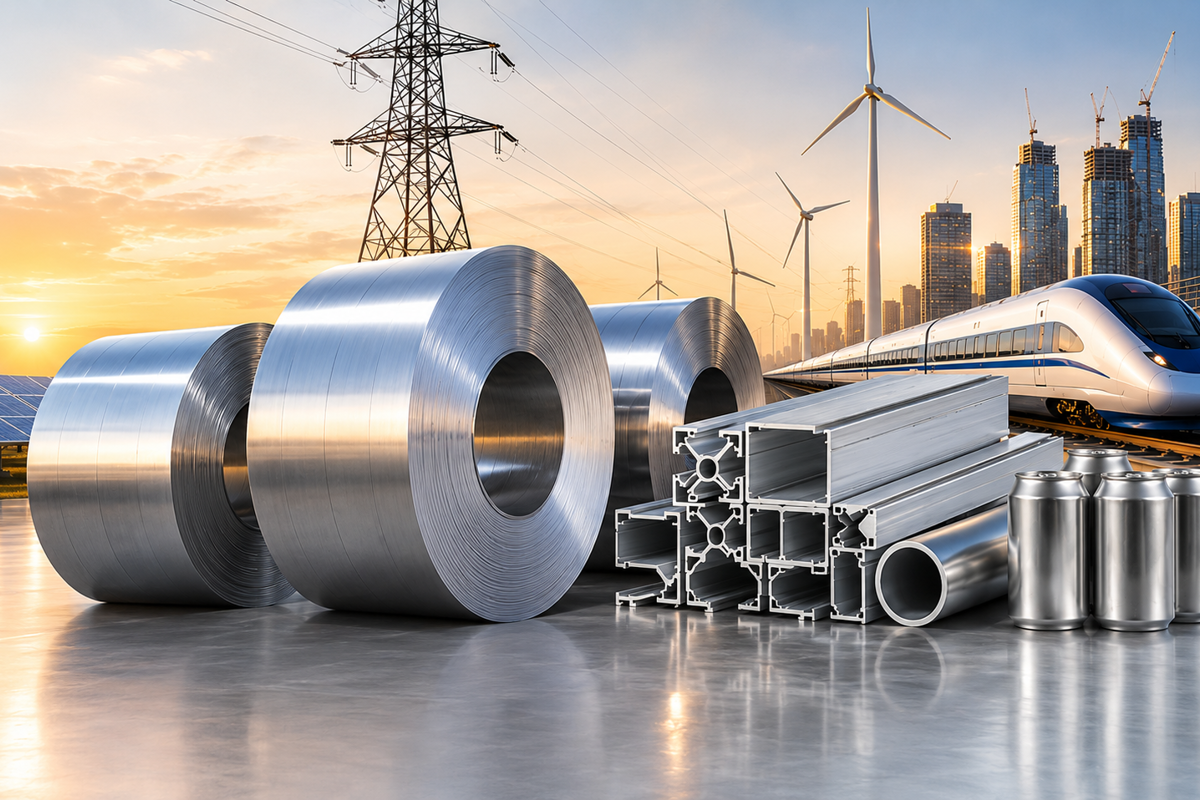
The image(s) used in this article is generated with an AI tool and does not depict any real-time moment
India's aluminium producers are building smelters, expanding refineries, opening mines and writing investment cheques worth more than INR 640 billion. Yet despite all that activity, the industry faces a rather uncomfortable question: what happens when demand grows faster than capacity can be built?
The timing of that question is hard to ignore as domestic aluminium demand is projected to climb from 4.5 million tonnes to 8.3 million tonnes by 2030, while the country is already importing close to 3 million tonnes of aluminium products every year to bridge supply gaps. Industry projections suggest imports could account for nearly 55 per cent of India's requirements in FY2025-26, contributing to a metals trade deficit of roughly USD 3.4 billion, or about INR 300 billion.
At first glance, the solution for the country positioning itself as a manufacturing powerhouse, and battling that size of a bill can seem straightforward. Just produce more metal.
But is India's aluminium story that simple? Demand is now being driven by long-term infrastructure programmes, renewable energy expansion, electric vehicles, urbanisation and industrial growth. These are not sectors that switch direction every few quarters. They are decade-long consumption engines.
That is why many industry participants at times describe India’s aluminium volumes as being effectively "booked" for the foreseeable future.
The market is growing. And it’s growing FAST.
India’s aluminium market is currently valued between USD 11.28 billion and USD 13.77 billion and is projected to reach USD 18.84 billion by 2030. Consumption has expanded at an annual pace of approximately 8 per cent over the past five years, while long-term forecasts suggest domestic demand could eventually touch 37 million tonnes by 2070.
The irony is that India still consumes remarkably little aluminium compared with the rest of the world, wherein per capita consumption remains between 2.2 kg and 3.7 kg, far below the global average of around 8-12 kg.
And that is precisely why producers are nervous and excited at the same time.
Every new highway, railway corridor, solar park, transmission line, metro project, factory and electric vehicle pushes aluminium consumption higher. The industry's challenge is not finding buyers. It is ensuring there is enough metal available when those buyers come knocking.
Get insights on bauxite & alumina supply-demand trends, trade flows, refinery expansions, pricing outlook & geopolitical shifts shaping the global market till 2036 with our curated report
If there is one customer keeping aluminium producers busy, it is the power sector
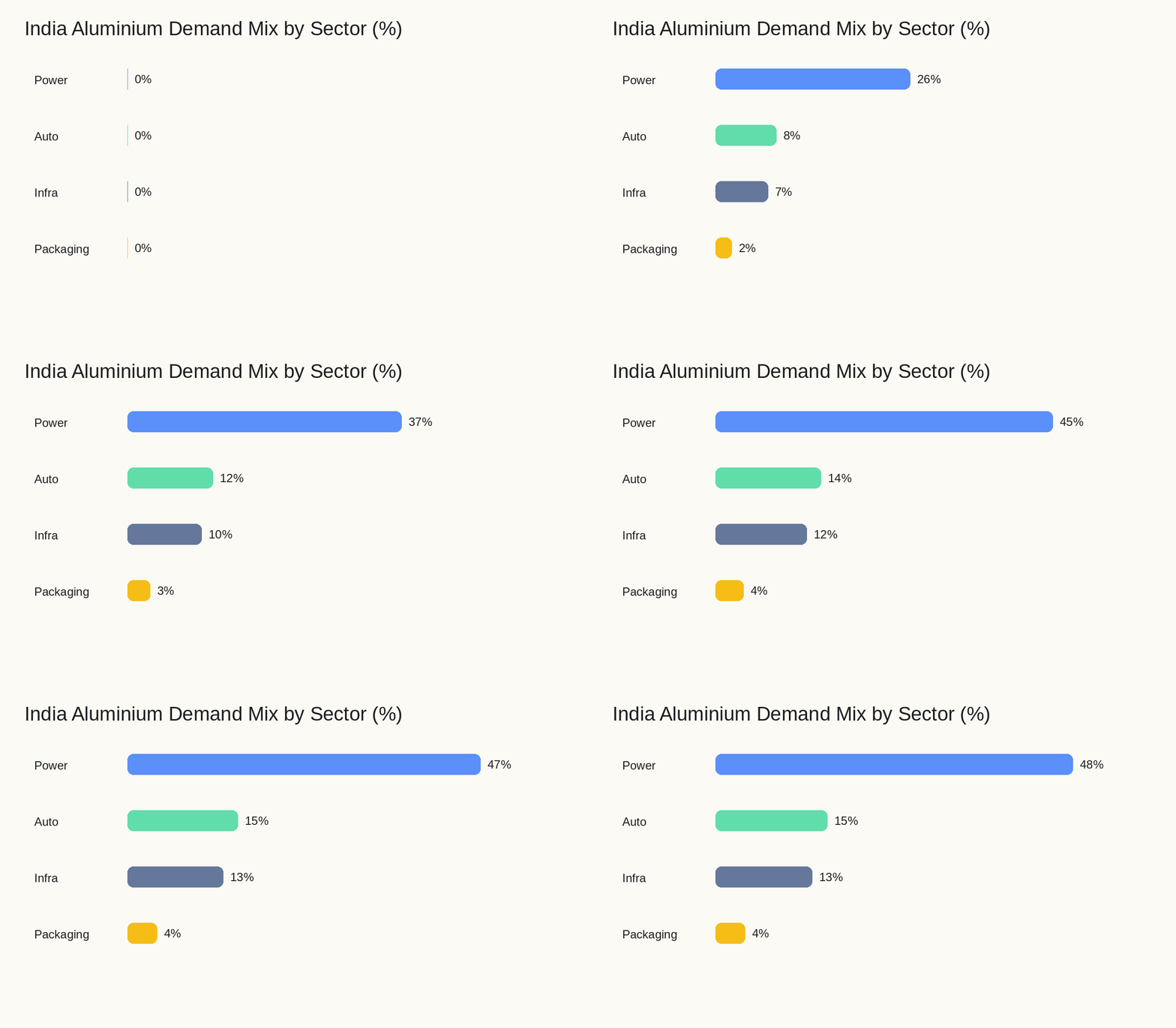
Nearly half of all aluminium consumed in India eventually finds its way into the electrical sector. At approximately 48 per cent of total demand, power transmission remains the single largest consumer of the metal.
India was among the first countries to extensively replace copper with aluminium in transmission infrastructure, helping create a network of nearly 600 conductor and cable manufacturers with a combined production capability of around 400,000 tonnes annually.
Next comes the next wave. How? The country plans to integrate 470 GW of renewable energy capacity while simultaneously embarking on a transmission investment cycle worth approximately INR 9 trillion through 2032.
Every megawatt added to the grid requires conductors, cables, substations and transmission networks. For aluminium suppliers, that means demand visibility stretching years into the future.
It also means the order book keeps getting thicker.
Cars, on the other hand, are quietly becoming aluminium-hungry machines
The automotive sector currently accounts for around 15 per cent of domestic aluminium consumption. That may sound modest, but the growth trajectory tells a different story.
A vehicle manufactured in India today contains roughly 40-50 kg of aluminium. By 2030, that figure is projected to rise and match the present global level of approximately 160-180 kg.
When calculated, that's more than a fivefold jump.
Digging deeper, the reason comes to carmakers being under increasing pressure to improve fuel efficiency and meet stricter emissions regulations.
Fuel cost is also a pressing factor. Average fuel prices in India stand at roughly INR 105 per litre for petrol and INR 95 per litre for diesel, though in many states the value is much higher.
Industry estimates show that reducing vehicle weight by 10 per cent can improve fuel economy by between 6 per cent and 8 per cent. Aluminium offers one of the most effective routes to achieving that objective.
Electric vehicles are accelerating the trend further. Battery enclosures, structural components, crash-management systems and chassis applications increasingly rely on aluminium to offset battery weight and improve range.
As a result, India's automotive aluminium market is expected to grow from USD 2.90 billion to USD 5.60 billion by 2033.
The secondary aluminium segment tells a similar story. Demand from vehicle manufacturers is forecast to increase from 1.7 million tonnes to as much as 2.5 million tonnes over the same period.
Interestingly, about 60 per cent of that demand is concentrated among just four companies, i.e. Maruti Suzuki, Tata Motors, Mahindra & Mahindra and Hyundai India, creating highly stable purchasing patterns that are unlikely to disappear anytime soon.
Participate in our upcoming magazine “Mine to Market: Aluminium Producer & Manufacturer 2026” to share your valuable of the value chain. The magazine consists of aluminium’s story beginings deep in the earth and ends in the infinite versatility of engineered products.
Infrastructure is turning extrusions into a growth story of their own
If power transmission dominates the demand landscape and automotive drives future growth, infrastructure remains the industry's dependable workhorse.
Construction and infrastructure projects account for approximately 13 per cent of aluminium consumption, supporting demand for extrusions used in facades, curtain walls, windows, roofing systems and structural applications.
Government spending remains a key catalyst. Capital allocations worth around INR 10 trillion towards highways, railways, smart cities and urban development projects continue to create opportunities for downstream manufacturers.
It explains why extrusions have emerged as one of the strongest-performing downstream product categories, accounting for approximately 34 per cent of domestic demand. Flat-rolled products and foil contribute another 32 per cent, followed by castings at 23 per cent and wires and cables at 8 per cent.
India is producing more aluminium than ever. But it still isn't enough.
The country's aluminium ecosystem has expanded substantially over the years.
Domestic production capacity, including downstream fabrication facilities, stood at approximately 6.4 million tonnes during FY2024-25. Yet even that has not been sufficient to satisfy local demand.
The supply gap explains why India's largest producers have launched some of the most ambitious expansion programmes in their history.
Vedanta on the path to produce more metal, more alumina
Vedanta Aluminium already contributes more than half of India's primary aluminium output. Yet the company is still expanding aggressively.
Its INR 132.26 billion investment programme aims to increase primary smelting capacity from 2.4 MTPA to 3.1 MTPA by FY28.
The strategy extends well beyond smelting.
The Lanjigarh refinery has already expanded from 2 MTPA to 3.5 MTPA, while long-term plans target between 5 MTPA and 6 MTPA. Captive bauxite availability is expected to reach 9 MTPA, supported by access to multiple mining assets. Coal production could rise from 2.6 MTPA to more than 40 MTPA, strengthening the company's raw-material security.
Downstream operations are also receiving attention. Billet production capacity at Jharsuguda is increasing from 580 KTPA to 830 KTPA.
The scale of operations is reflected in recent production records. During FY26, Vedanta produced 2.92 million tonnes of alumina and 2.46 million tonnes of primary aluminium, both company highs.
Hindalco is betting on the future of value-added aluminium
While Vedanta is focused heavily on upstream integration, Hindalco's expansion story is equally about downstream opportunities.
The company has committed INR 210 billion towards a new 360,000-tonne-per-annum smelter at its Aditya Aluminium complex, part of a broader INR 370 billion investment pipeline in Odisha.
But perhaps the more interesting development is occurring further down the value chain.
Hindalco recently commissioned a 170,000-tonne-per-annum flat-rolled products and battery foil facility backed by an investment of INR 45 billion.
The facility is capable of supporting up to 100 GWh of lithium-ion cell manufacturing capacity, positioning the company at the centre of India's battery ecosystem.
It also addresses a longstanding challenge. The country currently relies on imports for roughly 40 per cent of its flat-rolled product requirements. Hindalco expects the new facility to reduce that dependence significantly.
Meanwhile, domestic downstream capacity is increasing from 400 KTPA to 600 KTPA as new projects come online.
Financially, the company appears well equipped to fund this growth, having generated record revenue of INR 2.75 trillion and EBITDA of INR 380.97 billion during FY26.
NALCO is preparing for a transformation of its own
Not to be left behind, NALCO is evaluating one of the largest expansion plans in its history.
The state-owned producer is pursuing a proposed INR 300 billion brownfield project that includes a new smelter and a 1,080 MW thermal power plant.
If completed as planned, the project would increase smelting capacity from around 0.46 MTPA to approximately 1 MTPA.
The company is simultaneously expanding refinery capacity from 2.1 MTPA to 3.1 MTPA through a separate INR 70 billion programme.
Supporting this growth will be the Pottangi bauxite mine, designed to produce 3.5 MTPA of ore.
NALCO's latest operating numbers underline how quickly domestic demand is absorbing available production. During FY26, the company excavated 77.01 lakh tonnes of bauxite, produced 22.75 lakh tonnes of alumina and generated a record 4.72 lakh tonnes of cast metal.
Behind every tonne of aluminium lies a much bigger mining story
One of the less glamorous realities of aluminium production is that smelters cannot operate in isolation.
Producing a tonne of primary aluminium requires approximately two tonnes of alumina. Producing that alumina requires roughly six tonnes of bauxite.
Suddenly, every expansion announcement looks much larger. A smelter addition is also a refinery expansion. A refinery expansion is also a mining project.
That is why the industry's current investment cycle includes around 4 million tonnes of additional alumina refining capacity alongside primary metal growth. Without that supporting infrastructure, future smelters would struggle to secure adequate feedstock.
Recycling helps, but imports remain unavoidable
India's secondary aluminium industry is estimated at between 3.5 million and 4.5 million tonnes annually and plays a crucial role in balancing supply.
But domestic scrap generation supplies only around 30-35 per cent of the required feedstock. The remaining 65-70 per cent must be imported.
Though scrap imports have increased from 0.88 million tonnes in 2015 to 1.97 million tonnes in 2025. Import expenditure climbed from USD 3.60 billion to USD 4.30 billion within a year and is projected to reach USD 4.50 billion in 2026.
North America supplies approximately 35 per cent of imported scrap, Europe contributes 25 per cent, the Middle East provides 20 per cent and Southeast Asia accounts for 15 per cent.
In other words, even India's recycling ecosystem remains closely tied to global supply chains.
So, will the expansion wave change the scenario?
On paper, India's aluminium industry is doing everything it should.
Producers are investing tens of hundreds of billions. Smelting capacity is rising. Refineries are expanding. Mines are being developed. Battery foil plants are being commissioned. New downstream facilities are entering production.
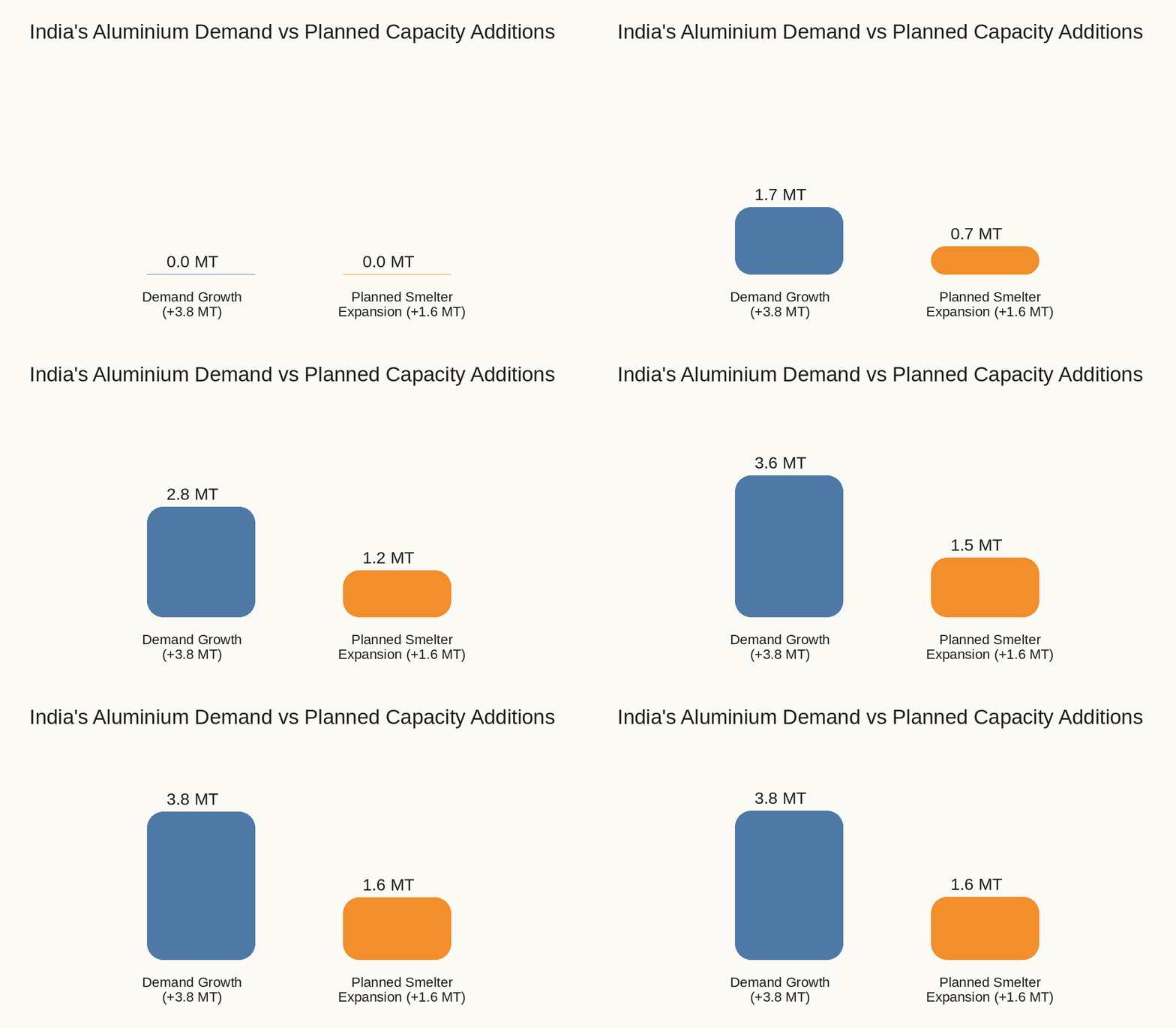
Yet demand keeps moving the goalposts. The three major producers collectively plan to add approximately 1.6 million tonnes of primary smelting capacity. Meanwhile, domestic consumption is expected to create an additional requirement of roughly 3.8 million tonnes by 2030.
Thus, it is evident that even after the announced projects are completed, the market will still require substantial volumes from imports, recycled material or future expansion phases.

Unlock full access – sign up for FREE.
Key benefits
LME aluminium prices decline on June 10 amid lower inventories and weaker contract values
Next articleRussian aluminium's share of LME stocks climbs to 93% in May as Indian inventories decline
Grow with
AL Circle