您想继续阅读英文文章还
是切换到中文?
是切换到中文?

THINK ALUMINIUM THINK AL CIRCLE

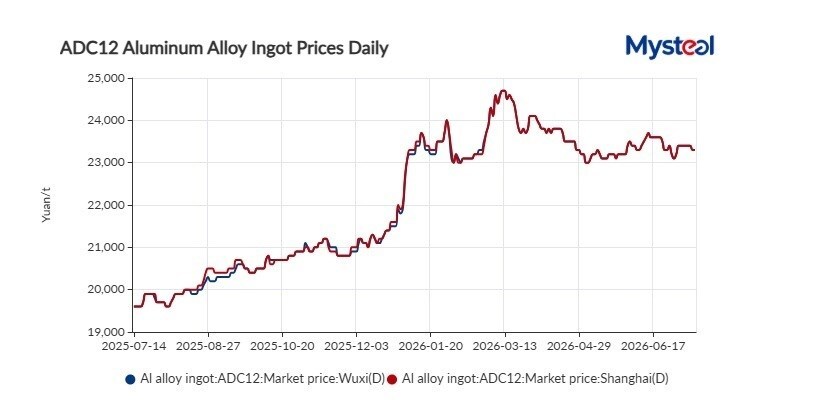
This image has been obtained via Mysteel official website
In the first half of 2026, China's domestic cast aluminium alloy prices initially surged and created a multi-year high before pulling back. By end-June, the spot prices in East China stood at RMB 23,200 per tonne, up 18.37 per cent year-on-year, having hit a record high of RMB 24,700 per tonne during the period.
{alcircleadd}The price rally was driven by three main factors. First, overseas geopolitical tensions pushed up global aluminium prices, lifting domestic A00 prices and alloy prices in tandem.
Second, tighter tax enforcement, including the suspension of reverse invoicing (note: reverse invoicing is a method where the buyer issues the invoice to the seller, primarily to address the missing of VAT deduction document caused by unregistered individual sellers) for aluminium scrap in many regions, constrained input tax credits for secondary aluminium producers, leading to significant output cuts.
Third, the closed import window due to higher overseas aluminium prices limited domestic scrap imports, forcing some import-dependent smelters to scramble for domestic scrap, exacerbating the shortage.
When cast aluminium alloy prices created new highs in the first half, the profitability saw sharp swings in the first half. Margins opened the year at their highest levels, then steadily eroded as raw material shortages intensified, at times falling to near break-even, before recovering modestly after reverse invoicing was suspended in some regions. That is, margins declined rapidly after the Chinese New Year, and some producers were operating at break-even by May 2026.
According to Mysteel, the weighted average full cost of ADC12 was RMB 22,959 per tonne in June 2026. Compared with Mysteel's assessment of ADC12 spot average at RMB 23,459 per tonne, the per-tonne profit rose RMB 504 per tonne month-on-month, implying a theoretical industry margin of RMB 500 per tonne.
On the supply side, total installed capacity of cast aluminium alloy among 191 sampled producers reached 19.105 million tonnes per year by end-June, rising, 5 per cent Y-o-Y, based on Mysteel's survey. After excluding 1.766 million tonnes of idled capacity, effective operating capacity was 15.606 million tonnes per year. The combined production in the first half totalled 3.24 million tonnes, down 8.91 per cent Y-o-Y, with Anhui recording the largest decline.
The global aluminium casting usage is expected to reach 24.2 million tonnes in 2026. To know about the future market trends, prebook our upcoming report “Global Aluminium Casting Market 2026-2032
In addition, as of June 2026, the planned new secondary aluminium capacity in China for 2025-2026 added up to 2.265 million tonnes per year, but only 440,000 tonnes per year is expected to materialise in 2026, a gap of 1.825 million tonnes per year due to various constraints.
According to customs data, China's cumulative imports of unwrought aluminium alloy in January-May 2026 totalled approximately 378,500 tonnes, down 18.58 per cent year-on-year. The decline was driven by narrowing import margins amid US-Iran geopolitical tensions, which pushed import volumes steadily lower.
Currently, overseas ADC12 prices are generally higher than domestic levels, while strong LME aluminium prices have kept overseas scrap costs and production costs elevated. In addition, neighbouring countries such as Japan, South Korea, and India have been paying higher prices for ADC12 than China, limiting China's import appetite. Import volumes are unlikely to recover in the near term, and imports are expected to remain lower year-on-year in the second half.
In contrast, China's cumulative exports of unwrought aluminium alloy in January-May reached 171,400 tonnes, up 81.30 per cent year-on-year. Exports surged to a record high in May, driven by a confluence of geopolitical supply gaps, higher overseas prices, and concentrated order releases.
Looking ahead to the second half, raw material availability remains the central issue. Supply will be shaped by domestic tax policy direction, while demand from downstream die-casters typically strengthens in Q3-Q4. If supply constraints persist, the market could tip into deficit. In addition, with import margins recovering, alloy imports are expected to recover modestly, and exports may ease.
Costs will largely follow scrap prices, and as scrap supply picks up in H2, costs are likely to move in line with alloy production. Tax enforcement remains a wildcard, with potential compliance costs adding further upside.
In summary, once summer heat subsides and die-caster operating rates rise, downstream demand is expected to firm. Given ongoing tax policy constraints, the cast aluminium alloy market is likely to remain tight in H2, with prices expected to trade in a range of RMB 22,500-24,800 per tonne, supported by seasonal demand and policy-driven supply shortfalls.
Note: This news is published under a content and exchange agreement with Mysteel
Responses