China’s aluminium wire and cable exports recovered in October 2024, marking a month-on-month surge of 53.8 per cent and a year-on-year increase of 13.64 per cent. However, the monthly uptick in October was not enough to counter the sluggish performance throughout the year-to-date, attributed to tight domestic end-user sector demand, particularly from the building and construction sector.
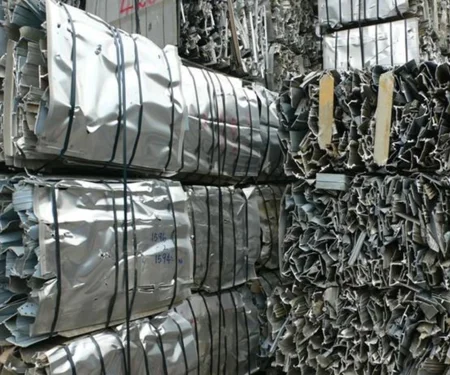
Image Source: Made-in-China
According to the Shanghai Metals Market survey, the export volume in October was 14,300 tonnes versus 9,300 tonnes in September, generating a value of $41.5 million compared to $28.06 million. Thus, the export value also demonstrated M-o-M hike of 47.9 per cent.
Specifically, exports of steel-core aluminium-stranded wire and similar products were 8,480 tonnes, up 82 per cent M-o-M. In comparison, exports of aluminium-stranded wire and similar products reached 5,831 tonnes, up 23 per cent M-o-M.
From January to October, China’s total aluminium wire and cable exports totalled 151,600 tonnes, down 2.85 per cent Y-o-Y. In addition to poor demand, increased capacity for overseas production has also led to a downfall in China’s year-to-date aluminium wire and cable exports.
However, there is a potential rebound in export orders in the Chinese market due to the anticipation of tariffs imposed by the United States on Chinese aluminium products and the removal of an export tax rebate by the Chinese government, which may get transferred to the consumers in the form of added cost to aluminium products.
SMM predicts China’s aluminium wire and cable exports are expected to reach around 200,000 tonnes, up by 4.33 per cent from 191,700 tonnes in 2023. For more such forecast, read Al Circle's report: "ALuminium Wires & Cables - Insights & Forecast to 2030".
Export sources, destinations & product-classifications
In October, Jiangsu and Henan were among the top twenty Chinese exporting countries of aluminium wire and cable, supplying 6,184.3 tonnes and 4,542.9 tonnes. Together, they exported 10,727 tonnes, representing 75 per cent of the total export volume.
There were fifteen major export destinations for Chinese aluminium wire and cables in October, most of which were in Africa, South America, and Southeast Asia, as they increasingly focus on power grid construction.
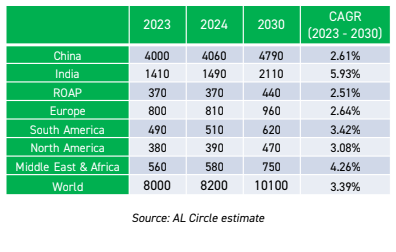
Region-wise aluminium wire rod usage, forecast to 2030
Throughout 2024, the primary sources of China’s aluminium wire and cable exports were Jiangsu, Henan, and Beijing, destined to Ghana, Malaysia, Uzbekistan, the Philippines, and Egypt. China’s three provinces together accounted for 68.2 per cent of the total exports.
Exports of steel-core aluminium stranded wire from January to October were 91,537 tonnes – 7 per cent higher than 85,503 tonnes of output during the corresponding period of the previous year. The volume accounted for 60 per cent of China’s total aluminium wire and cable exports. In contrast, other types of aluminium wire exports decreased over the year by 14.8 per cent to 60,121 tonnes, compared to 70,797 tonnes in 2023. This opposite trend indicates the higher use of aluminium wire and cables for power grids in the overseas market over other applications.
This opposite trend during the same year indicates that aluminium wire and cables are mostly used for power grid construction in the overseas market over other applications.