Solvent-free process pushes extrusion-printed aluminium close to full density
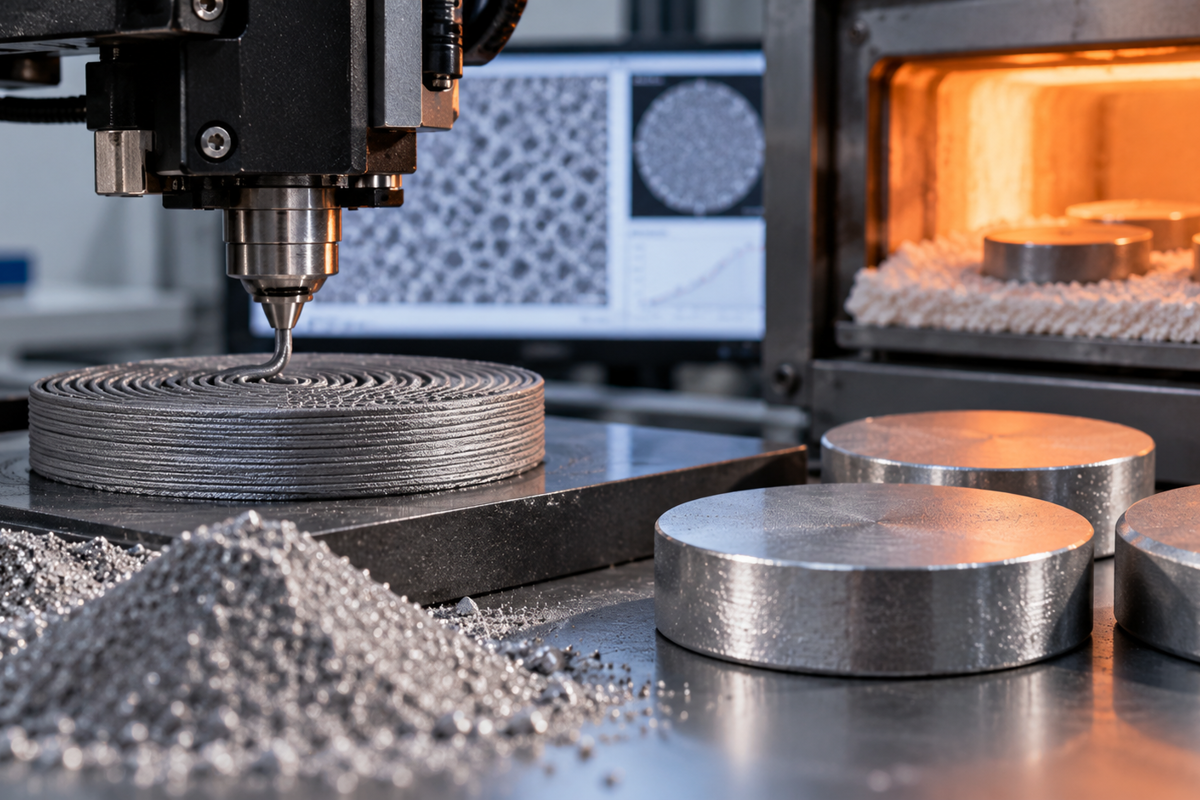
The image used in this article is generated with an AI tool and does not depict any real-time moment.
A Swiss-Polish research team has achieved up to 97.9 per cent relative density in extrusion-printed AA6061 aluminium by removing the solvent-debinding stage and extending the sintering process. The approach offers a potential alternative to conventional processing routes for sinter-based aluminium additive manufacturing, where oxidation has remained a major obstacle.
The study, led by the Swiss Federal Laboratories for Materials Science and Technology (Empa), was published in Progress in Additive Manufacturing on October 15, 2026. An earlier version appeared as a preprint in May, making the journal publication the latest stage in the research’s release.
The researchers combined a single-step wick-debinding process with a longer sintering hold to improve the density of printed aluminium parts. Their highest result came from Kcmix feedstock, which reached 97.9 per cent relative density after sintering for 10 hours. EnCeram feedstock achieved 96.8 per cent under the same extended sintering conditions.
The findings suggest that the step between printing and sintering could be crucial to improving extrusion-based aluminium manufacturing, without requiring newly developed binders or specialised powders.
Aluminium oxidation sets a limit on debinding
In material extrusion additive manufacturing (MEX-AM), a printer deposits a mixture of metal powder and thermoplastic binder to form a so-called green part. The binder must then be removed before the metal particles can bond during sintering.
Conventional processing typically uses a solvent bath followed by thermal debinding in air. However, aluminium readily oxidises, and the resulting surface oxide can obstruct the sintering process.
Thermal analysis of the AA6061 powder showed that oxidation begins at around 400°C, below the approximately 500°C programme recommended by the binder suppliers. This creates a narrow processing window in which the binder must be removed without allowing excessive oxidation to compromise the final component.
The team used gas-atomised AA6061 powder at a concentration of 60 per cent by volume, combined with three commercial binders: EnCeram from Chemische Fabrik Budenheim, Kcmix3.3 and EmbemouldCC from KRAHN Chemie. EmbemouldCC separated during extrusion and was excluded from further testing.
The remaining feedstocks were pelletised and printed into 20-millimetre discs using a Tumaker Voladora NX+ pellet-screw printer.
To know the global production, demand and consumption forecasts of aluminium extrusions, explore our report "The World of Aluminium Extrusions to 2035"
Solvent treatment leaves room for improvement
The researchers initially followed the suppliers’ recommended process, combining solvent debinding with thermal treatment in air at 350°C. Although this removed at least 96 per cent of the binder, the resulting parts showed limitations in their final density.
EnCeram parts treated in water reached only around 75 per cent relative density. The researchers attributed the poor result to the formation of hydroxide on the powder surface, which converted into oxide during heating and left a porous outer layer of unbonded particles.
Kcmix parts treated in high-purity acetone performed better, reaching approximately 94 per cent density. However, their edges did not fully densify. These results led the team to investigate whether eliminating the solvent stage could improve the process.
Wick debinding delivers higher density
Instead of using a solvent bath, the researchers placed the printed parts in a porous alumina powder bed. Capillary action drew liquid binder out of the components during a single 24-hour heat treatment in air.
At 350°C, the process removed more than 97 per cent of the binder without causing cracking, blistering or deformation.
Increasing the temperature to 400°C proved counterproductive. In a separate test, the aluminium powder gained approximately 0.25 per cent in mass through oxidation after 24 hours at that temperature. Parts wick-debound at 400°C also achieved lower sintered density.
After wick debinding at 350°C, the samples were sintered in nitrogen at 635°C. With a two-hour sintering hold, Kcmix parts reached 96.7 per cent relative density, while EnCeram parts achieved 93.6 per cent.
Extending the sintering hold to 10 hours increased the figures to 97.9 per cent for Kcmix and 96.8 per cent for EnCeram. The researchers also reported even densification from the centre to the edges of the parts.
The authors noted that the results exceeded the densities reported for most additively manufactured aluminium feedstocks, although comparisons depend on the specific materials and processing methods involved.
Industrial potential remains to be tested
The study points towards a comparatively straightforward approach to improving sinter-based aluminium extrusion printing. Rather than developing new powder formulations or specialised binders, the researchers focused on modifying the debinding stage and extending the time spent sintering.
The process also uses commercially available feedstocks and standard extrusion-printing equipment, while the debinding treatment takes place in air. The same feedstocks could potentially be used in other manufacturing processes, including warm pressing, extrusion and injection moulding, the authors noted.
However, the route still requires 24 hours of debinding followed by a 10-hour sintering hold to achieve the highest reported density. The team measured density and microstructure but did not evaluate mechanical properties.
Further testing will therefore be necessary to establish whether the process can deliver the strength and performance required for industrial applications. For now, the findings identify debinding as a promising area for improving the manufacture of dense, extrusion-printed aluminium components.
Explore downstream aluminium products from our comprehensive list on AL Biz.
Grow with
AL Circle