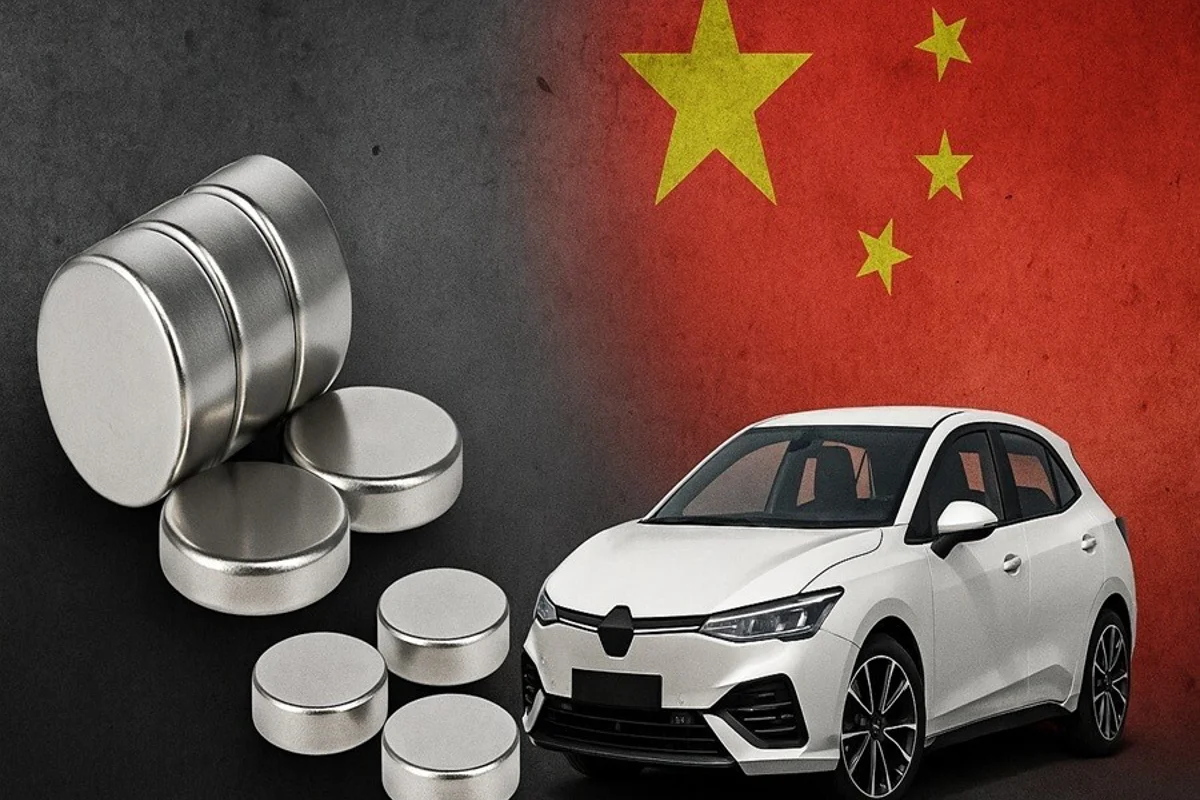
India’s automobile sector is on alert as supplies of rare earth magnets from China remain suspended, two weeks after Beijing promised to ease export restrictions. Despite high-level talks between the two countries, automakers and component suppliers say little has changed on the ground, and concerns are mounting that production could be disrupted during the upcoming festive season, when demand typically spikes.
Why Beijing tightened the screws?
The trouble dates back to April 2025, when China’s Ministry of Commerce issued Announcement No. 18. The directive imposed new licensing rules and export controls on seven key rare earth elements, including dysprosium, terbium, and samarium. These materials are indispensable for electric vehicle motors, wind turbines, defence hardware, aerospace technologies, and high-performance electronics.
Beijing argued the measures were necessary to protect national security and comply with non-proliferation rules for dual-use materials. Yet trade analysts say the timing was no coincidence — it came soon after Washington raised tariffs on Chinese goods.
With China refining more than 90 per cent of global rare earths and supplying over 80 per cent of the world’s magnets, the curbs were seen as a calculated move in the ongoing trade and technology standoff.
The effects were immediate. Chinese exports of rare earth magnets fell 74 per cent year-on-year in May, while shipments to the US collapsed by more than 93 per cent. A partial trade truce in mid-2025 opened the door for more permits in June and July, but the late-August announcement of easing has yet to restore actual flows.
Bottlenecks and policy uncertainty
The shortage has worsened due to bureaucratic delays. Chinese exporters are now required to obtain special licenses and submit detailed end-use documents, a process that industry sources say is taking weeks. As a result, shipments remain stuck at ports awaiting clearance.
Although Beijing has announced an easing of restrictions, uncertainty around compliance checks and sudden enforcement has kept many exporters from moving cargo. Analysts say this stop-start approach is typical of China’s efforts to keep tight control over sensitive mineral exports while leaving room for political maneuvering.
Indian automakers feel the heat
For Indian vehicle makers, the shortage has forced difficult choices. “There is an intent, but there has been no change on the ground and magnet supply has not resumed,” said Shenu Agarwal, MD & CEO of Ashok Leyland, speaking at the Society of Indian Automobile Manufacturers’ annual convention, reported by ET.
TVS Motor Co. has been hit as well. “We are managing the magnet shortage on a day-to-day basis, which means it is challenging,” admitted K. N. Radhakrishnan, the company’s director and CEO.
Magnets built from rare earths are essential for electric motors in cars, bikes, and commercial vehicles. Without them, production lines risk slowing or even stopping just as festival-season demand builds. Smaller firms, such as Bajaj Auto, have already cut production and delayed launches. Price hikes of between five and eight per cent are also being discussed.
Larger manufacturers are in a stronger position—for now. Mahindra & Mahindra has secured enough stock to last until December, while Maruti Suzuki and Tata Motors are experimenting with altering magnet compositions. But analysts caution that these are temporary fixes, not long-term solutions.
Explore our B2B market place: AL Biz
India’s dependence and government response
The current crisis has underscored how heavily India leans on China for critical inputs. More than 90 per cent of the rare earth magnets used in the country are imported from Chinese suppliers.
To counter that dependence, the Ministry of Mines has moved to diversify sourcing. It is signing agreements with mineral-rich countries such as Australia, Argentina, Zambia, and Peru. State-run Khanij Bidesh India Limited (KABIL) has been tasked with acquiring overseas assets of strategic importance.
Yet insiders admit progress will be slow. Industry executives privately estimate that non-Chinese supply chains will take years to build and may not be fully operational before 2028.
In the meantime, manufacturers are scrambling for workarounds. Sona Comstar, a leading supplier of EV traction motors, has announced plans to set up domestic production of rare earth magnets under the government’s Production-Linked Incentive scheme. Some automakers are exploring recycling rare earths from used batteries, though the process is still at a pilot stage.
Others are reaching out to suppliers in Vietnam, Japan, Malaysia, South Korea, and the US. But none of these countries currently has the scale to match China’s capacity. Stop-gap measures include importing sub-assemblies directly from China or redesigning motors to use lighter rare earth elements that are easier to source, though this often comes at the cost of performance.
Why China stepped back—partially
Beijing’s late-August decision to ease restrictions followed pressure from trade partners and mounting disruption in global markets. The earlier hardline stance had caused widespread shortages in industries from EVs to electronics. In response, China raised export quotas, streamlined parts of the licensing process, and introduced “green channels” for shipments to trusted destinations, including the US and Europe.
Still, trade officials caution that normalization remains only partial. Bureaucratic hurdles persist, especially for magnets headed into sensitive applications like defence and electric vehicles. Industry insiders describe the current flow as “a trickle, not a recovery.”
Balancing risks with long-term plans
For Indian automakers, the situation remains precarious. “So far production has not been disrupted. But unless supplies resume soon, it will remain a balancing act,” one senior industry executive said, as per ET.
The government’s long-term goal — building self-reliance in critical minerals and magnets — X`fits with India’s ambition to become a global hub for electric vehicles. But the reality today is less reassuring: patchwork fixes, thin inventories, and the risk of disruption just as sales are about to peak.













_md.webp)
_md.webp)







