The Middle East’s rise as a global aluminium powerhouse has largely been driven by the Gulf Cooperation Council (GCC). Large, energy-efficient smelters across the region have enabled steady production growth and helped the Middle East secure a stronger foothold in the global aluminium market.
Primary aluminium output increased from 5.8 million tonnes in 2021 to 6 million tonnes in 2022, reflecting a 3.14 per cent year-on-year rise. Expansion continued as production reached 6.2 million tonnes in 2023 and 6.3 million tonnes in 2024, marking growth of 2.35 per cent and 2.07 per cent respectively.
However, momentum slowed in 2025, when output declined to 6.15 million tonnes, a 2.95 per cent drop from the previous year. The slowdown followed raw material supply crisis last year and is still continuing. In this backdrop the question rise: can the region gain back the momentum in the time to come?
Globally, the Middle East accounts for approximately 8–9 per cent of aluminium production.
A production hub with limited upstream resources
Although the Middle East hosts several large smelters, its domestic supply of raw materials remains limited. Across the broader region - including the UAE, Saudi Arabia, Iran, Oman, Qatar, Turkey and Bahrain - combined aluminium production capacity stands at around 6.92 million tonnes per year, supported by roughly 4.95 million tonnes of alumina refining capacity.
Maintaining this level of output requires approximately 13.08 million tonnes of alumina, which in turn would need 26.16–39.24 million tonnes of bauxite under standard industry conversion ratios.
Actual aluminium output in 2025 reached about 6.1 million tonnes, translating into demand for roughly 12.2 million tonnes of alumina and 24.4–30.5 million tonnes of bauxite. These figures illustrate how strongly the region’s aluminium sector depends on steady raw material flows.
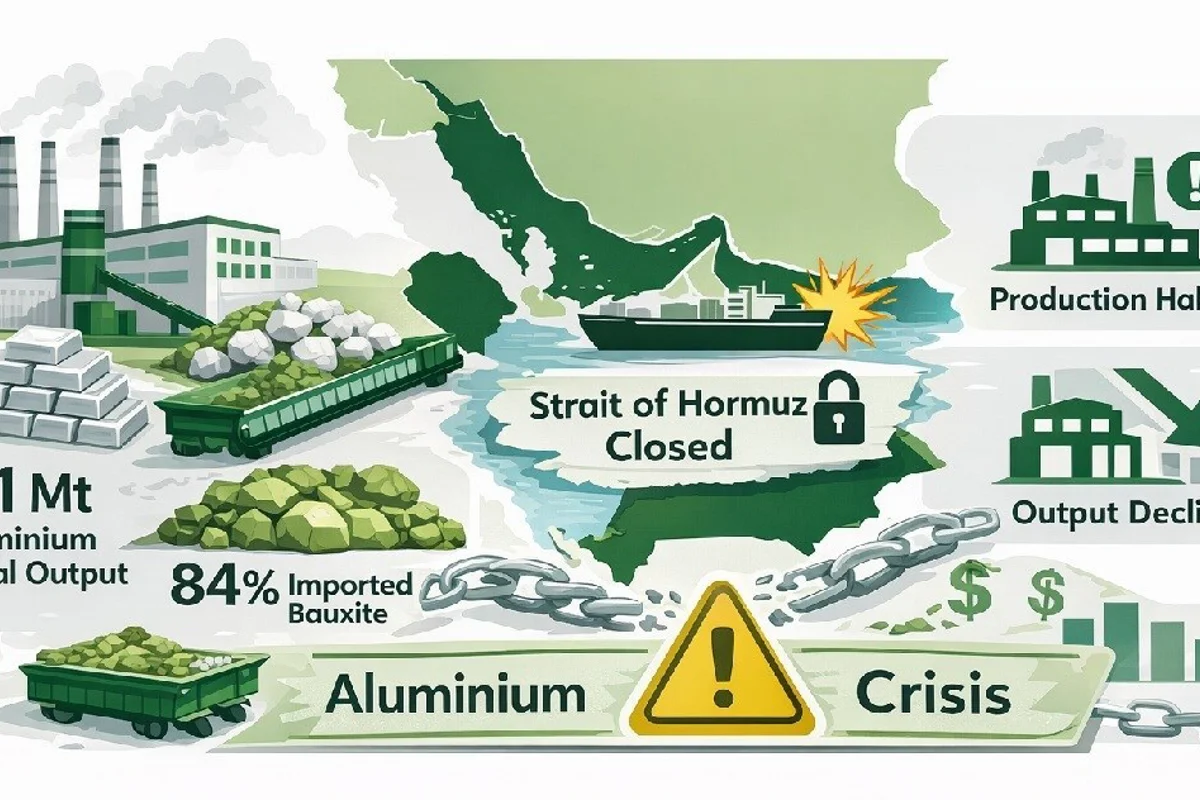
Domestic resources remain modest. Saudi Arabia produces around 5.4–5.7 million tonnes of bauxite each year, a relatively small amount compared with regional requirements. Using an average demand estimate of 34.6 million tonnes of bauxite, domestic supply accounts for only about 16 per cent, leaving the industry roughly 84 per cent reliant on imports.
Import dependence and changing supply routes
The region’s sourcing pattern began to shift after the suspension of Emirates Global Aluminium’s (EGA) operations in Guinea. Exports from the operation declined from 14.1 million tonnes in 2023 to 10.8 million tonnes in 2024, with shipments continuing to fall in 2025.
As a result, GCC buyers started seeking alternative sources. In 2025, about 2.9 million tonnes of Australian bauxite moved through GCC-linked supply routes. Turkey has also emerged as an additional supplier.
Turkey exported around 160,200 tonnes in 2024 which is about 45 per cent of the total import of GCC. The trend continued through 2025, helping partly offset the reduction in Guinean shipments. Even so, the drop in supply from Guinea has already contributed to slower aluminium production growth in the region.
Dependence on external supply chains extends beyond bauxite. Regional smelters obtain 97 per cent of their alumina requirements through international trade, mainly from refineries in Malaysia, Indonesia and China.
With regional alumina production capacity at only about 4.35 million tonnes per year, the Middle East must import roughly 8.9 million tonnes annually to meet demand of around 13 million tonnes of alumina for smelters.
Explore- Most accurate data to drive business decisions with Global ALuminium Industry Outlook 2026 across the value chain
Strait of Hormuz becomes a new pressure point
A new risk emerged in 2026 with the closure of the Strait of Hormuz, one of the world’s most important shipping routes. The Middle East accounts for around 8–9 per cent of global aluminium output, yet a large share of the bauxite and alumina required for this production travels through the strait.
The waterway handles approximately 8–10 million tonnes of alumina shipments each year destined for regional smelters, making it a crucial chokepoint in the aluminium supply chain.
If disruptions continue, the consequences could be significant. The 2.9 million tonnes of Australian bauxite shipped through GCC-linked routes in 2025 alone could support about 580,000 tonnes of primary aluminium output. Likewise, if Turkey maintains its 2024 export levels, disruptions could affect approximately 26,700 -40,050 tonnes of aluminium production.
Shipping data shows that vessels carrying aluminium raw materials to the Middle East are already changing course. With the Strait of Hormuz closed, several ships have diverted from their original routes.
Three bauxite carriers - Richmond, Glory Energy and Penelope Oldendorff-were initially heading for the United Arab Emirates but have altered course, according to vessel-tracking data from Kpler’s MarineTraffic platform. Their combined cargo totals roughly 371,000 tonnes, according to LSEG data.
Both Glory Energy and Penelope Oldendorff, which departed Ghana in February, had been travelling along the East African coast toward the Gulf but have since moved further east, indicating a possible diversion toward Asian ports.
Two alumina carriers destined for the Gulf have also changed course. Timorsun and African Sanderling, which left Australia in February for the Bahraini port of Sitra, appear to be rerouting. The African Sanderling was last recorded near the coast of Sri Lanka, while Timorsun was positioned slightly further west.
Operational pressures are already visible. Aluminium Bahrain (Alba), which produces more than 1.62 million tonnes of aluminium annually, has halted shipments due to shipping constraints linked to the Strait of Hormuz and is exploring alternative options to maintain deliveries.
Meanwhile, Norsk Hydro reported that its joint-venture smelter Qatalum in Qatar, with an annual capacity of 648,000 tonnes, has declared force majeure and plans to shut down completely by the end of the month.
What if the disruption continues?
If the Strait of Hormuz remains closed for three months, pressure on raw material supplies could intensify. Based on annual flows of 8–10 million tonnes of alumina, roughly 0.67–0.83 million tonnes normally pass through the route each month.
A three-month interruption could therefore block 2.0–2.5 million tonnes of alumina supply, tightening feedstock availability for regional smelters. Since aluminium production requires roughly 2 tonnes of alumina for every tonne of metal, the disruption could affect around 1.0–1.25 million tonnes of aluminium output.
Considering the Middle East produced about 6.1 million tonnes of aluminium in 2025, this would put roughly 16–20 per cent of regional production at risk if alternative supply channels are not secured.
If vessels are forced to bypass the Strait of Hormuz, many shipments may have to travel via the Cape of Good Hope. This detour would extend the distance by 60–70 per cent, add 18–24 days to transit times, and increase shipping costs by 30–40 per cent per shipment. Such delays could exceed the inventory limits of several smelters, raising the possibility of further operational disruptions.
Taken together, these developments underscore a critical challenge: while the Middle East has become a major aluminium producer, its rapid growth remains closely tied to fragile supply chains and a handful of key maritime routes.
Don't miss out- Buyers are looking for your products on our B2B platform