Rare earth elements are central to the United States’ military technology that operates across the air, land, sea, and space domains. Their strong magnetic and electronic characteristics enable compact, high-performance motors and actuators used in precision-guided munitions, missile control, and advanced aircraft such as the F-35 fighter jet.
In naval operations, rare earth magnets and alloys enhance radar, sonar, and propulsion systems aboard Virginia-class submarines and Arleigh Burke destroyers, providing the stealth and detection capability that defines modern warfare.
The US uses roughly 20 tonnes each year, a quantity small enough to fit on a single truck, but its strategic weight is immense. Gallium underpins radar, communication, and satellite systems across the Pentagon’s advanced platforms. Yet despite its importance, the country has no domestic production and relies entirely on imports.
Dependence on overseas refining
The US has not produced primary gallium since 1987. Every tonne used by the defense and technology sectors is imported or recovered from scrap. By 2025, nearly all refining and processing capacity was located abroad — in Japan, Germany, Canada, and South Korea — nations that themselves depend on Chinese feedstock dominating global supply.
Figures from the US Geological Survey (USGS 2025) show that between 2020 and 2023, US gallium imports were sourced mainly from Japan (24 per cent), China (19 per cent), Germany (19 per cent), Canada (17 per cent), and others — including South Korea and Slovakia — which accounted for 21 per cent.
When China imposed its export ban in December 2024, shipments to the US continued mostly from Japan, Germany, and Canada, all refining material originally processed in China.
Over those years, the US imported about 11.3 tonnes annually — 2.6 tonnes from Japan, 2.17 tonnes each from China and Germany, 1.94 from Canada, and roughly 2.39 from smaller suppliers. The numbers may appear minor, but this 100 per cent import reliance represents a structural weakness for a metal essential to defense manufacturing.
Rebuilding domestic capability
Washington is now moving to secure a homegrown source through new mining projects, recovery programmes, and public-private partnerships. The flagship project is the Sheep Creek project in Montana, where concentrations reach about 300 ppm, far above the global average of 50 ppm.
Operated by US Critical Materials in collaboration with the Idaho National Laboratory, the deposit offers a potential long-term supply and is geologically unusual — the gallium is contained within rare-earth minerals rather than extracted as a by-product of bauxite, which simplifies processing.
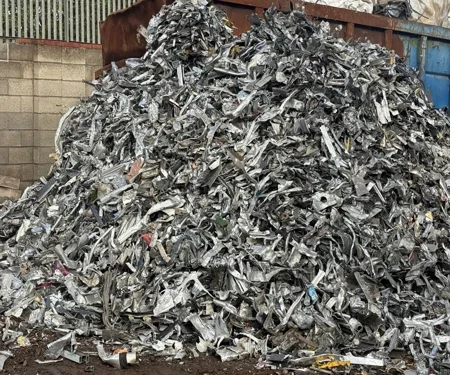
Alongside mining, the Department of Energy (DOE) is working on gallium recovery from industrial waste such as aluminium refining residues and semiconductor scrap through its TRACE-Ga initiative. The programme funds pilot plants to produce high-purity gallium for defense and advanced manufacturing.
Private firms, including GreenMet, are planning refining facilities — possibly near US Army installations — to ensure secure processing and stockpiling inside the country.
Gallium in defense systems
Gallium’s real importance lies in its chemistry. Its compounds — gallium nitride (GaN) and gallium arsenide (GaAs) — make semiconductors that perform at voltages, temperatures, and frequencies beyond what silicon can handle. These are the materials that give modern weapons their electronic precision and endurance.
In radar and missile guidance, GaN amplifiers power active electronically scanned array (AESA) radars used in F-35 and F-22 aircraft and in Aegis destroyers. They detect smaller, faster targets over longer ranges while using less power. In electronic warfare, gallium devices operate at up to 300 °C, supporting jamming, signal-intelligence, and directed-energy systems that must survive the most demanding conditions.
GaAs technology dominates solar arrays on military satellites because of its efficiency and radiation resistance. The same material appears in night-vision equipment, infrared lasers, and optical sensors across US Army and Air Force systems.
The Department of Defense (DoD) uses gallium in more than 11,000 components, from radar modules and missile seekers to satellite payloads and high-frequency amplifiers.
To protect access, the Defense Logistics Agency (DLA) and DoD have listed gallium as a critical mineral under the Defense Production Act. Technologies such as Metallium’s Flash Joule Heating process and DOE’s TRACE-Ga programme are being expanded to recover gallium from LED waste and aluminium residues, reinforcing domestic resilience against future export restrictions.
Global military adoption: who’s using gallium — and why it matters
The strategic reach of gallium extends well beyond US borders. China, the world’s dominant producer and refiner, has integrated gallium-based components across its armed forces. They are found in the J-20 stealth fighter, PL-15 missile, modern naval destroyers, and new air-defense systems. Beijing’s control of refining gives it both a technological advantage and significant leverage — a reality highlighted by the 2024 export ban.
Japan and South Korea depend on gallium for high-purity semiconductors used in radar, communications, and missile systems, building on their advanced industrial bases. In Europe, Germany is reviving its refining capacity to limit exposure to imports.
Russia uses gallium in radar and electronic-warfare systems as part of its military modernization, while India and Turkey are investing in GaN-based radar technology to strengthen domestic defense production.
Across these programmes, wide-bandgap gallium semiconductors are replacing silicon, producing smaller and more efficient devices that can handle higher voltages and temperatures. The shift is quietly setting new performance standards for next-generation defense electronics.
Gallium has become one of the most strategically sensitive materials in global defense supply chains. For the US, it represents both a technological necessity and a supply vulnerability; for China, it is an industrial strength and a tool of influence.














_md.webp)