Indonesian Aluminium: The shift from mining to smelting
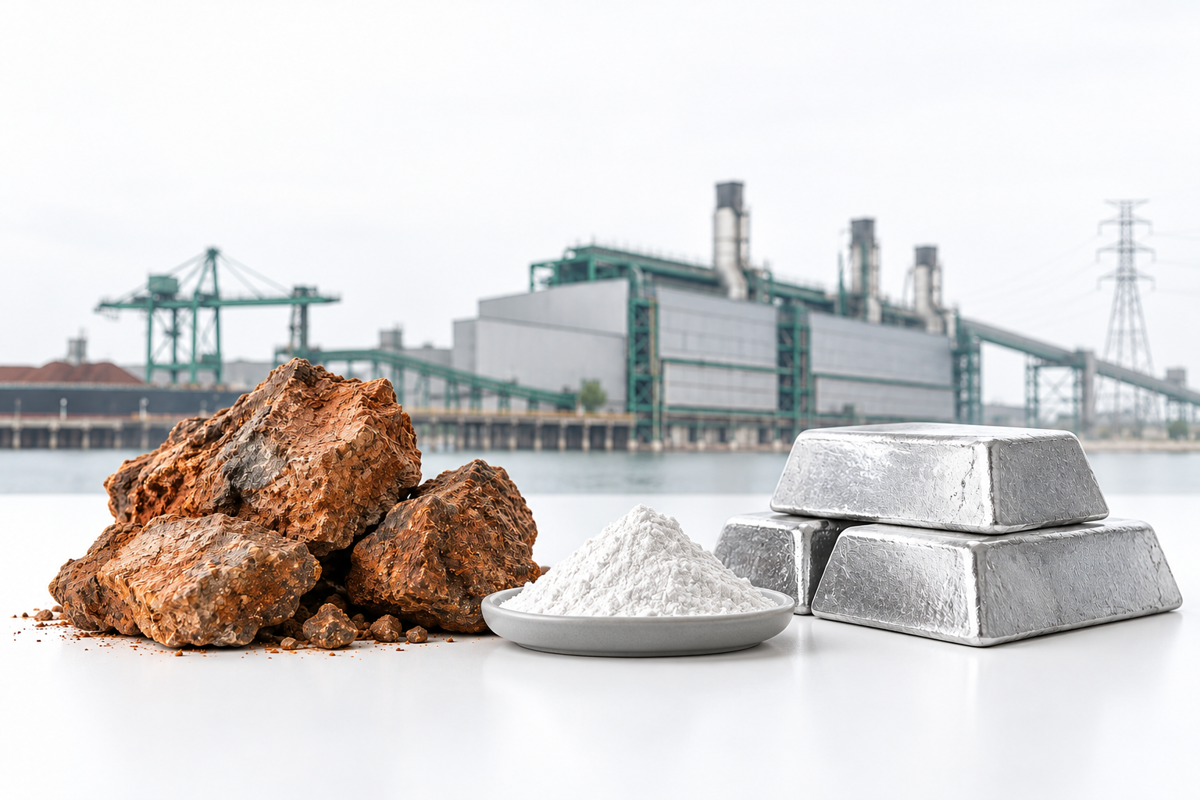
The image used in this article is generated with an AI tool and does not depict any real-time moment
Indonesia is pitched as the next big Asian aluminium hub as the country has released an expansive alumina and aluminium expansion plan, based on the abundant bauxite resource in the country. China has exhausted its aluminium capacity cap and is unlikely to raise installed capacity significantly in the coming years. Additionally, geopolitical conflicts, sanctions, and tariffs have made much of global aluminium capacity inaccessible and vulnerable. This includes Russian aluminium and the Gulf output, along with restricted and costly access to Canadian aluminium for the US smelters. The already tight supply conditions have been made worse after the Iran-Israel-US war that disrupted the Gulf aluminium capacity.
Under current supply conditions, India and Indonesia will play a critical role in building alternative aluminium capacity. As part of the series, “The Rise of Global Aluminium Hubs Outside China”, the second chapter will explore Indonesia’s potential as a key player in the global aluminium landscape. We will also break down the challenges and opportunities and explore how Indonesia can contribute meaningfully to the global aluminium supply chain.
The foundation
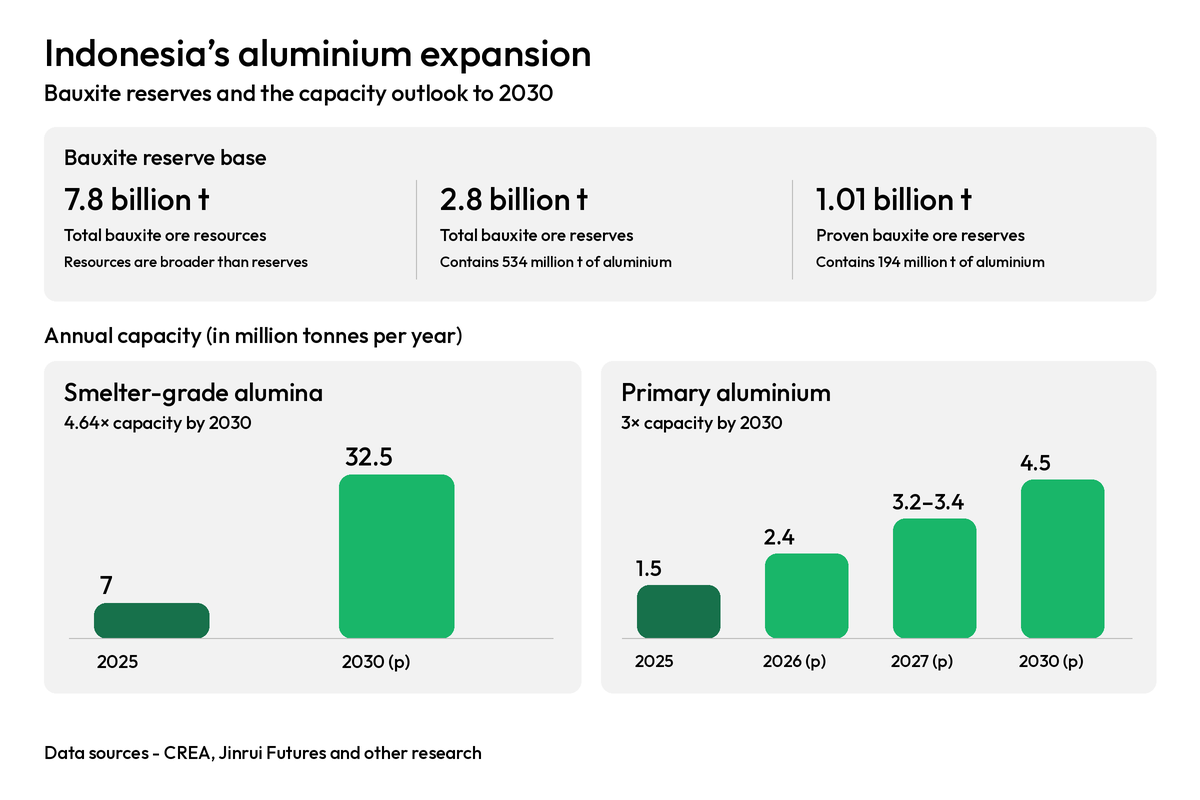
Indonesia has the fourth-largest bauxite resource globally, following Guinea, Australia, and Vietnam. The country has a total bauxite ore resource of 7.8 billion tonnes, with about 2.8 billion tonnes of bauxite reserves containing 534 million tonnes of metal. Proven reserves total 1.01 billion tonnes, containing 194 million tonnes of aluminium metal. This makes it one of Asia's most promising regions for aluminium smelting.
According to Indonesia's Ministry of Energy and Mineral Resources, 65 per cent of Indonesia’s bauxite reserves are high-grade, with over 46 per cent alumina (MEMR, 2025). This distribution reflects both industrial strength and systemic uncertainty - while the reserve base is considerable, a large share still depends on further feasibility assessments.
Geographically, Indonesia’s bauxite reserves are highly concentrated in West Kalimantan, with about 460 million tonnes, or 86 per cent of national reserves, containing 534 million tonnes of metal. Riau Islands and Central Kalimantan also host additional deposits, along with Bangka Belitung.
Downstream shift: the driving factors
Mining policy shift
A major policy shift by the Indonesian government drove this downstream expansion in bauxite. After the nickel export ban in January 2020, Indonesia’s bauxite export ban took effect in June 2023. The ban aimed to curb rampant bauxite mining and exports of raw ore. This was followed in 2024 by a copper concentrate export ban to drive domestic downstreaming and processing of critical raw materials.
Indonesia’s Law No. 3/2020 (the Mining Law) required bauxite miners to sell ore to domestic smelters and incentivised them to invest in alumina refineries in exchange for mining export quotas. As a result, the law spurred a series of investments in domestic alumina refineries, especially around West Kalimantan.
State-backed investments
This downstream push is further reinforced under President Prabowo Subianto’s Asta Cita (eight aspirations) mandate, which aims to drive economic and social growth through 17 priority programs including industrial downstreaming. As a result, Indonesia is transitioning from a raw bauxite exporter to a dominant alumina refinery hub in Asia, with plans to expand further up the value chain.
Indonesia officialised its downstream investment plan with the launch of Danantara Indonesia (Badan Pengelola Investasi Daya Anagata Nusantara) in 2025, a state-backed sovereign wealth and investment management agency. The agency will bring together state-owned enterprises to drive national economic growth, industrialisation, and export competitiveness.
Danantara launched its first phase of downstream developments in 2026, with a USD 7 billion (IDR 118 trillion) infrastructure portfolio. The investment targets domestic aluminium expansion, under the state-owned mining conglomerate MIND ID, with two alumina-aluminium projects in Mempawah, West Kalimantan.
Chinese investment
Global aluminium market dynamics also drove sudden interest in Indonesia’s aluminium expansion. US and European aluminium capacity has been falling steadily due to energy insecurity and unviability. South32 closed its Mozal Aluminium smelter this year, further reducing capacity. Meanwhile, China implemented a cap on primary aluminium production at 45 million tonnes per year to curb overcapacity and control carbon emissions.
China’s primary aluminium production has crossed its self-imposed ceiling, reaching 45.05 million tonnes in 2025. As a result, China is considering building integrated primary aluminium capacity outside China to meet domestic demand. Meanwhile, Guinea, China's largest bauxite supplier, is considering export restrictions to develop a domestic alumina refinery. In this scenario, Indonesia has emerged as the ideal destination because of its large bauxite reserves and supportive government investment policies.
Reports indicate that about 75 per cent, or 34 of 45, of all bauxite and aluminium projects in Indonesia are funded by Chinese companies, either through direct investment or joint ventures with Indonesian miners. China has already established the ecosystem needed to develop aluminium facilities, including logistics networks, captive power assets, and connecting infrastructure.
Existing capacity and expansion plans
As outlined in a report by the Centre for Research on Energy and Clean Air (CREA), Indonesia’s total smelter-grade alumina production capacity is expected to jump fourfold to 32.5 million tonnes per year by 2030 from 7 million tonnes in 2025. Chemical-grade alumina capacity remains flat at 300,000mt, keeping investment focused on primary metals rather than high-value speciality products. Consequently, bauxite demand is estimated to jump from 14 million tonnes to 65 million tonnes per year.
Meanwhile, primary aluminium smelting capacity is likely to increase from 1. 5 million tonnes in 2025 to 4.5 million tonnes by 2030, if the downstream expansion projects are implemented as planned. Jinrui Futures expects Indonesia’s primary aluminium nameplate capacity to rise from approximately 1.5 million tonnes per year in 2025 to around 2.4 million tonnes in 2026 and 3.2–3.4 million tonnes in 2027.
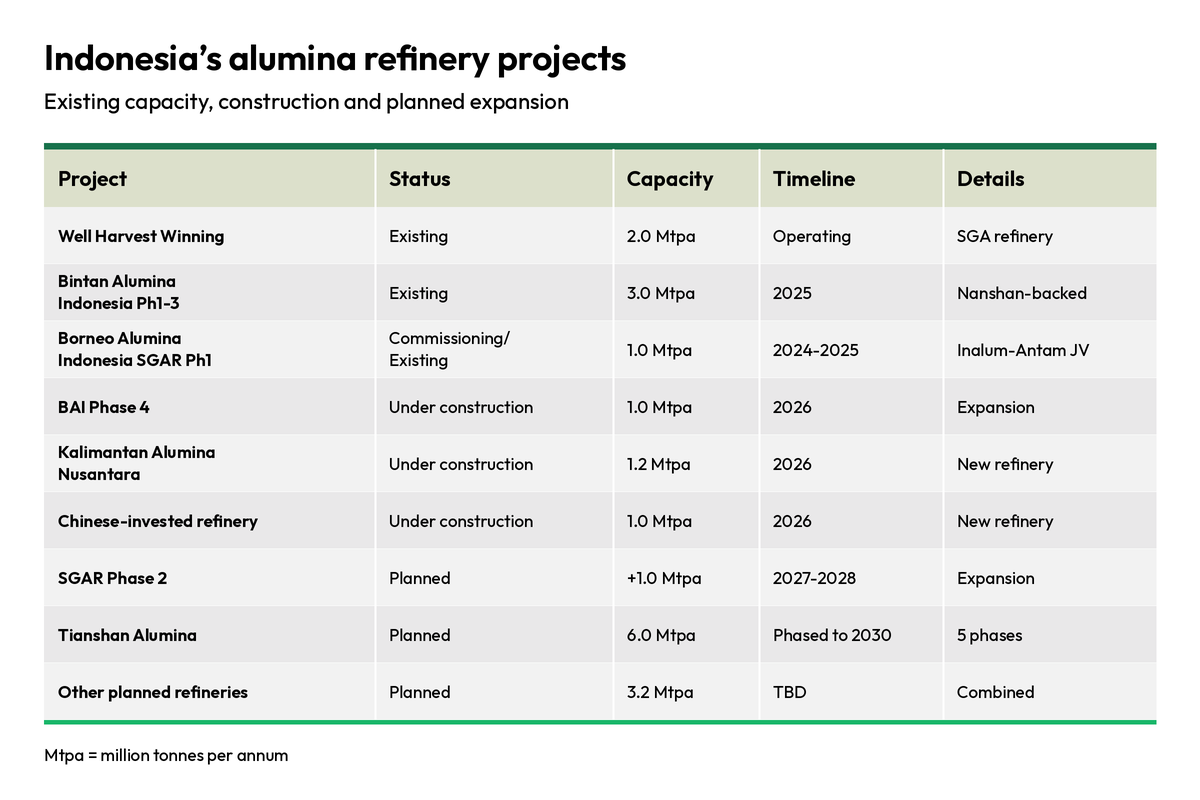
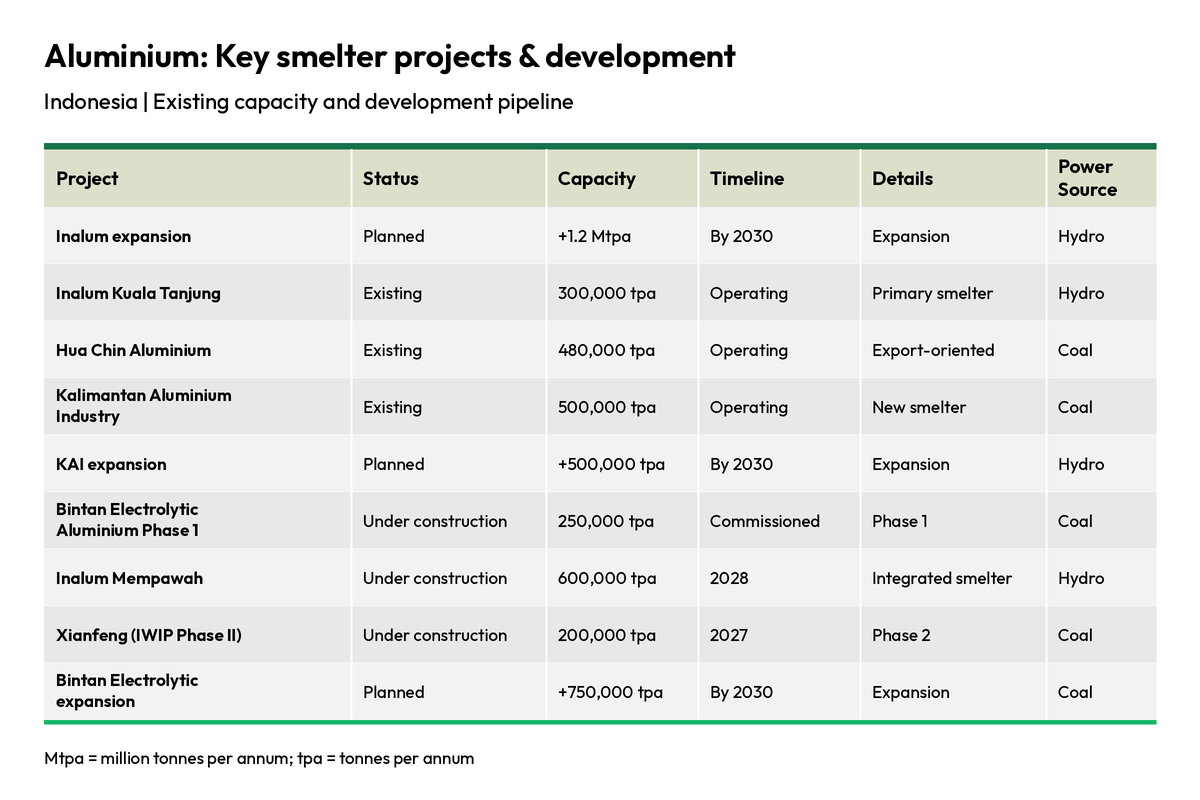
(Note: PT Kalimantan Aluminium Industry (KAI) has already commissioned Phase I of its aluminium smelter with a capacity of 500,000 tonnes per annum. Developed by PT Alamtri Resources Indonesia Tbk (IDX: ADRO), the smelter exported its first shipments of primary aluminium in June 2026, marking the commercial debut of one of Indonesia’s newest aluminium smelters. The planned subsequent phase is expected to be commissioned by 2030, adding more than 500,000 tonnes per annum of capacity.)
Challenges
1. Resource depletion
The aluminium expansion plan is likely to deplete Indonesia’s proven 1 billion tonnes of bauxite reserves in under 12 years, according to CREA. Similar resource exhaustion is expected in coal, with about 9.8 GW of existing captive power currently fuelling the aluminium sector. About 32 prospective projects are likely to add another 8 GW.
Indonesian state-owned aluminium producer Inalum flagged oversupply concerns and pressure on the country’s bauxite reserves. Inalum CEO Melati Sarnita said the aluminium industry will face overcapacity issues similar to the nickel sector after rapid growth. This may raise environmental concerns and negatively affect aluminium demand and prices. The company urged the government to revise expansion plans to preserve resources responsibly.
2. Emission concerns from coal-based power
The expansion of alumina refineries and aluminium smelters could significantly increase Indonesia’s energy demand and emissions. Meanwhile, most proposed projects still rely on captive coal-fired power, with limited integration of renewable energy.
Petromindo identifies approximately 10.3 GW of major project-linked power capacity across North Kayong, IMIP, IWIP, Mempawah, Ketapang, KAI and the new Bintan plant. Of the 10.3 GW, 8 GW is linked to coal power and supported by about 32 prospective projects. Petromindo projects potential annual coal requirements of close to 45 million tonnes. Coal can provide firm baseload electricity and support Indonesia’s near-term production objectives.
However, power costs, reliability, and carbon intensity are becoming increasingly relevant to aluminium producers and investors. If the planned capacity is realised, the downstream aluminium push could drive another wave of captive coal development, potentially pushing the industry into a carbon-intensive growth path. This may derail Indonesia’s decarbonisation plan and increase environmental hazard. Furthermore, such carbon-intensive output may prove uncompetitive in the growing carbon-conscious export market.
3. Energy security, the key criteria
Indonesia’s aluminium expansion plan will depend heavily on the timely commissioning of power-generation and transmission infrastructure. Despite the growth projections, actual production is expected to remain below nameplate capacity, increasing from around 730,000–880,000 tonnes in 2025 to 1.30–1.45 million tonnes in 2026 and 2.60–2.70 million tonnes in 2027.
The difference between nameplate capacity and actual production reflects the commissioning period of new facilities, delays in power availability, shared electricity arrangements, and projects that may begin production only in the second half of the year. The 2027 production outlook therefore depends on successfully coordinating power generation, transmission, reserve capacity, rectifier systems, carbon anodes, and electrolyte materials with aluminium potline commissioning.
Also read: India: The next big Asian aluminium hub
Individual project status
· Indonesia Morowali Industrial Park (IMIP)
The Indonesia Morowali Industrial Park (IMIP) currently provides clear evidence of alignment between aluminium production and electricity availability. Jinrui Futures reports that generating units U3 and U9, with combined capacity of approximately 760 MW, are operating and supporting Hua Chin’s roughly 500,000-tonne-per-year capacity. Taijing also has approximately 760 MW from U10 and U11, following the redirection of those units from the original Hua Chin Phase II plan.
Customs data also indicate that IMIP has progressed beyond the main power-equipment delivery phase towards installation and testing. Cryolite imports through Morowali increased significantly in the first half of 2026, indicating production has started. Petromindo’s separate project assessment similarly identifies Hua Chin as operating and Taijing as undergoing power-on commissioning, while also identifying a broader Xinfa aluminium-power integration project.
· Indonesia Weda Bay Industrial Park (IWIP)
Indonesia Weda Bay Industrial Park (IWIP) presents a more complicated situation because substantial electricity generation capacity already exists alongside large nickel and nickel pig iron operations. The key issue is therefore not simply total installed generation capacity, but the amount of firm electricity available to individual aluminium projects after existing nickel-related demand is met. Tsingshan reportedly asked NPI producers to reduce output to free up electricity for aluminium smelters.
This timing matters for several aluminium projects. Juwan needs additional generation to increase utilisation, Xianfeng may need more electricity from the shared system, and Halmahera depends on a separate generation program.
- KAI Phase I
KAI Phase I in North Kalimantan has a 500,000-tonne-per-year capacity and requires approximately 800–900 MW at full load. Its associated generation platform comprises four units with a combined capacity of around 1,100 MW. Petromindo identifies a closely comparable 1,060 MW thermal platform and classifies KAI as operating and ramping up.
Export shipments recorded in June 2026 confirm that KAI has moved beyond construction and trial energisation. Jinrui estimates KAI’s 2026 production at approximately 120,000–180,000 tonnes, despite the 500,000-tonne annual nameplate capacity.
For 2027, the main issue is whether all four generating units can provide the reliability required for continuous potline operation.
- Bintan and Halmahera
Nanshan’s aluminium expansion at Bintan has several announced power arrangements, but physical evidence of near-term readiness is comparatively limited. Petromindo identifies an existing 160 MW self-owned thermal plant, a 4 × 150 MW power plant under development, along with a 20-year third-party power purchase agreement. Jinrui expects only approximately 50,000–100,000 tonnes of Nanshan production in the second half of 2027 rather than a full-year contribution from the 250,000-tonne-per-year first phase.
Halmahera could contribute about 200,000–250,000 tonnes in 2027, but its power-generation schedule remains a key uncertainty.
- Inalum expansion
Inalum has an established hydropower-based electricity system that supports its existing 275,000-tonne-per-year aluminium smelter. Petromindo identifies approximately 509 MW of hydropower together with around 25 MW of additional PLN supply. Petromindo cancelled a previously planned 3 × 300 MW coal-fired expansion, leaving no clearly defined near-term electricity solution for a proposed additional 50,000 tonnes per year of aluminium capacity.
- Bosai provides a grid-based power model.
Bosai’s Pasuruan project represents another power-supply model. Petromindo is building a 600,000-tonne-per-year smelter, supported by a PLN commitment of approximately 1,260 MVA through the 500 kV system, with a target start-up in April 2027.
- North Kayong
North Kayong represents a different sequence, with power infrastructure progressing ahead of the associated metallurgical projects. Petromindo identifies a 7 × 380 MW power platform, representing approximately 2.66 GW. The immediate contribution to primary aluminium production remains limited because the associated metallurgical projects are less advanced.
Indonesia’s aluminium export dynamics
Indonesia’s aluminium exports are increasingly concentrated around its newer production centres. In the first half of 2026, Bahudopi, Weda, and Tanjung Selor accounted for most aluminium export volumes, while Kuala Tanjung remained a smaller contributor. If Indonesia reaches the 2.60–2.70 million-tonne production estimate for 2027, it will become a significant source of additional primary aluminium for global markets. However, the timing of new production depends on commissioning power projects.
The road ahead
Indonesia’s aluminium pipeline can support a substantial production increase, but the 2027 outlook depends on synchronising power generation, transmission, potline commissioning, and raw-material supply rather than simply adding nameplate capacity. The 2.60–2.70 million-tonne production estimate for 2027 therefore depends on several project timelines converging within a relatively narrow period. The central issue for Indonesia’s aluminium expansion is whether it can bring electricity generation, transmission, potlines, and logistics online as an integrated production system.
Indonesia’s aluminium expansion plan remains subject to energy security and raw-material constraints. Despite infrastructure and investment support, projects are unlikely to materialise significantly before 2030. The country’s expansion plan is unlikely to help it avoid the recent supply crisis in the aluminium sector. Indonesia needs to explore renewable power sources to remain credible in the export market. Further, the expansion plan needs recalibration so that the aluminium sector does not face the same overcapacity and bearish conditions currently weighing on the nickel sector.
NOTE: This is an exclusive AL Circle coverage and may not be reproduced, republished or shared without prior permission
LME aluminium cash bid slips to $2,998.50 as three-month prices fall 0.63%
Next articleEx-China aluminium market remains weak, spot offers in major markets fall under pressure
Grow with
AL Circle