Just when the Indian aluminium industry is prioritising its production, aiming to increase it by sixfold to achieve more than 30 million tonnes per annum of output from the present 4.2 million tonnes, the mandate issued by Renewable Consumption Obligation seems to have dampened the spirit because the mandate says the captive power consumers must derive 29.91 per cent of electricity from renewable sources and scale it up to 43.33 per cent by FY2030. On paper, this mandate is a well-meaning policy designed to support the Indian manufacturing industry to decarbonise its production, but in case of aluminium, some are of the opinion that it contradicts the country’s ambitious production dream and may even stall the progress it seeks to accelerate.
Critics warn that aluminium smelting requires uninterrupted, stable energy because it operates 24×7. Even a brief outage can cause irreversible damage and may even lead to operation shut down for up to two years. In such scenario, renewable energy in its current form is intermittent in nature because it is dependent on weather. For many industries, it is a manageable inconvenience but not for aluminium.
Recognising the concern, NITI Aayog, the government’s own think tank, has stated unequivocally in its report on the aluminium industry: “It is unfair to expect the aluminium industry to source their power from renewable sources as it needs stable, concurrent, uninterrupted and quality power.”
Lessons from global peers
Here the question arises if uninterrupted power is so critical, how do aluminium producers abroad manage to embrace renewables? Company like Rusal for Rusal Allow sources over 90 per cent of the electricity from hydropower, while Norsk Hydro in Norway relies on more than 70 per cent of renewable energy for electricity. How do they manage? The answer lies in advanced technologies like pumped hydro storage, battery storage, thermal energy storage, mechanical energy storage, and hydrogen electrolysis. These technologies balance the intermittency of renewables by storing or converting energy for use when required.
In India, the problem is it still lacks this infrastructure at the magnitude that aluminium demands. In the current form, intermittent renewable energy paired with storage solutions cost more than double the captive power generation. Especially, in a country where electricity accounts for 40 per cent of the total production cost of aluminium, and the country that sets its aluminium prices based on the global London Metal Exchange benchmark, the additional costs of renewable energy storage infrastructure would pass on to the consumers. The result would be heavy costs dampening demand in the domestic market.
The renewable push and its limits
Although the exact consumption of renewable energy by the entire aluminium industry in India is not known, but it is for sure that the country has made remarkable strides in building renewable capacity, standing as the fourth largest in the world with its renewable energy capacity (including hydro). It is fourth in wind power capacity and in solar power. Since 2014, India’s solar power installation capacity surged from 2.6 GW to 70.10 GW, while wind capacity grew from 21 GW to now at 43.7 GW. By 2030, the aim is to install 500 GW of renewable energy.
For a country like India where infrastructure is a concern and so is the cost associated with it, 30 per cent of the whole requirement of electricity in the aluminium industry can be met through renewable energy, which is also close to 29.91 mandate issued by the Renewable Consumption Obligation. According to a research analyst, hybrid power plant can supply 400 MW of RTC RE using the combined electricity generation capacity of a 400-MW solar power plant, a 900-MW wind power plant, and 100 GWh of battery storage. As per the prices and terms of this tender, we assumed that RTC RE power is available at INR 3.60 per kWh at the generation point, with an 80 per cent availability on an annual basis. Study shows the use of power sourced from renewable energy abates 49 per cent of emissions, corresponding to 38 MtCO2 of total emissions from the industry. The graph below shows that 49 per cent usage of renewable energy can help the Indian aluminium industry achieve the net-zero goal. In India, 20.88 tonnes of Co2 is emitted per tonne of aluminium production.
Emission mitigation pathway for alumina refining and aluminium smelting
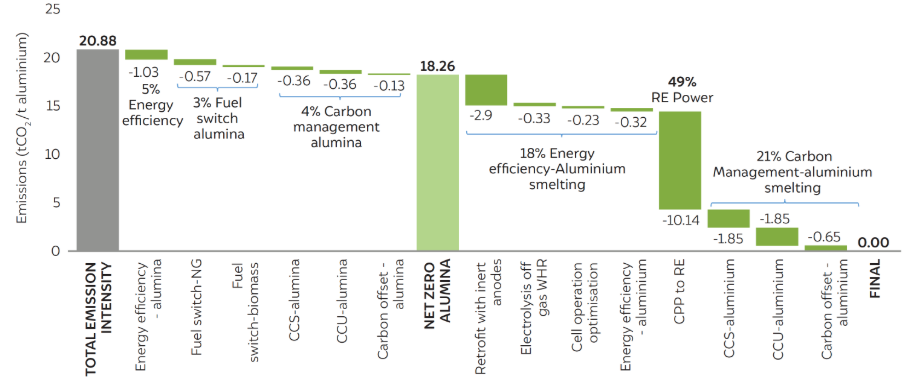 Image source: Ceew.in
Despite cost pressures, Indian aluminium giants like Vedanta Aluminium, Hindalco, and NALCO are already accelerating their renewable energy adoption. Vedanta Aluminium, for instance, aims to turn 30 per cent of its total power consumption to renewable energy by 2030, primarily to solar and wind power. It will source 1,335 MW of renewable power to supply its operations in Odisha and Chhattisgarh, as part of the 30 per cent target.
Overall, India’s aluminium industry is on track to integrate 18–20 gigawatt (GW) of solar and wind energy capacity by 2030, supported by 104 megawatt (MW)/416 megawatt-hour (MWh) energy storage systems, as per a recent report by JMK Research & Analytics. This green transition is anticipated to involve an investment of approximately $5 billion (around ₹42,500 crore).
By 2030, India aims to meet 50 per cent of the additional aluminium capacity requirements through renewable energy, transition the share of grid electricity currently used in smelting operations to renewable sources, and Replacing five per cent of the energy used in alumina refineries with green hydrogen—particularly in high-temperature processes such as calcination.
But the crux of the debate is there is a mismatch between ambition and feasibility. Industry analysts are pointing out that globally, renewable energy consumption in aluminium is 6 per cent, and India by contrast is mandating five times higher. They have also noted that India’s renewable energy generation (excluding large hydro projects, which are already tied up with the State discoms) accounts for only 13.9 per cent of total output in FY2025. With a compliance target of 29.91 per cent, there is already a 50 per cent shortfall in available renewable energy.
So, unless carefully calibrated, the RCO might risk India to scale back its production ambitions. The outcome could be a supply deficit, greater reliance on imports, and an uncompetitive domestic market - ironically undermining the very industrial growth the nation seeks to accelerate.
To get live market update from industry expert, watch our upcoming webinar.












_md.webp)