India has crossed an ambitious milestone by achieving 50 per cent of its entire installed energy capacity from renewable sources — five years ahead of its 2030 target for renewable energy under the Paris Agreement. This announcement and massive leap forward, confirmed by the Ministry of New and Renewable Energy, highlight India's increasing energy independence and increasing technological expertise in renewables.
Union Minister for New and Renewable Energy Pralhad Joshi commented on a social media platform: "India’s total installed energy capacity stands at 484.8 GW, of which 242.8 GW comes from non-fossil clean energy sources."
Solar’s dominant rise and aluminium solar panels
Solar energy has taken centre stage in India's green transition, contributing almost half a share of India's renewable energy pie. As of May 2025, India has 111 GW of installed solar capacity, 51 GW of installed wind capacity, and 48 GW of installed hydro capacity. One of the many things driving the growth of solar energy deployment is the use of new and environmentally sustainable materials. These materials include lightweight aluminium solar panels that enhance infrastructural efficiency and reduce costs. It also enables rapid project scaling across diverse terrains.
Corporate powerhouses at the helm
This rapid rise is not just a story of the government. The private sector has been the front-runner, with global leaders like Waaree Energies, Adani Green Energy Ltd. (AGEL) and NTPC Green Energy leading the charge through capacity and innovation.
For instance, Waaree Energies has seen a jump in module sales; they were up 59 per cent to 4.3 GW in FY25, including a share of exports. They received a lot of substantial orders, such as 410 MW from Aditya Birla Renewables and 362 MW from Engie India. The demands have positioned Waaree Energies within the solar module manufacturing sector, and they are gaining acceptance and commitment timely.
Meanwhile, NTPC Green is accelerating its growth as well, having commissioned 1.6 GW of projects already, with 9.1 GW under execution currently.
Adani Green’s giant leap in Gujarat
AGEL has just launched 187.5 MW of new solar capacity at Khavda, Gujarat, bringing its total operational renewable portfolio to 14,528.4 MW. The company is looking to move to add another 5 GW by FY26, of which 95 per cent has already been sanctioned and financed. CFO Saurabh Shah emphasised that financing on all debt has been secured and will allow for the expansion to go smoothly.
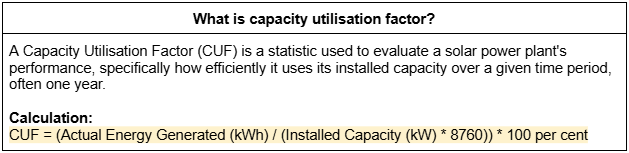
With regard to capacity utilisation factors, AGEL’s CEO Ashish Khanna noted that solar CUFs (Capacity Utilisation Factor) are exceeding 32 per cent for the current quarter due to India's highest 5.2 MW wind turbines and other technological advancements.
A blueprint for green growth
The early success of India reflects not only implementation commitment but also the acceleration exhibited by its private sector, which continues to set the global benchmark. In solar, aluminium solar panels have increased efficiency, and domestic mega players such as AGEL and Waaree have updated capacity records. India's clean energy story is now becoming a playbook for emerging economies globally.













_md.webp)
_md.webp)
_md.webp)