Norsk Hydro’s 2024 was challenging, but the business had an overall growth-hinting year. There have been several superlative financial, environmental, and social achievements during the calendar year.
While there was a drop in adjusted Return on Average Capital Employed (RoaCE) from 22.2 per cent in 2022 to 8.5 per cent in 2024, with an adjusted EBITDA standing at NOK 26.3 billion. Hydro has overseen the pursuit of its profitability target of over 10 per cent across the cycle. The company reported NOK 10.1 billion (USD 907.98 million) in accumulated improvements through its ongoing programme against the 2018 baseline, edging closer to its target of NOK 9.5 billion by 2024. Commercial ambitions also saw NOK 2.6 billion in accumulated improvements, reinforcing Hydro’s commitment to operational efficiency and growth while maintaining a strong pay-out ratio of 50 per cent.
The operating results are primarily affected by price developments of Hydro’s main products, raw materials, margin developments and fluctuations in the most significant currencies for Hydro, which are USD, NOK, EUR, and BRL.
Environmental performance
Hydro’s environmental performance was led by the global industry’s broader push towards sustainability. The company revealed in its annual report 2024 a 16.1 per cent reduction in total greenhouse gas emissions against the 2018 baseline, which is also a 4.2 per cent progress Y-o-Y. The company has advanced in reducing non-greenhouse gas emissions, including a 57 per cent cut in sulphur dioxide emissions, 67 per cent in nitrogen oxides, and 37 per cent in particulate matter, all against the 2017 baseline.
Sustainability performance
Hydro’s recycling capacity reached 451 thousand tonnes, advancing towards its ambition of 850-1,200 thousand tonnes by 2030. Waste management efforts saw 19 per cent of total waste directed to landfills, reflecting the company’s aim to eliminate recoverable waste landfills by 2040.
Chemical usage and waste production are present at all sites, with an inherent risk of spills and leakages. Aluminium, bauxite and alumina are the business areas most exposed to potential impacts on the environment due to the volumes and nature of hazardous materials used in operations as well as the locations of large sites. There has been a reduction in the number of environmental incidents reported across Hydro in 2024 compared to the previous year. Although bauxite mining in the Amazon region requires the removal of overburden as well as vegetation clearing activities with a material environmental impact on biodiversity, the strip mining method allows for the progressive rehabilitation of mined areas. A robust rehabilitation process is in place at Paragominas with key support from the Biodiversity Research Consortium (BRC). Hydro is pursuing its own Nature Positive-related ambitions to supplement the ongoing 1:1 rehabilitation practice.
Hydro encountered one fatal accident in 2024. Hydro has not been exempt from challenges in ensuring worker safety in industrial operations. Total recordable injuries improved to 2.0 per million hours worked, down from 2.4 in the previous two years.
It has expanded its employee development initiatives, reaching 206 thousand individuals with skills and education programmes. Progress towards gender diversity targets was evident, with women comprising 24 per cent of employees and 21 per cent of leadership roles, both on track to meet the 2025 target of 25 per cent.
Governance and compliance remained robust, with one substantiated claim of corruption reported in 2024. Hydro maintained its focus on fostering a culture of integrity and trust, achieving a 77 per cent score in its integrity culture index. Compliance awareness and training saw over 51,000 completed modules, reinforcing the company’s commitment to high governance standards.
Social performance-related risks continue to be influenced by a combination of increasing customer and civil society expectations, scrutiny, as well as legislative development in Norway, Brazil, and Germany and the implementation of the EU Corporate Sustainability Due Diligence Directive (CSDDD). The EU is also pushing ahead with its Forced Labor Ban regulation, which aims to stop sourcing from regions with state-sponsored forced labour risks.
Human resource management
The 2024 ended with Hydro employing 4161 staff in the bauxite and alumina projects, 479 in the energy segment, 4418 in the aluminium production department and 1523 people in the metals market segment. Meanwhile, Hydro’s most heavily staffed segment, with 19,617 employees, stood tall in the extrusions segment.
Q4 vs nine-months consolidated
In the first nine months of 2024, Hydro’s adjusted EBITDA totalled NOK 18,617 million, up by 0.52 per cent from NOK 18,522 million during the corresponding period of the previous year.
Hydro’s adjusted EBITDA for the fourth quarter of 2024 was NOK 7,701 million (USD 691.5 million), up 106 per cent from NOK 3,737 million (USD 335.5 million) in the same quarter last year. The results increased from higher alumina and all-in aluminium prices, and positive currency effects.
This was partly offset by higher raw material costs, lower extrusions volumes and recycling margins, and higher fixed and other costs, including a tax settlement in Aluminium and a provision for future social projects in Bauxite & Alumina. Hydro generated NOK 1.7 billion in free cash flow during the fourth quarter, and 2024 adjusted RoaCE ended at 8.5 per cent.
Events of 2024 in a snapshot
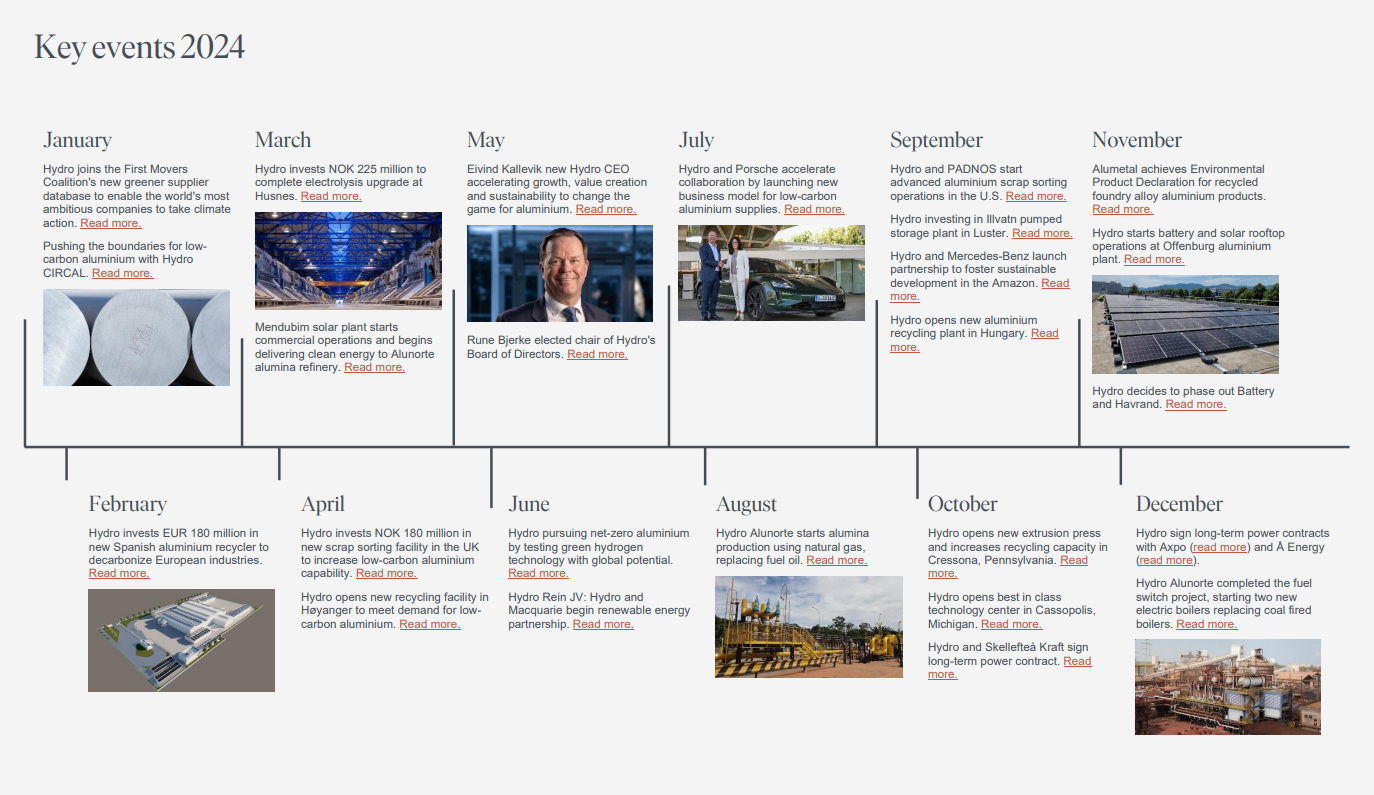
Norsk Hydro experienced an eventful 2024, where the year started for the business with the joining of the First Movers Coalition’s greener supplier database, furthering its commitment to sustainable procurement. The company also continued to push the boundaries for low-carbon aluminium through its Hydro CIRCAL initiative.
In February, aligning with its strategy to decarbonise European industries, Hydro announced a EUR 180 million (USD 188.28 million) investment in a new Spanish aluminium recycling facility. In March, another NOK 225 million (USD 20.2 million) investment in the Husnes electrolysis upgrade and the commencement of commercial operations at the Mendubim solar plant was announced, with an aim to access clean energy to the Alunorte alumina refinery.
In the subsequent three months, Hydro invested NOK 180 million (USD 16.16 million) in a new UK-based scrap sorting facility, saw leadership changes with Eivind Kallevik becoming the new CEO as Rune Bjerke was elected as the new Chair of the Board of Directors and formed Hydro Rein JV with Macquarie for renewable energy partnerships.
In July, Hydro and Porsche launched a new business model for low-carbon aluminium supplies. Whereas, in August the business witnessed Hydro Alunorte starting alumina production using natural gas, replacing fuel oil.
The concluding four months were about multiple developments like the start of advanced aluminium scrap sorting operations in the U.S. with PADNOS, investment in the Illvatn pumped storage plant in Luster, and a partnership with Mercedes-Benz for sustainable development in the Amazon. Hydro also opened a new aluminium recycling plant in Hungary.
Hydro opened a new extrusion press in Cressona, Pennsylvania, and a technology centre in Cassopolis, Michigan, alongside signing a long-term power contract with Skellefteå Kraft. In November, Alumetal achieved an Environmental Product Declaration for recycled aluminium products and the start of battery and solar operations at the Offenburg aluminium plant. Hydro also announced the phase-out of Battery and Havrand.
Finally, in December, Hydro signed long-term power contracts with Axpo and A Energy and completed the fuel switch project at Alunorte, installing two electric boilers to replace coal-fired ones.
All information and images sourced from: https://www.hydro.com/