China, which has been the long-standing dominator of rare earths and its supply chain, imposed strict restrictions on rare earth exports on October 8. Many dependents on China’s rare earth, including the US and the EU, faced impacts, but later on, managed to strike a year-long truce. Beside China, the EU also entered into rare earth supply agreements with Canada, Namibia, Chile and others. Meanwhile, the bloc is also targeting to become self-reliant with 10 per cent extraction, 40 per cent processing and 15 per cent recycling. We are here to analyse if self reliance with no trace of domestic rare earth mining would be feasible for Europe.
EU’s imports of rare earth from China
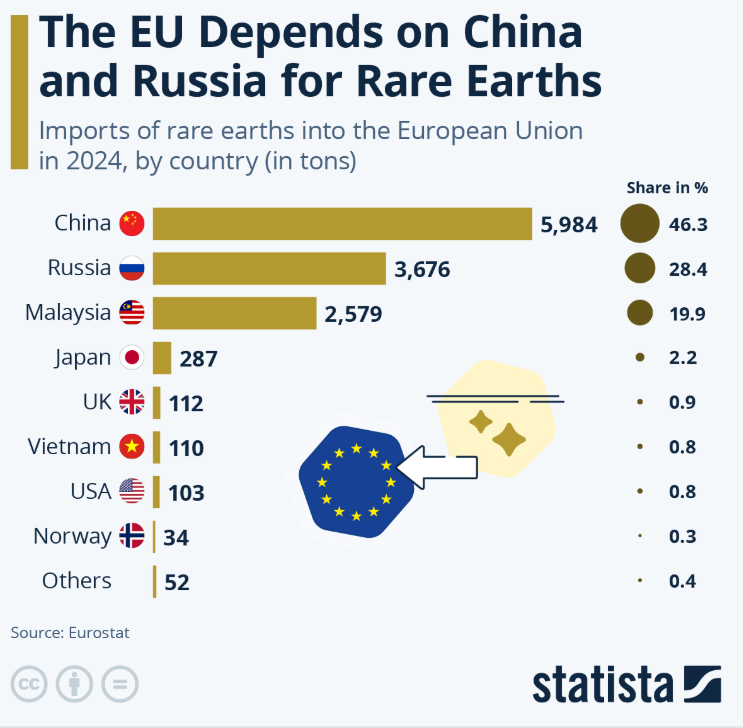
As per the report of Statista, the EU imports nearly half of its rare earth from China, followed by Russia, which accounts for almost 29 per cent and then Malaysia at 20 per cent. In 2024, the EU imported a total of 5,984 tonnes of rare earth from China, 3,676 tonnes from Russia, and 2,579 tonnes from Malaysia. Other countries like Japan, the UK, Vietnam, the USA, and Norway also export rare earth to the EU.
(Image source: statista.com)
As the number says, the EU’s dependency on China in 2024 accounted for 46.3 per cent, which further nudged the bloc to target becoming self-reliant, but is it truly possible in the next 5 years?
Being self-reliant is just a dream or soon to be reality?
Europe hosts just two rare earth processing facilities, one located in Estonia and the other in western France. The plant in France is the only facility outside of China that can process all 17 rare earth elements, which can attract immense investment, especially as it transitions from mainly catering to the catalytic converter market to addressing the rising demand for rare earth magnets. In the short term, the facility is focusing on recycling rare earths that are already in circulation across Europe, as it is deemed that about 30 per cent of the region’s needs can be met by reclaiming materials from old motors and other equipment.
In May 2024, the EU imposed the Critical Raw Materials Act (CRMA), setting targets for 17 strategic raw materials (SRMs), which are vital and in short supply. By 2030, the EU plans to produce at least 10 per cent of the raw materials to consume domestically, process a minimum of 40 per cent of its consumed processed output and recycle at least 25 per cent of its consumed recycled output. Additionally, the CRMA limits dependence on any single external supplier to no more than 65 per cent for each strategic raw material, emphasising the EU’s commitment to diversifying its supply chains and enhancing resilience.
A bold initiative by Ursula von der Leyen, the European Commission President, is looking to secure Europe’s independence in the critical raw materials. At the Berlin Global Dialogue Forum 2025, the European Commission President introduced “RESourceEU”, the EU’s new initiative to reduce the bloc’s dependency on China. Under this initiative, the bloc is planning to increase its efforts to secure dependable, locally-sourced supplies of critical raw materials for both the short and long term.
On the other hand, Rare Earths Norway is collaborating with both local and national authorities to develop a zoning plan for unveiling a pre-feasibility study by the end of the year. However, despite these advancements, the company is still looking at a lengthy development timeline, indicating its first commercial deliveries of rare earths cannot be scheduled before 2030. To push forward with its exploration efforts, the firm further plans to use an “invisible mine” strategy at the Fen site, an approach that enables rare earth elements extraction while minimising surface disruption and reducing environmental footprint.
Explore- Most accurate data to drive business decisions with 50+ reports across the value chain
The EU is also working on two key projects that focus on extracting rare earth elements. These are crucial for producing high-performance magnets that power wind turbines and electric motors, which are essential for renewable energy and e-mobility. Alongside three other EU-based projects aimed at processing rare earths, this expanded initiative is designed to bolster the EU’s supply security and minimise vulnerabilities throughout the rare earth value chain.
EU’s strategic investment
The EU is investing at least EUR 3 billion (USD 3.5 billion) in the coming years to reduce its dependence on China for rare earths that are crucial for modern technologies and defence systems. This funding will come from various EU programs, including EUR 2 billion (USD 2.16 billion) to invest in raw materials between 2026 and 2027. Additionally, EUR 700 million (USD 756 million) will be invested to boost the supply chains and promote climate-friendly technologies.
The European Commission is set to officially present the proposal today, December 3, although the numbers are subject to change after the proposal. These commitments are part of the “RESourceEU” initiative, which also aims to create a European Critical Raw Materials Centre to guide investments, build stockpiles, coordinate joint procurement, and enhance the recycling and reuse of materials within the EU.
Solvay has secured two supply agreements with the US magnet manufacturers to increase its rare earth processing efforts at its facility in France. It is one of the few companies outside China with advanced rare earth separation technology. Solvay began the limited processing of magnet-grade minerals at the plant back in April. However, the company pointed out that reaching full commercial production will depend on ongoing support from both customers and government stakeholders in France.
Must read: Key industry individuals share their thoughts on the trending topics
Japan, which is the first country to face a halt in the supply of rare earth from China, is reported to be improving now, with an import dependency of 62 per cent, irrespective of indulging in many investments in the past 15 years. Tokyo is building a strong alliance with Australia, Vietnam and Kazakhstan, promoting higher domestic recycling with strategic reserves along the subsidised operations. Currently, after China, the best bet for the EU is Japan, which is ready to be a partner to build a more sustainable production chain.
Besides importing rare earth from Japan, the EU should also focus on accumulating its technologies, which would aid in producing more of its own rare earths faster. Irrespective of the inter-country backing for each other, the EU must hone its expertise with Japan in exchange for its own to advance in this race faster.
With higher dependency on the rare earth imports and the domestic hurdles that the EU is currently facing, assessing whether it would be able to achieve the target of being self-reliant by 2030 still needs to be assessed.
Note: To feature your brand and share insights, contribute an article or interview in our forthcoming e-magazine "Mine to Market: ALuminium Producers & Manufacturers 2026"














_md.webp)
_md.webp)







