
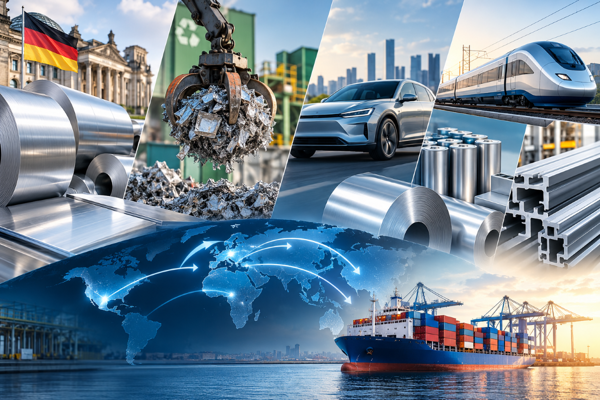
AL Circle analysis: Germany’s aluminium trade surplus, Novelis’ US expansion, Asia’s EV demand & India’s underutilised downstream capacity
Aluminium’s next growth phase is increasingly being shaped by downstream processing, supply-chain resilience and demand from specialised applications. Germany continues to generate a substantial trade surplus in flat-rolled products despite a shrinking primary aluminium base, while North America is investing in recycling and rolling. Across Asia, new manufacturing capabilities and growing demand from electric vehicles, railways and batteries are creating further opportunities. However, declining exports, underutilised capacity and uneven profitability show that investment alone does not guarantee success. For industry leaders, the challenge is to identify where demand is shifting, develop products that meet customer requirements and ensure that new investments translate into sustainable...
AL Circle Analysis: From Guinea to Gulf, how bauxite, tariffs and logistics redraw aluminium map
Aluminium markets in late 2026 are being shaped by more than the headline LME aluminium price. Bauxite security, alumina availability, geopolitical disruptions, tariff negotiations, logistics diversification and regional premiums are increasingly determining where metal moves and what buyers pay. From RUSAL reassessing Caribbean assets and Vedanta securing Odisha bauxite to Brazil extending mine life and EGA rebuilding its Guinea supply chain, producers are strengthening control over critical raw materials. At the same time, the US remains heavily dependent on imported bauxite and alumina, while Europe and Asia are experiencing sharply different premium dynamics. These developments point to a market where physical availability is becoming a regional factor even as aluminium itself remains...
Grow with
AL Circle

“Alumina refineries and aluminium smelters are increasingly realising the need for real-time process information,” Petra Mühlen, Partner and CEO, SpectraFlow Analytics
After working for 14 years in the family business Mühlen Sohn, which manufactures technical textiles and is also used in the aluminium smelters in sales and management roles, Petra started with the newly founded SpectraFlow Analytics in 2014. She has a master’s degree in mathematics and economics, which strengthens her quick technical as well as economic understanding. Her initial focus was on sales and technical implementation of the SpectraFlow product range over various industries. In 2020, she took over the CEO role as well. AL Circle: Please describe how SpectraFlow quantifies Gibbsite or Kaolinite content in bauxite ore. Does this technology ensure enhanced quality of bauxite? Petra Mühlen: SpectraFlow uses near-infra-red (NIR) technology to perform the real-time chemical analysis...

“The Asian aluminium extrusion market is steadily growing, especially in countries and regions such as China, Japan, India, and Southeast Asia.” Wang Xingyao, Founder of GLD ALLOYS (M) SDN BHD
Wang Xingyao is a seasoned veteran in the aluminium manufacturing industry with over 25 years of experience. He has successfully led several high-profile aluminium companies across Asia, producing various products including aluminium sheets, extrusions, and alloy wheels. Mr Wang’s expertise in supply chain management and operational efficiency has positioned him as a key player in the market. His leadership style is characterised by a keen focus on sustainability and environmental stewardship, ensuring long-term profitability while adhering to global best practices. Mr Wang’s vision and strategic acumen have consistently delivered impressive results, making him a valuable asset to the company. AL Circle: What motivated the founding of GLD ALLOYS (M) SDN BHD in 2024, mainly focusing on...
“The opportunities in Asia are still tremendous if one compares the aluminium consumption per capita of different countries and regions,” Dr-Ing. Oliver Moos, Managing Director, CETAG – Casthouse Engineering and Technology AG
Oliver started his professional life as a mechanical draftsman at a leading supplier of casthouse equipment in 1985. He worked in various technical and commercial positions for the same company after further education at the University of Applied Sciences in Konstanz, Germany, and the University of Brasov in Romania. Oliver became the Managing Director of CETAG in 2016. With its small but dedicated workforce, CETAG provides consulting services, project management, site services, and equipment to the aluminium industry worldwide. AL Circle: Please brief us about your services and solutions to the aluminium casthouse. How do you help casthouse enhance production while reducing carbon emissions? Dr-Ing. Oliver Moos: CETAG of Switzerland is an expert adviser in aluminium casthouse technology,...

“The mining industry has seen a surge in the adoption of drone technology in recent years.” Mughilan Thiru Ramasamy, Co-founder and CEO of Skylark Drones
Mughilan holds a master’s degree in Aerospace Systems from Purdue University, Indiana (USA). Mughilan designed over 8 Un-Manned Aerial Vehicles, all of which were successfully test-flown; he led the team to win the NASA Systems Engineering Award for engineering a holistic UAV-based solution. Mughilan is also on the R.V. College of Engineering board and helps them design industry-relevant courses. He has given over 100 talks and workshops. AL Circle: Please brief us on the functionalities of Spectra and their usage in bauxite mining. Mughilan: Spectra is a worksite intelligence platform that harnesses drone data to provide actionable insights. By using drone images, Spectra generates accurate 3D models at a centimetre scale, aiding in precise planning and monitoring. It runs on the cloud,...

“Asia is the largest and most important region in terms of aluminium supply in the world,” Dr Yanchen Wang, Managing Director, SMM (Shanghai Metals Market) GLOBAL UK Ltd.
Dr Yanchen Wang is the Managing Director of the SMM UK office, which was established in May 2021. Currently, he focuses on base metals, battery metals market research, and overseas business development for SMM. Dr Yanchen Wang has a PhD in Engineering from the Chinese Academy of Sciences and is a well-known analyst in the global commodity industry. His expertise includes the base metals market, the coal and power industry, and the carbon emission market. He has recently extended his research into the battery metals markets. He has visited more than 100 base metals assets around the world. Dr Yanchen Wang has more than 19 years of commodity market research experience. He also often attends technical and market conferences and gives presentations as a keynote speaker, like AABC, Cobalt...

China’s alumina production continues an upward trajectory in August, marking a 2.8% Y-o-Y rise
After surpassing 7 million tonnes in July 2024, China's metallurgical-grade alumina production continued its upward trajectory in August, showing a month-on-month increase of 0.67 per cent, according to the Shanghai Metals Market. On a year-on-year basis, the output in August registered a hike of 2.82 per cent. According to SMM data, China's alumina production in August 2024 stood at around 7.22 million tonnes versus 7.173 million tonnes in July. At the end of August, China's metallurgical-grade alumina capacity stood stable at around 100.6 million tonnes, with the operating capacity up by 0.81 per cent M-o-M. The operating rate was 84.63 per cent, compared to 83.5 per cent in July. From January to August, China's total alumina production amounted to approximately 54.686 million tonnes,...

Big wheels, bigger results: Cat 992 Loaders drive Bauxite Hill output to the maximum
Metro Mining Limited has significantly increased throughput rates at its Bauxite Hills operation in Western Australia. One of the biggest reasons was commissioning two new Cat 992 Wheel Loaders and installing a new screening system. The company introduced a new apron/wobbler feeder screening circuit in May, marking a key step in its expansion strategy. The integration and optimisation of the expansion are already yielding results, with Metro achieving a record monthly shipment of 720,000 tonnes (wet) in August 2024, a 13 per cent increase from July and a 29 per cent rise compared to July 2023, which AL Circle has already reported on September 6, 2024. This milestone came despite a two-day shutdown for conveyor belt replacements at the barge loading facility and planned transhippers...
“The aluminium market is global, and Asia is already a key region for aluminium production and consumption,” Vincenzo ZINNI, CEO & Maël de la BELLIERE, Co-Head of Sales and Marketing, Niche Fusina
Vincenzo ZINNI, Chief Executive Officer, joined Fusina in 2022 when Dada Holding and Invitalia acquired the plant. With a background in metal trading, he manages the group and drives the team to excellence, quality, and reliability. Under his management and focus, the plant is on track to regain its position in the marketplace. This is the result of a series of new investments and production improvements. Fusina, under its new leadership and ownership, has been able to be considered as one of the best suppliers for marine, road transportation, silos or defence applications. Maël de la BELLIERE, Co-Head of Sales and Marketing, joined Fusina in 2017. With a background in flat-rolled products at Alcoa and in the coil coating industry with Euramax, he is steering the development of markets...
“Aluminium has become the metal of choice for sunrise sectors,” John Slaven, CEO, Vedanta Aluminium
John Slaven is the Chief Executive Officer of Vedanta Aluminium, India's largest producer of aluminium and among the top producers globally. He is a reputed leader in the industry with over three decades of rich experience in the metals, mining and modern manufacturing industries. Through diverse positions in industry-leading companies within these sectors, John has helped shape the overall domain in transformative ways. He previously held key leadership positions at Alcoa, BHP, and The Boston Consulting Group (BCG) in roles across the industry value chain from exploration, development, operations, strategy, finance, and sales & marketing. Over the years, he has lived and worked in countries across the globe, including South Africa, the USA, China, Singapore, the Netherlands, Australia,...

China’s aluminium processing industry PMI hovers below 50% in August despite M-o-M growth
China’s comprehensive Purchasing Managers’ Index (PMI) for the aluminium processing industry witnessed an increase of 1.8 percentage point month-on-month, yet stood below the 50 per cent mark during August 2024, owing to the persistent traditional off-season in the domestic market. According to the Shanghai Metals Market survey, China’s PMI for the domestic aluminium processing industry was recorded at 43.6 per cent, with a few sectors standing as an exception above the 50 per cent mark. While the PMIs for China’s domestic construction aluminium extrusion and plate/sheet, strip and foil segment were below the 50 mark, the industrial extrusion segment and aluminium wire and cable sector witnessed PMIs of 51.97 per cent and 50.5 per cent. Although certain sectors recovered from the...

July 2024: Alumina production in Africa & Asia grows 4.5% Y-o-Y, raising its share of global output to 9.95%
In July 2024, alumina production in Africa & Asia (ex-China) recorded a month-on-month decline of 1.95 per cent, yet stood above 1.2 million tonnes, unlike in April and May when the region's alumina output was at 997,000 tonnes and 1.117 million tonnes, respectively. However, on an annual basis, the output grew by 4.49 per cent, leading to a greater contribution to the world alumina production, accounting for 9.95 per cent in July 2024 versus 9.5 per cent in July 2023. According to the International Aluminium Institute, alumina production in Africa & Asia (ex-China) during July 2024 was 1.209 million tonnes versus 1.233 million tonnes in June and 1.157 million tonnes in July 2023. The daily average production in July 2024 was 392,100 tonnes, down by 2.37 per cent from 401,600 tonnes a...

“The sustainability goals of the Indian aluminium industry are gaining momentum, with large players deploying a multi-pronged approach to reduce emissions.” Mayank Chauhan, Co-Founder and Chief Executive Officer of LogicLadder Technologies
As the Co-Founder and Chief Executive Officer of LogicLadder Technologies, Mayank Chauhan is a sustainability and Net Zero leader who empowers enterprises to navigate the climate economy. From envisioning to executing innovative solutions, he has meticulously crafted the growth narrative of India’s first climate tech company, LogicLadder. Today, the company’s climate action platform, The Sustainability Cloud, is used by 1000+ customers worldwide to measure, track, and report their carbon emissions, manage ESG initiatives, and drive their sustainability goals toward a Net Zero future. In his role, Mayank strategises product development and collaborates closely with local leadership in international markets to spearhead the continuous expansion of LogicLadder. With a wealth of experience in...

Brazilian miner MRN gains preliminary license for bauxite project lifespan extension
Brazilian mining company Mineração Rio do Norte (MRN), a joint venture between Glencore, Rio Tinto, and South32, announced on September 3, 2024, that it has received an initial license from the Brazilian environmental agency, Ibama. This approval marks a significant step towards extending the operational lifespan of its bauxite mining activities in northern Brazil. The license will enable MRN to continue extracting bauxite, a critical raw material in aluminium production, as the company seeks to maintain and expand its operations in the resource-rich region. Brazil's position in global bauxite production is noteworthy. It ranks among the top countries. However, as reported by USGS, Brazil's bauxite production stood at an impressive 31 million tonnes in 2023. Shareholding Structure of MRN...
"The Aluminium business from The GCC perspective." Mahmood Dailami, Secretary General of the Gulf Aluminium Council (GAC)
AL Circle : The world is likely to surpass a dangerous temperature threshold within the next ten years unless countries transition away from fossil fuels. GCC countries are currently using gas as a source of energy. How do you foresee the situation developing? Mr. Mahmood Dailami : Looking around, emissions reduction plans by most governments are falling short, and if the situation continues, the world will reach 2.8C degrees by 2100. We can reverse the trend by reducing the use of fossil fuels and helping developing nations develop their renewable energy facilities and infrastructure. The European Union is pressing Africa, India, and other countries to stop using Coal and wants the GCC to halt any new oil and gas exploration projects. If they do, these countries will commit economic...
“Asia's non-ferrous metal industry, specifically aluminium, has several key opportunities for growth,” Parmod Sagar, Managing Director & CEO – India, RHI Magnesita
Parmod comes with more than 3 decades of extensive experience of serving the steel and refractory industry. A Mechanical Engineer by profession, Parmod started his career in the steel industry and worked in the sector for over 7 years gaining valuable insights. Thereafter, he transitioned to the refractories business joining Orient Refractories Limited (ORL) as a Manager -Technical Marketing in 1992. In 2013, after RHI AG acquired ORL, Parmod was appointed in the role of Managing Director & CEO of ORL. He currently holds the position of the Managing Director and CEO of the RHI Magnesita India Ltd. Additionally, he is also the President of World Refractories Association. AL Circle: How do you see the aluminium industry's future evolving in the Asian market, particularly in the context of...

Volkswagen on cost curtail drive with plant closures amid raw material and production challenges
Volkswagen Group, a German public multinational conglomerate manufacturer of passenger and commercial vehicles, is reportedly considering closing one of its large vehicle plants and one component factory in Germany as part of the ongoing cost-cutting drive at its core VW brand. Cost curtail goal Through this cost curtail goal, Volkswagen Group aims to save €10 billion ($11.07 billion) by 2026 to save up for electric car manufacturing. Moreover, this move is much needed to streamline the production costs given higher logistics, energy, and labour value. Amid the economic upheaval impacting consumers’ purchasing power, Volkswagen Group recorded the H1 2024 brand margin falling to 2.3 per cent versus 3.8 per cent during the corresponding period of the previous year. Recently, the automaker,...

Africa’s primary aluminium production in July 2024 jumps by 4.65%, yet total Y-T-D output drops
Africa's primary aluminium production in July 2024 reached a new high compared to the previous six months' data but still stood lower than in the same period last year, found the International Aluminium Institute (IAI). According to IAI, Africa's primary metal output in July 2024 witnessed a month-on-month jump of 6,000 tonnes or 4.65 per cent, standing at 135,000 tonnes, the highest in seven months, but recorded a year-on-year drop of 1,000 tonnes from the production in July 2023. It is to be noted that Africa's primary aluminium production until July 2024 surpassed 130,000 tonnes for only two months. In the remaining five months, the output lingered below 130,000 tonnes, mostly ranging around 128 tonnes. February 2024 was the onlooker of this year's least primary aluminium production in...

Aluminium foil coating innovation: A new hope for microbe-free water purification
Globally, more than 2 billion people lack access to safe, uncontaminated drinking water*, with 418 million of them living in African nations**. This issue is particularly severe in rural areas, where rivers, lakes, and hand-dug wells serve as the primary water sources, often contaminated by harmful pathogens. The contamination stems from inadequate sanitation facilities, open defecation, and agricultural runoff, leading to devastating consequences. Waterborne diseases like cholera, typhoid, and diarrhoea claim hundreds of thousands of lives in Africa each year, with children being especially at risk due to their developing immune systems. This vicious cycle of waterborne illness not only endangers health but also entrenches poverty, as sick children miss school and adults are unable to...

