Italian officials are calling for an early review of the European Union's plan to ban the sale of new internal combustion engine vehicles by 2035. Energy Minister Gilberto Pichetto Fratin criticised the policy as "absurd" and driven by an "ideological vision," arguing that it imposes a rigid, state-controlled approach to policymaking within the bloc.
Speaking at the TEHA business forum in Cernobbio, Italy, Pichetto Fratin highlighted the significant challenges of the EU's decision, particularly in light of the ongoing slowdown in the European auto industry. He stressed that the ban should be reassessed to reflect shifting market realities.
Italy's Industry Minister Adolfo Urso also weighed in, suggesting that the planned mid-point review of the legislation, currently scheduled for 2026, be moved forward to the start of next year. This, he argued, would allow for an urgent and more immediate evaluation of the industry's ability to meet the new regulations.
Both ministers emphasised the importance of considering the policy's economic implications, calling for a more flexible approach as the EU pursues its green transition goals.
Adolfo Urso said in Cernobbio, "In an uncertain landscape which is affecting German automotive industry, clarity is needed to not let the European industry collapse."
"Europe needs a pragmatic vision; the ideological vision has failed. We need to acknowledge that."
The EU law mandates that all new cars sold after 2035 must have zero carbon emissions, effectively banning the sale of fossil fuel-powered vehicles across its 27 member states. However, Italy's right-wing government, led by Giorgia Meloni, advocates for greater flexibility in how member states meet the agreed decarbonisation goals. They support a more gradual transition from combustion engine technology rather than an abrupt shift. While Italian officials are not opposed to developing and producing electric vehicles, they argue that it should be part of a broader strategy that includes a diverse range of automotive propulsion systems.
On September 7, Renault CEO Luca de Meo warned that Europe's automotive industry could face fines of up to €15 billion ($17.4 billion) for carbon emissions, driven by a slowdown in demand for electric vehicles.
Automakers will face stricter EU CO2 targets in 2025, with the cap on average emissions from new vehicle sales dropping to 94 grams per kilometre, down from 116 g/km in 2024.
"If electric vehicles remain at today's level, the European industry may have to pay 15 billion euros in fines or give up the production of more than 2.5 million vehicles," de Meo said.
"The speed of the electric ramp-up is half what we would need to achieve the objectives that would allow us not to pay fines."
Car sales growth slowed in the first half of 2024, following last year's strong rebound in light vehicle sales, as anticipated. Notably, all three major car markets—China, the US, and the EU—experienced some growth during this period. In Europe, car sales (including the EU, the UK, and the European Free Trade Association) rose by 4.4 per cent year-on-year, according to the European Automobile Manufacturers' Association.
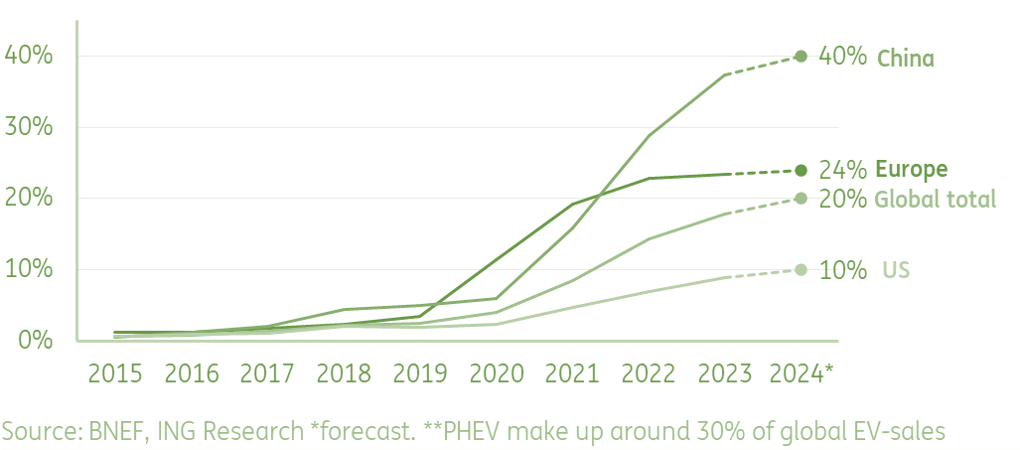
Share of electric vehicles (BEV+PHEV**) in total new car registrations per region
The European automotive industry is navigating a challenging period as it grapples with the historic transition to electric vehicles (EVs), compounded by growing competition from new players like BYD. Short-term priorities are significantly shaping the industry's direction, as the path to widespread EV adoption remains unpredictable and non-linear, with numerous uncertainties emerging in recent years. This shift intensifies pressure on European car manufacturers, all while total new car sales in their domestic markets struggle to recover to pre-pandemic levels.
Volkswagen Group CEO Oliver Blume emphasised the need for change, citing the shrinking European market and intensifying competition as key driving factors.
"Fewer cars are being sold in Europe. At the same time, new competitors from Asia are forcefully pushing into the market," Blume said.
Western-made electric cars have become less profitable for manufacturers due to rising competition and continued reliance on Chinese supply chains. This limits the rollout of more affordable, compact EVs consumers are eager for. Introducing tariffs on Chinese vehicles may hinder the energy transition, as it reduces the pressure on established automakers to launch new EV models. Affordability remains a key concern for adopting electric vehicles (EVs), particularly among low-mileage drivers. In Europe, the reduction of government incentives in Germany, the region’s largest market, caused a notable drop in sales during the first half of 2024.
Aluminium is a key material for electric vehicles (EVs), a market that has experienced a substantial surge in recent years. As predicted at the beginning of 2024, aluminium demand will be driven largely by the transportation sector, with EVs playing a significant role in 2024. Europe is not anticipated to witness a resurgence in aluminium production until 2025.
At the beginning of the year, the world faced challenges from previous years that influenced the supply and demand dynamics of aluminium and its derivatives. Geopolitical tensions, energy crises impacting various nations, persisting high inflation rates, an economic deceleration in the Western world, unresolved impediments in supply chains, and a waning growth trajectory in key economies are among the array of issues that may cast a shadow on the immediate growth outlook.













_md.webp)