The European Union's approach to Russian primary aluminium imports has significantly transformed in a landscape marked by evolving geopolitical tensions, as revealed by a recent report by Eurasia Strategic Consulting.
While presently, any formal sanctions on Russian aluminium remain absent, other than the earlier ban on the aluminium wire rod, foil, tubes, and pipes supplied from Russia, the practical reality of self-sanctioning by European importers and the ripple effects of secondary sanctions have dramatically altered the market dynamics.
Recent actions from the U.S. and UK governments have significantly influenced the shift in the EU's stance on Russian primary aluminium imports. In April 2024, both nations took decisive steps that led the London Metals Exchange (LME) and the Chicago Metals Exchange (CME) to exclude Russian aluminium from their trading systems. This move underscores a broader trend of economic isolation and highlights the growing impact of international pressure on trade practices.
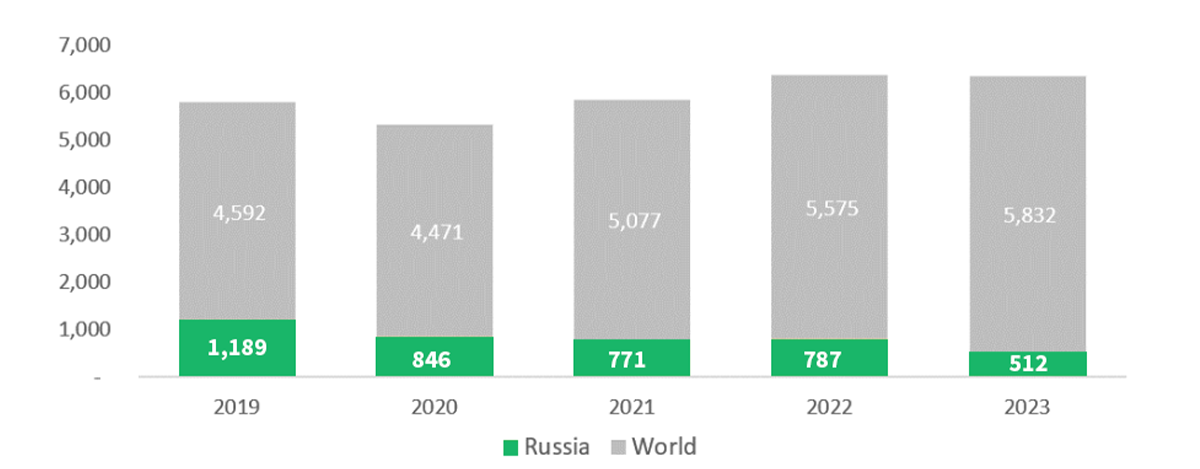
The consequences of these measures are starkly evident in the statistics. The proportion of Russian aluminium in total EU imports has plummeted from 18 per cent in 2021 to a mere 8-9 per cent in 2023. This decline is further highlighted by the fact that imports of Russian aluminium into the EU have dropped to 512,122 tonnes, reflecting a sharp decline in market share.
Russia Vs World – Aluminium import in EU, 2019-2023 (in 000 tonnes)
This decline comes amid a broader downturn in EU-Russia trade relations, exacerbating the effects of ongoing economic sanctions. The European Union is now facing mounting calls from pressure groups, industry lobbyists, and politicians across several member states to incorporate sanctions on Russian aluminium into the upcoming EU sanctions package.
As the EU prepares its next moves, the question remains: Will the union formalise its stance on Russian aluminium, or will it continue to rely on the ripple effects of self-sanctioning and secondary sanctions? The outcome could have far-reaching implications for both the aluminium market and broader EU-Russia relations.
The report indicates that there is no consensus within the EU regarding sanctions. Only a few member countries—Poland, Latvia, Lithuania, and Estonia—are actively advocating for comprehensive sanctions. Meanwhile, major international aluminium producers are also calling for a ban, but their motivations might include reducing market competition.
In contrast, policymakers in larger EU industrial nations like France, Germany, and Italy recognise the strategic value of Russian aluminium. They understand its role in lowering the overall carbon footprint of aluminium production and are mindful of potential impacts on employment rates.
Sanctions on Russian primary aluminium could sharply drive up prices in the EU, jeopardize net zero goals, and disrupt aluminium-consuming industries. This would likely lead to job losses and company closures, especially among SMEs, representing 70 per cent of turnover and 92 per cent of employment in the sector. These SMEs might face shortages and higher costs, pushing them to purchase higher-carbon aluminium from coal-fired smelters. As a result, the influx of higher-carbon aluminium into the EU would increase, becoming more expensive after carbon import taxes (CBAM) are implemented in 2026.
Aluminium produced in Russia benefits from low carbon emissions, with around 2.1 tonnes of CO2 per tonne of aluminium (Scope 1 and 2), due to its use of hydroelectric power. In contrast, aluminium from countries like China and India, which may increase exports to the EU without Russian aluminium, can have a carbon footprint of 15-20 tonnes per tonne, compared to the world average of 15 tonnes.
Under the EU’s Green Deal, significant measures are required to achieve net-zero targets, but the policy is already under strain, with forecasts indicating many targets may be missed. The potential removal of a major low-carbon aluminium supply could exacerbate these issues.
To address this, the EU is implementing a Carbon Border Adjustment Mechanism (CBAM) to price the carbon content of imports, including aluminium. This creates a paradox: while the EU penalises high-carbon products, it may also consider banning low-carbon alternatives.
Sanctions on aluminium imports from Russia to the EU are unlikely to impact the Russian aluminium industry or its economy significantly. RUSAL, the leading producer, is already shifting its focus, with exports to China tripling over the past three years. Cooperation between Russia and China in alumina and aluminium is growing.
The EU sanctions will have minimal effect on the Russian energy sector. Although Russian Aluminium’s production and sales increased in early 2024—export volumes were up 30 per cent in January—the impact of EU sanctions on energy usage is negligible compared to total consumption.
While profitability in the global aluminium industry has declined, including in Russia, the tax revenue from Russian aluminium producers is minimal. With Russia likely to find alternative markets, any price increase due to sanctions could potentially boost Russian aluminium’s revenue and profits.
Replacing the supply of over 500,000 tonnes of low-carbon aluminium from Russia poses a significant challenge. Consumers will find it difficult to secure suitable alternatives in the short term due to the need for additional smelters and the ongoing geopolitical tensions affecting transportation. Consequently, the EU will likely see an increase in imports of higher-carbon aluminium.
Disruptions in the Red Sea and other regional hotspots impact supply chains and imports into Europe from the Middle and Far East. This increases costs as exporters must find longer, alternative routes to the European market. This situation exacerbates the challenges and expenses for EU aluminium consumers, especially given that the EU relies on imports for approximately 90 per cent of its primary aluminium needs. Aluminium imports from Russia, utilizing well-established and shorter transportation routes, are currently less affected compared to the revised, lengthier routes necessitated by these disruptions.
China could leverage increased supplies of low-carbon Russian aluminium, redirected from the EU, to advance its carbon reduction goals and boost exports of low-carbon manufactured and semi-finished aluminium products globally, including to the EU. With its dominant position in key critical and strategic minerals, a stronger alliance between China and Russia on aluminium and other essential resources could complicate procurement for the EU and other nations. This collaboration might allow Russia to prioritise its supply of critical materials to China over other regions like the EU and the USA.
EU aluminium imports from Russia have significantly dropped
The European Union has imposed sanctions on Russian aluminium products such as wire rods, extrusion, flat-rolled products (FRP), and foil. However, primary aluminium, which constitutes 85 per cent of total aluminium imports, remains unaffected by these sanctions. In 2023, the EU imported 512,122 tonnes of Russian aluminium, accounting for approximately 8 per cent of its total aluminium imports. This represents a decline from 12 per cent in 2022 and 21 per cent in 2019.
Note: The information and all the data have been sourced from the Macro-Advisory, Bespoke Report, Aluminium in Russia, August 2024, Eurasia Strategic Consulting.












_md.webp)
_md.webp)
_md.webp)