

AL Circle analysis: Germany’s aluminium trade surplus, Novelis’ US expansion, Asia’s EV demand & India’s underutilised downstream capacity
Aluminium’s next growth phase is increasingly being shaped by downstream processing, supply-chain resilience and demand from specialised applications. Germany continues to generate a substantial trade surplus in flat-rolled products despite a shrinking primary aluminium base, while North America is investing in recycling and rolling. Across Asia, new manufacturing capabilities and growing demand from electric vehicles, railways and batteries are creating further opportunities. However, declining exports, underutilised capacity and uneven profitability show that investment alone does not guarantee success. For industry leaders, the challenge is to identify where demand is shifting, develop products that meet customer requirements and ensure that new investments translate into sustainable...
AL Circle Analysis: From Guinea to Gulf, how bauxite, tariffs and logistics redraw aluminium map
Aluminium markets in late 2026 are being shaped by more than the headline LME aluminium price. Bauxite security, alumina availability, geopolitical disruptions, tariff negotiations, logistics diversification and regional premiums are increasingly determining where metal moves and what buyers pay. From RUSAL reassessing Caribbean assets and Vedanta securing Odisha bauxite to Brazil extending mine life and EGA rebuilding its Guinea supply chain, producers are strengthening control over critical raw materials. At the same time, the US remains heavily dependent on imported bauxite and alumina, while Europe and Asia are experiencing sharply different premium dynamics. These developments point to a market where physical availability is becoming a regional factor even as aluminium itself remains...
Grow with
AL Circle

USVI’s conservation effort gets a sustainable boost with Tropical Water’s aluminium packaging
With consumer preferences increasingly prioritising sustainability, transparency, and efficiency, aluminium is gaining prominence as the material of choice due to its recyclability, lightweight nature, and ability to maintain product quality. Image Source- Tropical Water As per the latest update, Florida-based MSPFLA, Inc., has formed an exclusive distribution partnership with Caribbean Food Services in St. Thomas, US Virgin Islands, to wholesale its eco-friendly Tropical Water brand across the USVI (U.S. Virgin Islands). Overall, the aluminium packaging industry saw consistent growth in 2023. Packed in reusable aluminium cans, this partnership supports USVI's conservation efforts by providing the local community, island visitors, retail outlets, and resorts with a sustainable alternative...

2024 to 2025: Learn how the previous AL year influences the upcoming one
Recently, Shanghai Metals Market (SMM) proffered a critical piece where the aluminium industry sat across the table, witnessing its own SWOT analysis. 2024 has been an eventful year, and the industry insights indicate a similar trend for 2025. The entire aluminium value chain, from the raw material, i.e. bauxite, to the end-user products like aluminium-made mobile cases, laptop chassis and vehicle bodies, has gone through vigorous and eventful turmoil to shape the industry as it is today and as it hints to be tomorrow. 2024's performance in a glimpse According to International Aluminium Insititute's data, from January 2024 to November 2024 — 125.66 million tonnes of metallurgical alumina and 8.113 million metric tonnes of chemical alumina were produced worldwide. Primary aluminium...

Global shift toward aluminium cans strengthens the packaging sector
As consumer preferences shift towards sustainability, transparency, and efficiency, aluminium is emerging as a material of choice for its recyclability, lightweight properties, and ability to preserve product quality. The aluminium packaging industry experienced steady growth in 2023, driven by an increasing demand for beverage cans and packaging foils. With over 11.5 million tonnes of aluminium flat-rolled products used in the packaging sector throughout the year, the industry’s expansion has been fuelled by a shift away from traditional materials like plastic and glass. The demand for aluminium in the packaging sector is primarily fuelled by beverage cans. While developed economies continue to drive this demand, developing countries are experiencing a faster-growing preference for...

Shareholders alert: Aluminium share updates, both domestic and international, might need your attention!
Aluminium trading prices have remained stable at INR 241.4 (US$2.82) in India as on December 30, 2024 and while the prices have not changed, key data indicates an underlying tension in the market due to supply and demand dynamics. According to the International Aluminium Institute (IAI), global primary aluminium production increased by 3 percent year-on-year, reaching 6.04 million tonnes in November. However, the downside pressure on prices was mitigated as traders withdrew over 82 thousand tonnes from London Metal Exchange (LME) warehouses, marking the highest withdrawal since mid-October, primarily from stockpiles in South Korea. The global refined aluminium market experienced a short supply of 40.3 thousand tonnes in October, indicating a continued imbalance between production and...

World alumina production grows 1.9% Y-o-Y during Jan-Nov 2024, partially affected by output curtail at Alcoa’s Kwinana refinery
Through the first eleven months of 2024, the world’s metallurgical-grade alumina production stood at 125.66 million tonnes, reflecting a year-on-year increase of 1.91 per cent from 123.304 million tonnes, according to the latest data revealed by the International Aluminium Institute (IAI). Separately, the chemical-grade output amounted to 8.113 million tonnes, up 3.97 per cent from 7.803 million tonnes. In November 2024, the world’s monthly production of metallurgical-grade alumina was 11.508 million tonnes, down by 3.22 per cent from 11.891 million tonnes in October, in tandem with the dip in daily average output. In November, the production each day was 100 tonnes less, standing at 383,500 tonnes versus 383,600 tonnes in October. However, on an annual basis, the world’s alumina...

Market Commentary: Middle East aluminium industry's past, present and tentative future analysed amid global market shifts in 2024
The Middle Eastern aluminium market is poised for significant growth, with projections indicating a valuation of USD 16.68 billion by 2030, driven by a compound annual growth rate (CAGR) of 5 per cent from 2024. This burgeoning market, according to an elaborate report by NextMSC , is currently valued at USD 11.33 billion and is being fuelled by a confluence of factors, including a growing emphasis on sustainability and the region's position as a major global producer. Global production landscape While China continues to dominate global aluminium production, accounting for an estimated 39,653 thousand tonnes in 2024 (January-November), representing nearly 60 per cent of the total output, the Gulf Cooperation Council (GCC), which consorts a massive middle-eastern aluminium trading...

Know what to expect from Vedanta’s revised demerger plan, scheduled in January 2025
Vedanta Limited has brought a different plan for its demerger scheme, which is to retain the base metal business under the parent company's umbrella. So, instead of six separate companies, billionaire Anil Agarwal-led Vedanta will demerge into five distinctive entities – Vedanta Limited, Vedanta Aluminium, Vedanta Oil and Gas, Vedanta Steel and Ferrous Materials, and Vedanta Power, with the process to be completed by January 2025, distributing shares in 1:1 ratio. This revised demerger plan is in response to lenders' feedback and efforts to restart the Tuticorin copper smelter. Vedanta thinks this strategic move will ease the process of lenders' approval, given the recommencement of the smelter will streamline operational and financial complexities. However, as the new demerger plan...

The metal that won’t quit – aluminium’s circular journey towards a greener tomorrow
A circular economy is an essential part of building a sustainable future as it addresses critical global challenges like resource depletion, waste generation, and environmental degradation. Aluminium plays a pivotal role in this context due to its exceptional recyclability. According to the International Aluminium Institute, aluminium is one of the most recycled materials on Earth. Nearly 75 per cent of the 1.5 billion tonnes of aluminium ever produced remains in use today. Each year, over 30 million tonnes of aluminium scrap is recycled globally, reinforcing its status as a cornerstone of sustainable materials. Growing focus on 'green aluminium' Aluminium businesses are increasingly prioritising 'green aluminium,' aiming to minimise environmental impact while meeting industrial demands....

US aluminium plates, sheets and bars exports downtrend by 2.77% in Q3 2024, attributed to Canada
The United States' aluminium plates, sheets and bars exports decreased through the third quarter of 2024, totalling 189,800 tonnes. The export volume fell sharply by 2.77 per cent from 195,200 tonnes compared to the previous quarter. In September 2024, the United States exported 59,400 tonnes of aluminium plates, sheets and bars, which reflected a M-o-M decline of 7.76 per cent from 64,400 tonnes. The export volume in August decreased by 2.42 per cent from 66,000 tonnes in July. There has been a continuous declining trend in the United States aluminium plates, sheets and bars exports since May 2024, barring an intermittent hike of 11.68 per cent in July to 66,000 tonnes. From January to September, the United States' aluminium plates, sheets and bars exports totalled 583,000 tonnes, down...

RUSAL’s 2024 had its own ups and downs, but it was a year of innovation, resilience and sustainability
RUSAL has cemented its position as the successor to the Russian and Soviet aluminium industry, consolidating leading facilities, innovative research, and cutting-edge technologies. Operating across four strategic business units—aluminium, alumina, energy, and mining and metals—the company's core segments, as highlighted in the H1 2024 report, remain aluminium and alumina. As 2024 comes to a close, we examine the industrial giant’s performance, milestones, and challenges. A legacy of leadership The roots of Russia’s aluminium industry trace back to 1885 when A. Novoveisky established the country’s first aluminium smelter in Sergiev Posad. Significant breakthroughs followed, including the Bayer method of alumina production in 1889 and the launch of the Soviet Union’s first aluminium smelter...

US alumina imports downtick Y-o-Y from January to September 2024 despite hikes in Q2 and Q3
According to the United States Geological Survey, the United States alumina imports through the first three quarters of 2024 reflected a year-on-year downfall of 1.1 per cent, despite sequential growth in the second and third quarter of the year. Image Source: iStock A sharp fall in Q1 by 20.33 per cent Q-o-Q and 11.46 per cent year-on-year to 286,000 tonnes has contributed to the downfall in the United States year-to-date alumina imports. Even the subsequent increase in the second and third quarter by 13.64 per cent and 16.31 per cent, respectively, failed to offset the year-to-day downtick. In the second quarter of 2023, the United States alumina imports were 325,000 tonnes, which climbed up in Q3 to 378,000 tonnes, also up by 5.29 per cent Y-o-Y from 359,000 tonnes. From January to...

World primary aluminium production poised to outstrip 2023 record, reaching 66.522 million tonnes by November 2024
Based on the latest data revealed by the International Aluminium Institute, the world's primary aluminium production is set to surpass the previous year's output, marking a new year's high. In December 2024, the world's primary aluminium output needs to achieve only above 4.194 tonnes to exceed the 2023 total of 70.716 million tonnes. From January to November 2024, the world's primary aluminium production reached 66.522 million tonnes. Image Source: Flickr In November 2024, the world's primary metal output decreased by 3.07 per cent M-o-M, reaching 6.04 million tonnes. However, according to a year-on-year calculation, the production saw an increase of the same percentage, 5.863 million tonnes. However, calculating the daily output of November vs October, the monthly decline was only due...
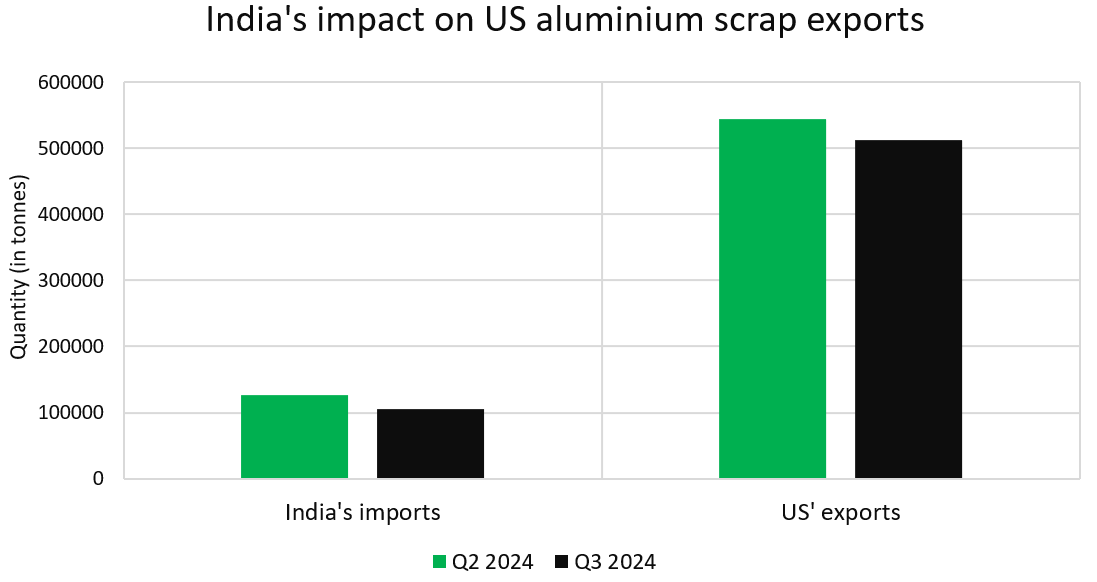
A double-digit decline in India's aluminium scrap imports affects the United States Q3 export volume
The third quarter data from the United States Geological Survey shows a sequential fall in the country’s aluminium scrap exports, in line with a decreased volume of scrap recovery during the same period of 2024. A 2 per cent decline in the United States aluminium scrap recovery during Q3 resulted in a 5.7 per cent fall in the export volume. In the third quarter of 2024, the United States aluminium scrap exports stood at 513,000 tonnes, down by 5.7 per cent from 544,000 tonnes in Q2, despite an M-o-M increase in September exports by 5.4 per cent to 177,000 tonnes. In August, the export remained restrained M-o-M at 168,000 tonnes. In comparison to the first quarter of 2024, exports in the September quarter increased by 3.6 per cent from 495,000 tonnes. However, when compared to the third...

Year-end delivery of backlog orders supports China’s aluminium wire and cable operating rate, bringing it 1.27% higher M-o-M
The comprehensive operating rate of China’s domestic aluminium wire and cable industry in November 2024 saw a month-on-month increase of 1.27 per cent and a year-on-year hike of 10.36 per cent, nearing 60 per cent. The operating rate increased without being impacted by temperature on power grid construction. Instead, resilient demand for distribution network order pickups supported the operating rate. Additionally, the effort behind completing the delivery tasks by year-end ramped up the operations. According to the Shanghai Metals Market, the operating rate precisely stood at 59.96 per cent, demonstrating a growth driven by large enterprises with an operating rate of 70.11 per cent. The medium-sized and small enterprises illustrated 56.32 per cent and 40.68 per cent operating rates, both...

Aluminium wire rod consumption: Key trends and global growth drivers
Global aluminium wire rod consumption has risen steadily across the world. Aluminium's unique properties make it a key material in the electrical and electronics industries, enabling a wide range of applications. The global wire and cable market, valued at US$ 191.6 billion in 2022, is anticipated to expand at a compound annual growth rate (CAGR) of 6.3 per cent between 2023 and 2032. The global aluminium wire rod market was valued at $22.6 billion in 2023 based on consumption and regional trade flow. It is anticipated to grow at a CAGR of 3.7 per cent from 2024 to 2030. The increasing demand from the power, automotive, and aerospace sectors is a substantial factor driving this market. Aluminium wire rod usage is driven mainly by the growth of worldwide electrical transmission and...

“The biggest impact that sport can have on carbon emissions is to mobilise fans to act”, Tom Gribbin, Co-founder of Planet League
Tom Gribbin is the Co-founder of Planet League, a platform leveraging football to inspire sustainable living. Since 2019, Tom and Planet League have helped football fans and clubs score green goals for the planet. He has worked in sustainability, behaviour change, marketing, sports, and venture space for over 20 years. He has an MBA from the University of Cambridge and has been a Trustee of Nottingham Forest Community Trust. AL Circle Team had the distinct privilege of interviewing Tom Gribbin, the visionary Co-founder of Planet League. AL Circle: What motivated Planet League to collaborate with Ball Corporation and Kroenke Sports & Entertainment on the Green Action League? How does this align with Planet League’s broader mission? Tom Gribbin: We use the passion of sports to create real...

Why is the world scrambling for aluminium's building block? Let's dig deep into the geopolitical scenario…
The World Bank identified aluminium as the 'high-impact, cross-cutting metal'. As a result, today's world intensely competes over securing bauxite ore, the raw material used to produce aluminium. "I read... that every clay bank was a mine of aluminium and that the metal was as costly as silver. I soon after began to think of processes for making aluminium cheaply," said Charles Martin Hall, an American inventor, businessman, and chemist. He is best known for his invention in 1886 of an inexpensive method for producing aluminium. This process was also discovered at nearly the same time by the Frenchman Paul Héroult, and it has come to be known as the Hall–Héroult process. Henceforth, the demand for non-ferrous metal, which was once even pricier than gold, has seen continual growth. Guinea...

Increased tariffs under Section 301 on China impact the United States Q3 aluminium plates, sheets and bars imports
The United States imports of aluminium plates, sheets and bars stood below 100,000 tonnes for the two consecutive months in the third quarter of 2024, resulting in a dip in the total import volume through Q3. According to the US Geological Survey, the imports of aluminium plates, sheets and bars totalled 300,600 tonnes, significantly down by 11.33 per cent from 339,000 tonnes in Q2 2024. However, annually, imports in Q3 2024 showed a rise of 25.25 per cent from 240,000 tonnes. Also from the first quarter of this year, the import volume stood 3 per cent higher than 291,800 tonnes. It is to be noted that despite the sequential fall in Q3, the import volume stood above the mark of 300,000 tonnes. In September 2024, the country imported 94,100 tonnes of aluminium plates, sheets and bars...

