Norway has established itself as the world's leading consumer of electric vehicles, driven by continuous strategic planning, government policies, and incentives designed to promote EV adoption as part of the country's carbon reduction goals. Among all the electric vehicle variants, Norway particularly boasts the highest market share of battery electric vehicles (BEVs) worldwide, thanks to tax exemptions for making BEVs financially attractive over traditional combustion engine vehicles.
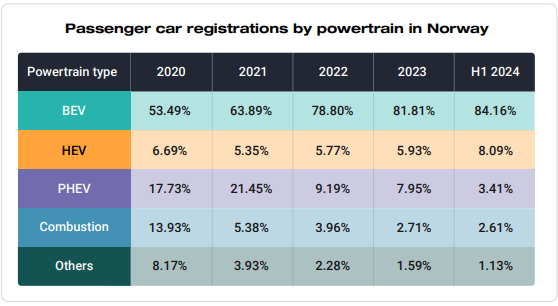
A few years later, after BEV consumption exceeded expectations, the government removed some incentives and even reduced tax benefits. But fortunately, nothing dampened the enthusiasm for electric vehicle purchases. That's because, beyond economic incentives, the net-zero carbon emissions goal from the vehicle market played a vital role in boosting EV consumption in Norway. From 2020 to H1 2024, battery electric vehicle (BEV) registrations in Norway surged from 53.49 per cent to 84.16 per cent, followed by hybrid electric vehicle (HEV) registrations reaching 8.09 per cent from 6.69 per cent, while plug-in hybrid electric vehicle registrations decreased to 3.41 per cent from 17.73 per cent. By 2025, Norway aims to achieve 100 per cent net-zero emissions from vehicles by completely switching to electric vehicles and banning all new ICE cars.
In November alone, 10,940 EVs were newly registered in Norway, bringing it to 93.6 per cent of all new car registrations. Although the figure showed a marginal difference compared to 10,862 EVs registered in October, it scaled up 30 per cent annually from 8,442 units.
Surge in Chinese electric cars consumption
According to Norway's Road Federation (OFV), Chinese electric vehicles have gained a dominant position in the Norwegian car market, accounting for 10 per cent of new car sales. A significant factor behind this success is the easy availability of Chinese EVs in Norway, facilitated by tariff-free imports. In November 2024, when the European Union imposed higher import duties on Chinese EVs of up to 45.3 per cent, Norway stood apart. Deputy Transport Minister Cecilie Knibe Kroglund said, "We treat all countries alike. The Nordic country is not part of the EU."
The growing market share of Chinese car manufacturers in Norway is an ongoing affair. In 2024, automakers like MG, owned by SAIC Motor, BYD, and XPeng, collectively held a market share of 8.8 per cent, compared to 4.1 per cent in 2021 and 5.1 per cent in 2023. This remarkable growth has occurred in only five years, with the first Chinese EV arriving in Norway in January 2020. Commenting on the abundance of electric vehicle options, Christina Bu, head of the Norwegian EV Association, said, "The Norwegian car market is probably one of the toughest in the world. There's fierce competition."
Who tops the competition?
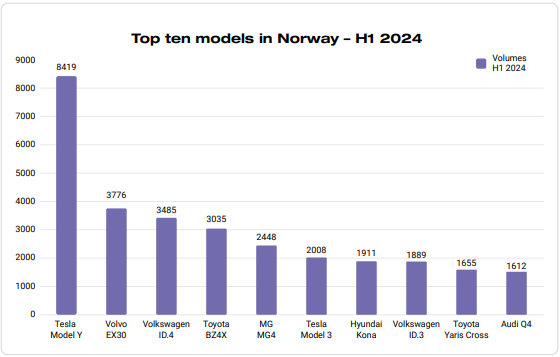
Throughout the first half of 2024, Tesla Model Y took the top spot in Norway, with 8,419 newly registered units, followed by Volvo EX30 (3,776 units), Volkswagen ID.4 (3,485 units), Toyota BZ4X (3035 units), and MG4 (2,448 units).
Tesla Model Y continued to top until November 2024 with 14,926 newly registered units, accounting for 13 per cent of all new car registrations. Volvo EX30 was in the second-highest position with 6,623 units being registered, followed by the Volkswagen ID.4 (6,544 units) and Tesla Model 3 (6,197 units).
Impact of the growing electric vehicle market on aluminium
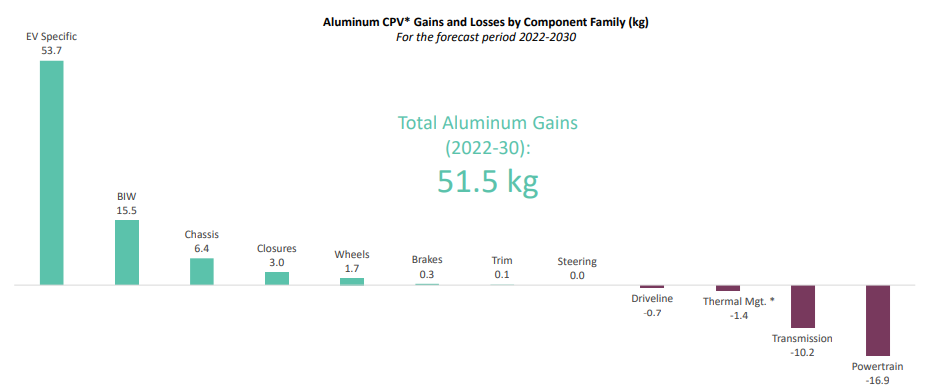
The ever-growing market for electric vehicles in Norway has led to a significant rise in aluminium usage owing to lightweighting needs and electrification. According to Ducker Research & Consulting, a rising share of European electric vehicles will take the aluminium content per vehicle to 256 kilograms by 2030. Particularly, in battery-electric vehicles, aluminium content per car is expected to rise from 43kg in 2022 to 51.5kg in 2030. The highest aluminium gains will come from the EV-specific family – nearly 54kg more aluminium will be needed per vehicle by 2030, followed by BIW with 15.5kg additional aluminium content.
Among the key aluminium product types used in each electric vehicle, the additional use of aluminium castings will increase to 22kg, extrusions to 15kg, and aluminium sheets to 14kg. The production of passenger cars (BEV-PHEV) is expected to reach 10.9 million units in 2030 from 2.2 million units in 2022.
According to AL Circle's "Future of Aluminium in Transportation Sector: An Industry Analysis with Forecasts to 2027", the usage of aluminium per European passenger vehicle (including EVs) is expected to reach 198.8 kg by the end of 2025.
Information credit - JATO Dynamics, Ducker Research & Consulting, and AL Circle Report.
Graphs credit - JATO Dynamics