The European Union is contemplating the release of its 16th sanctions package against Russia in February 2025, when the Russia-Ukraine geopolitical conflict will mark a third anniversary. A preliminary draft has been outlined for the forthcoming package, restricting aluminium imports, military equipment, and all those vessels transporting Russian oil. The 16th sanctions package is also likely to impose limitations on international payment systems SWIFT, said the people involved in the bloc committee discussion.
All these actions are specifically aimed at undermining Russia's revenue streams and limiting its ability to fund the war. A month ago, ten European Union member states even appealed for stricter sanctions on Russian aluminium, recognising the metal as a critical source of income for Russia. That was when the European Union's 15th sanctions package came into effect, extending restrictions from aluminium wire, pipes, and foil to primary metal.
The draft proposal of the 16th sanctions package is still under discussion and development between EU member states to determine the timeline and scope of sanctions on aluminium and to decide on the road map to restrict liquefied natural gas from Russia. While many nations have urged a ban on Russian gas imports, the EU still needs to conclude whether they should impose sanctions, put specific regulations, or apply a mix of the two.
Repercussions of sanctions on the European Union so far
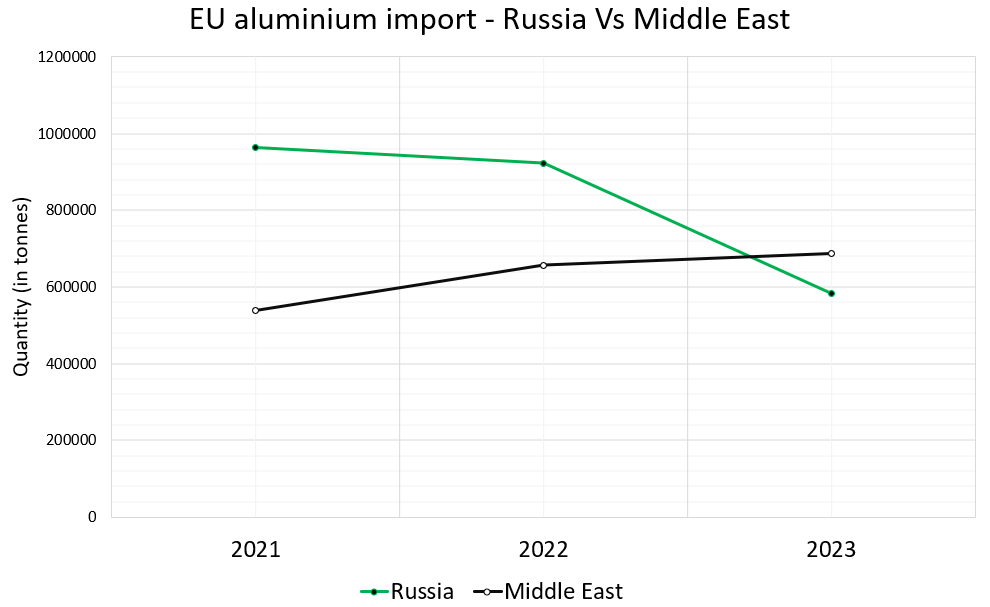
The impact of sanctions is clearly evident in the trade relations between the European Union and Russia. Over the past two years, the European Union's aluminium imports from Russia consistently decreased, from 922,896 tonnes in 2022 to 582,258 tonnes in 2023, reflecting an annual plunge of 36.9 per cent. In 2024, till October, the EU's imports were 302,139 tonnes, down by 43.55 per cent from 535,244 tonnes during the corresponding period of the previous year.
Notably, the imports of aluminium wire, pipes, tubes, and foils, which are subject to EU sanctions, decreased to 6,900 tonnes during January-October 2024, compared to 50,882 tonnes a year ago and 65,276 tonnes during the corresponding period of 2022. As a result, these products accounted for approximately 2% of total aluminium imports in 2024, a significant decline from 9.5% in the previous year.
Now, it remains to be seen how the European Union will address the void of aluminium supply in the domestic market. Following a further ban on Russian aluminium, the European Union will need to look for other capable sources of aluminium for nearly 500,000 tonnes per year amid a limited list of viable options.
As an immediate alternative, the Middle East is the only name striking our mind, capable of filling the dearth with its low-carbon metal. In fact, the European Union's aluminium imports from the Middle East grew from 656,172 tonnes in 2022 to 686,139 tonnes in 2023.
Will further sanctions hurt Russia?
Russia has a fair chance to reroute its aluminium supply to China based on the strong trade relationship they have developed. In 2023, China imported nearly 2.675 million tonnes of aluminium, around 50 per cent of which was imported from Russia. Imports of Russian-brand aluminium amounted to 1,239,000 tonnes in 2023, up from 519,000 tonnes in 2022, with 46 per cent of China's total primary aluminium imports, as disclosed by China Customs Statistics.
The European Union is now grappling with a formidable choice of imposing stricter sanctions and securing a supply of low-carbon aluminium, and that too when sustainability is the first choice of the global aluminium industry.














_md.webp)








