EU CBAM after H1 2026: Is carbon becoming aluminium's new €75/tCO₂ trade premium?
The image(s) used in this article is generated with an AI tool and does not depict any real-time moment
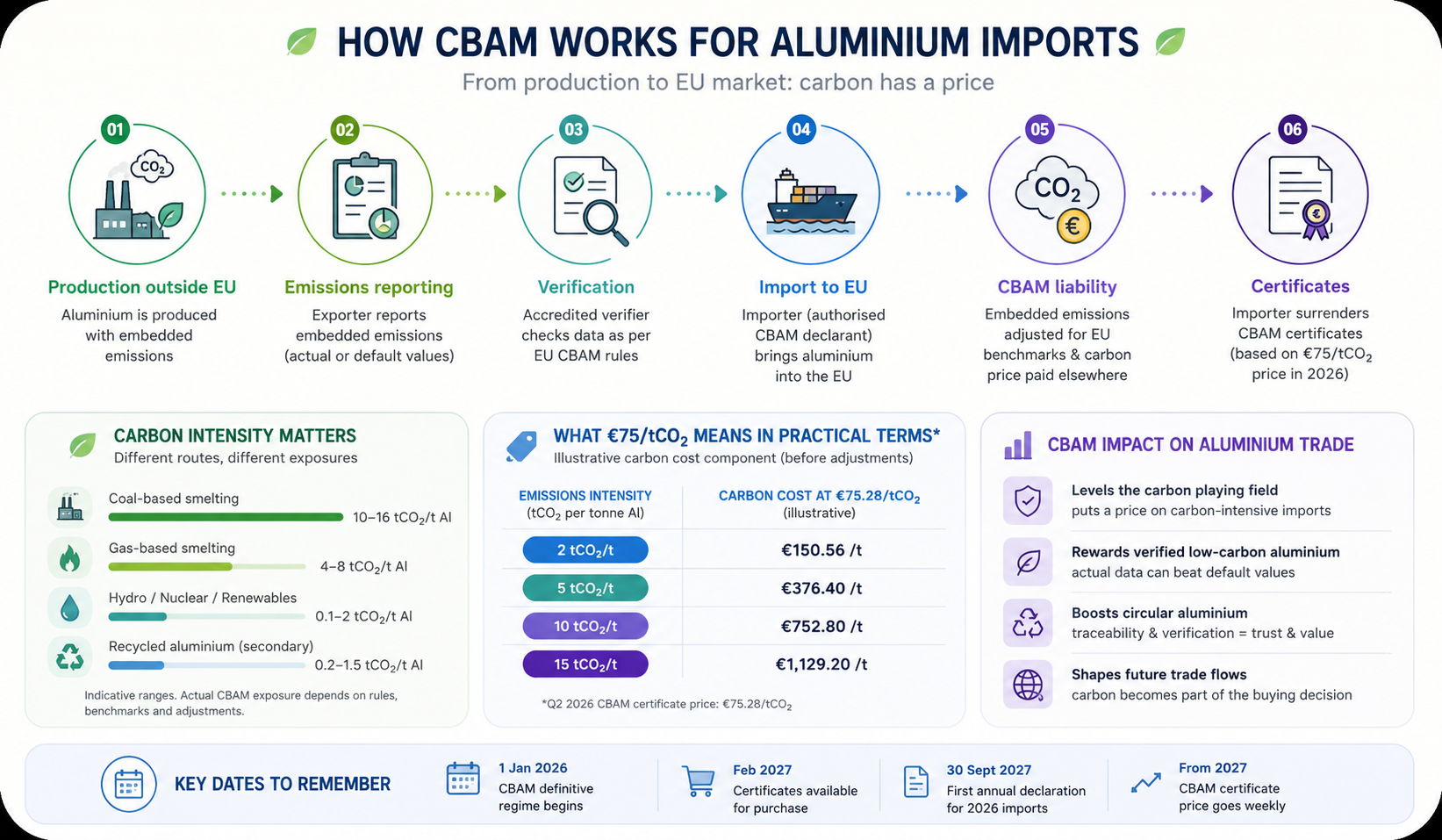
The European Union's Carbon Border Adjustment Mechanism (CBAM) entered its definitive regime on January 1, 2026, turning what had been a reporting exercise during 2023-2025 into a mechanism with an eventual financial liability. Aluminium sits alongside iron and steel, cement, fertilisers, electricity and hydrogen among the sectors covered.
The European Commission fixed the CBAM certificate price at EUR 75.36 per tonne of CO₂ for Q1 2026, followed by EUR 75.28 per tonne of CO₂ for Q2. The prices are calculated from the weighted average auction clearing price of EU Emissions Trading System (ETS) allowances. Four quarterly prices will apply during 2026 before the system moves to weekly pricing from 2027.
That does not mean every tonne of imported aluminium simply attracts its total carbon footprint multiplied by the EUR 75 cost addition. CBAM liability depends on the embedded emissions recognised under the mechanism, applicable EU ETS benchmarks and the free-allocation adjustment, as well as any eligible carbon price already paid in the country of production.
From reporting emissions to pricing them
The transitional phase gave the aluminium industry three years to become familiar with emissions reporting. The definitive phase raises the stakes.
EU importers, or their indirect customs representatives, importing more than the annual 50-tonne CBAM threshold must operate within the CBAM framework and obtain the required authorised-declarant status. The threshold was introduced as part of the EU's simplification package and is expected to exempt around 182,000 importers, predominantly SMEs and individuals, while keeping more than 99 per cent of emissions originally within CBAM's scope covered.
Importers must ultimately declare the embedded emissions associated with covered goods and surrender the corresponding number of CBAM certificates after the relevant adjustments.
There is an unusual timing element in the first year. Although CBAM has applied to 2026 imports since January, certificates will only become available for purchase through the common central platform from February 2027. The first annual CBAM declaration covering 2026 imports is due by September 30, 2027.
Join the webinar by Alberto Monje Gama to learn about recycled aluminium, CBAM and trust
EUR 75 per tonne of CO₂ is only the beginning of the pricing story
At first glance, a carbon price of approximately EUR 75 per tonne of CO₂ might appear small next to the price of a tonne of aluminium. But that comparison misses how CBAM works.
The actual commercial effect depends heavily on the emissions attributed to a product and the benchmark adjustment available to it. Consequently, aluminium originating from two countries — or even two plants in the same country — can create different carbon exposures despite meeting identical physical specifications.
For unwrought aluminium under CN code 7601, for example, the 2026 default value including the prescribed mark-up for Bahrain is 2.057 tonnes of CO₂e per tonne, based on the relevant production route. For Bolivia, the corresponding figure is 0.396 tonnes of CO₂e per tonne under the secondary-aluminium route.
These figures should not be mistaken for the final number of certificates payable. CBAM's free-allocation adjustment must still be applied using the relevant benchmark, and eligible carbon pricing in the country of origin can reduce the final obligation.
But the difference makes the commercial point. The carbon characteristics assigned to aluminium are no longer merely ESG information. They can influence its cost of accessing the European market.
That introduces a new layer into the familiar aluminium pricing equation with LME aluminium price + regional premium + freight + duty + CBAM exposure.
And CBAM exposure itself increasingly depends on another commodity — credible emissions data.
To explore trade opportunities of secondary aluminium, visit AL Biz
CBAM and aluminium trade: Why verified carbon data now matters
An aluminium producer can claim that its metal is low carbon. It can publish a sustainability report. It can operate on hydroelectricity, renewable power or high levels of recycled input. But under the definitive CBAM regime, the commercial value of lower emissions increasingly depends on whether those emissions can be calculated, documented and independently verified under the applicable rules.
As of July 2026, national accreditation bodies across Europe had begun preparing to accredit organisations capable of verifying CBAM reports, with the first accredited CBAM verifiers expected around September 2026. Accreditation is to remain valid for five years, subject to annual surveillance, while physical site visits form an important part of the verification process.
Failure to establish credible actual emissions data can force greater reliance on default values. And those values are deliberately structured with increasing mark-ups: the definitive-period regulation applies a 10 per cent mark-up in 2026, 20 per cent in 2027 and 30 per cent from 2028 onwards to the relevant default values.
Default values expose another CBAM pressure point
The European Commission published definitive-period default values at the end of December 2025, with the legally binding figures contained in Implementing Regulation (EU) 2025/2621. Industry participants subsequently raised concerns over apparent inconsistencies in parts of the dataset, including missing production routes and situations where assumptions across different stages of processing appeared technically questionable.
Some of the most vocal criticism has originated in the steel and stainless-steel industries, so those concerns should not automatically be extrapolated to every aluminium value in the regulation. Nevertheless, they highlight a broader CBAM problem of when a regulatory emissions number has a direct bearing on market access and cost, the technical integrity of that number becomes commercially significant.
Aluminium's old geography may acquire a carbon geography
Historically, aluminium's trade geography has been shaped by access to bauxite and alumina, electricity prices, smelting capacity, tariffs, freight costs and regional premiums. CBAM adds the carbon characteristics of production to that list.
A tonne of primary aluminium produced using carbon-intensive electricity can carry a radically different overall carbon footprint from metal produced using hydropower or other low-carbon electricity. Secondary aluminium generally has a substantially lower energy requirement than primary production.
However, it is important to distinguish that broader product carbon footprint from the emissions currently chargeable under CBAM. The two are not necessarily identical. What CBAM nevertheless does is create a regulatory mechanism through which differences in eligible embedded emissions can acquire monetary value.
Recycled aluminium's advantage increasingly comes down to proof
Few materials fit Europe's circular-economy ambitions as neatly as aluminium. It can be recycled repeatedly, and secondary production requires only a fraction of the energy associated with primary smelting.
The questions increasingly become: Where did the scrap originate? How was it processed? Can its recycled content be demonstrated? Which production route applies? Is the emissions information traceable? Can the carbon-footprint claim withstand independent scrutiny?
In June 2026, the Council of the European Union agreed its position on a proposed strengthening of CBAM that, among other measures, supports bringing pre-consumer metal scrap into the mechanism's scope as part of wider anti-circumvention provisions.
Recycling may offer a powerful route to reducing carbon intensity, but recycled content without traceability is becoming less commercially convincing. Europe's aluminium circular economy is therefore moving towards a market in which the value proposition may not simply be "recycled aluminium", but verified recycled aluminium.
This growing intersection between CBAM, recycling and assurance will also be examined in AL Circle's upcoming webinar, “Recycled aluminium, CBAM and trust: Why verification matters for Europe's circular economy”, scheduled for September 9, 2026. Alberto Monje Gama, Sustainability Policy Manager at TIC Council, will discuss supplier emissions data, embedded-emissions reporting, scrap traceability, recycled-content evidence, product carbon footprints and the role of independent verification across the European aluminium value chain.
The downstream problem: What happens if carbon leakage simply moves?
The existing mechanism concentrates heavily on raw and semi-finished carbon-intensive goods. But that creates a potential distortion.
Imagine an EU manufacturer purchasing CBAM-covered aluminium to make an aluminium-intensive finished product. Its material input carries a European carbon cost. A manufacturer outside the EU could potentially purchase aluminium, convert it into a product beyond the original CBAM scope and export that finished product to Europe.
In December 2025, the European Commission proposed extending CBAM to selected downstream steel- and aluminium-intensive products and strengthening its anti-circumvention provisions. On June 12, 2026, the Council agreed its negotiating position, supporting an extension to selected downstream goods while refining the proposed product list.
The Council explicitly acknowledged the risk that non-EU goods containing significant quantities of aluminium, iron or steel could replace comparable European products whose manufacturers bear ETS-related carbon costs.
Bruegel researchers have argued that a broad extension risks weakening CBAM's credibility as a climate-policy instrument if product selection becomes driven more by trade protection than demonstrable carbon-leakage risks.
Europe has an import shield — but what happens to its exports?
There is another asymmetry CBAM has yet to resolve completely. CBAM addresses carbon leakage on goods entering Europe. But European producers also sell aluminium and aluminium-containing goods into markets where competitors may not bear an equivalent carbon cost.
European industry groups have consequently pushed for measures addressing the competitiveness of exports. Recent criticism intensified after European Commission proposals for ETS reform did not deliver the export-protection mechanisms some industrial groups had expected.
Trading aluminium across borders? Find out the exact cost you need to bear for the embedded carbon in the product by using this CBAM calculator
CBAM certificates add a new market variable — but they will not become another ETS
In July, the European Commission launched a consultation on detailed rules for the sale and repurchase of CBAM certificates and the operation of the common central platform.
From February 2027, authorised CBAM declarants are expected to purchase certificates through that platform.

But unlike EU ETS allowances, CBAM certificates will not be freely tradable instruments. Member states will sell them without quantitative limits, and certificates will be assigned to individual declarants rather than traded between companies.
Under the draft rules, certificate purchases and repurchases will be conducted in euros, while a proposed fixed platform fee of EUR 0.05 per certificate would apply.
In 2026, quarterly pricing gives importers some visibility. From 2027, however, CBAM certificate prices will be calculated weekly, creating a much more responsive link between European carbon markets and import costs.
Note: This is exclusive coverage by AL Circle and may not be reproduced, republished or shared without prior permission.
Adani's proposed $11.5b aluminium project in Odisha to adopt hybrid power model
Next articleASI certifies Shyam Sel & Power Limited against Performance Standard V3.1
Grow with
AL Circle