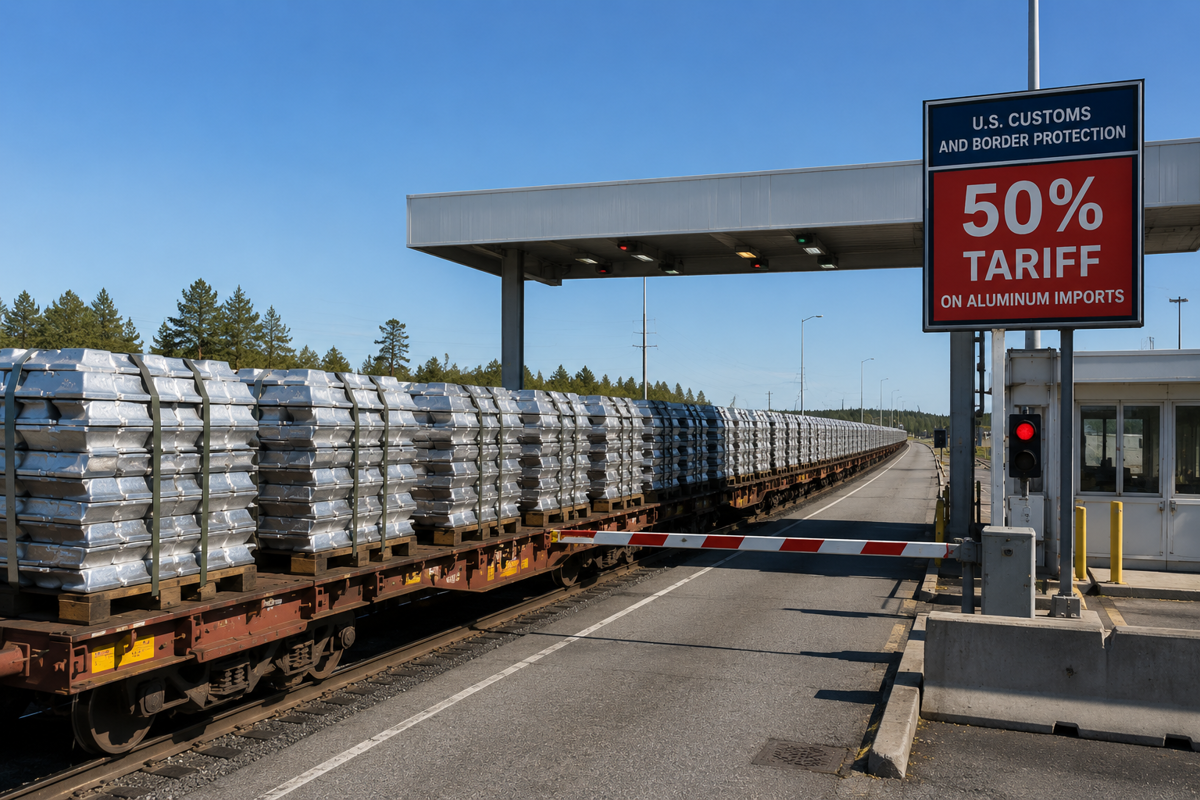
The image(s) used in this article is generated with an AI tool and does not depict real-time moments
Washington's tariff strategy aimed to revive domestic aluminium production and reduce reliance on Canadian imports. A year later, the numbers tell a more nuanced story — one where prices moved faster than production, diversification outpaced displacement, and one of the world's most integrated aluminium supply chains proved far more resilient than expected.
{alcircleadd}More than 2.9 million tonnes of aluminium left Canadian ports for global markets in 2025. Of that, roughly 2.3 million tonnes were shipped to the United States, more than the combined exports of the next nine supplying countries. That is the relationship Washington set out to change.
When the US raised Section 232 tariffs on aluminium imports from 25 per cent to 50 per cent, the objective was to make imported aluminium less competitive, stimulate domestic smelting, and gradually reduce dependence on foreign suppliers. Given Canada's dominance in the US import market, any meaningful change in America's aluminium supply chain would inevitably begin there.
A year later, the debate has moved beyond tariff announcements. The real question is whether the policy changed how aluminium moves across North America, or whether the cost of moving it simply increased.
And, if you ask, why the question matters, it is because aluminium fortifies industries from automotive and aerospace to construction, packaging and defence. For manufacturers, procurement teams and policymakers alike, the effectiveness of the strategy is best measured not by the tariff rate itself, but by what happened afterwards: Did trade flows change? Did domestic production rise? Did dependence on Canadian aluminium actually decline? The evidence suggests the answers are more complex than either supporters or critics anticipated.
Canada's aluminium industry entered the tariff era from a position of strength
To understand why the tariffs have produced mixed results, it helps to understand Canada's role in the North American market. Canada is the world's fourth-largest primary aluminium producer and one of the largest exporters of low-carbon aluminium, with more than 90 per cent of its primary metal produced using hydroelectric power.
Production has remained remarkably stable despite economic disruptions and shifting trade policy, rising from approximately 3.1 million tonnes in 2020 to around 3.35 million tonnes in 2025.
That spirit shows in export performance. Canada's cumulative aluminium exports rose from 3.119 million tonnes in 2020 to 3.319 million tonnes in 2024, while 2025 exports have stayed broadly in line with last year's pace, clearly hinting that although trade routes have gradually diversified, Canada's position as a leading global exporter has stayed intact.
The US has been central to that success. Between 2020 and 2025, Canadian aluminium exports to the US consistently ranged in the 3 million tonnes bracket annually, peaking in 2024. 2025 shipments stand at around 2.97 million tonnes.

Why Canada became America's aluminium lifeline
…and so much more!
SIGN UP / LOGINResponses