Ball Corporation Q3: A 144-year legacy holds with victorious survival amidst 2025 trade gusts

Just after Ball Corporation celebrated 90 years in the can manufacturing business, stakeholders cautiously rejoiced yet again as its third quarter felt a lot less like a wobble and more like a careful pivot wherein numbers whispered “steady” if anyone listened closely.
Explore- Most accurate data to drive business decisions with 50+ reports across the value chain
Why cautious? The turmoil of tariffs is yet to blow off. Then why rejoice? For the third quarter of 2025, which ended on September 30, 2025, Ball Corporation reported net earnings attributable to the company of USD 321 million, or total diluted earnings per share of USD 1.18 on sales of USD 3.38 billion.
Dig beneath the headline and you find the shape of a business that is squeezing more activity from the same geography-and-product map. The company started (with a different name) 144 years ago, only with an investment of a mere USD 200, now witnesses comparable diluted earnings per share of USD 1.02 in Q3, up from USD 0.91 a year earlier, a rise of 12.1 per cent.
In the meantime, global aluminium packaging shipments grew 3.9 per cent in the quarter, evidence that volume, not just price, is driving momentum.
Volume and price both mattered
In its Q3 2025 result revelation announcement, Ball says the USD 297 million uplift in Q3 sales versus the prior year broke down into roughly USD 145 million from higher volume, USD 120 million from price and mix (largely reflecting higher aluminium prices), and USD 64 million from currency translation. That mix helped push reportable segment sales to USD 3.205 billion for the quarter, led by North and Central America at USD 1.638 billion, EMEA at USD 1.059 billion and South America at USD 508 million.
Operations are also translating into cash returns. Ball returned USD 1.27 billion to shareholders through buybacks and dividends in the first nine months of 2025 and says it is on track to return at least USD 1.5 billion by the end of the year. The company completed USD 1.11 billion of repurchases through September and settled an accelerated share buyback that delivered 4.44 million shares at an average price of USD 56.30. Management has authority to repurchase up to USD 4.0 billion through 2027; as of September 30, about USD 3.14 billion remained available.
For the previous financial year’s nine months ended September 30, 2024, Ball’s net earnings attributable to the corporation were USD 4.04 billion, or diluted EPS of USD 12.96, on net sales of USD 8.92 billion. It is to be noted that this jump in earnings reflects the one-time gain from the sale of its aerospace businesses.
“Our global business remains resilient, and we are on pace to meet or exceed our financial objectives for the year. We continue to advance our strategic priorities with disciplined execution and a sharp focus on generating strong free cash flow. Our commitment to maintaining a robust financial foundation ensures we can deliver attractive returns today while positioning Ball for continued value creation in the years ahead,” said Daniel J. Rabbitt, senior vice president and interim chief financial officer.
Also read: Is the US fighting hard enough to keep its aluminium in-house from competitors like China?
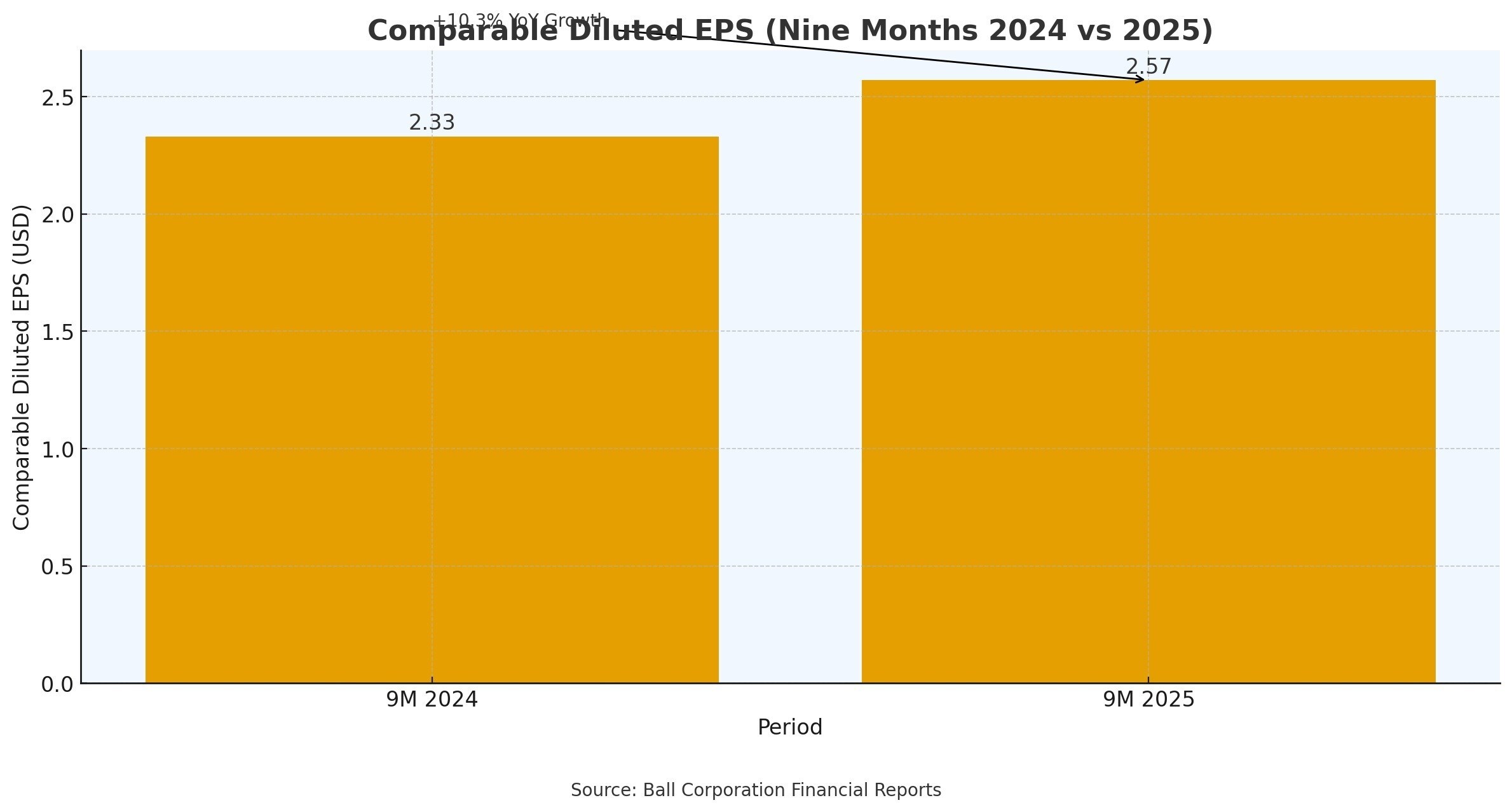
A few stress points to note
Cash and cash equivalents fell to USD 568 million at September 30, down from USD 885 million at the start of the year, while long-term debt stood at USD 6.864 billion — up from USD 5.312 billion at year-end 2024. Capital allocation has been busy: Ball used USD 574 million of cash in investing activities during the first nine months, including USD 160 million for the acquisition of Florida Can Manufacturing in February 2025.
That Florida Can deal is the sort of small, strategic tuck-in that mattered, adding an aluminium can plant in Winter Haven, Florida, and contributing USD 182 million and USD 386 million of incremental segment sales in the quarter and nine months comparisons, respectively. The aluminium can manufacturing giant also closed a transaction in March to deconsolidate its aluminium cups business and in August sold a 41 per cent stake of its majority-held Saudi can JV for USD 74 million in cash consideration (with USD 66 million received at closing), recognising an USD 86 million gain in the quarter.
Those disposals, plus the big divestiture of the aerospace business (the February 16, 2024, sale for USD 5.6 billion) that is now reported as discontinued operations, make year-over-year comparisons lumpy. The nine-month net earnings number in 2024 included a large gain from aerospace disposal that doesn’t repeat in 2025, so headline comparisons over the first nine months look distorted if you don’t strip out the discontinued ops.
Management’s message is numbers-first
Ball says it expects comparable diluted EPS growth of 12-15 per cent for full-year 2025, is focused on driving EVA and free cash flow, and remains disciplined on returns to shareholders while investing in sustainability and manufacturing efficiency. CEO Daniel W. Fisher emphasised operational excellence, innovation and cost management as the levers that produced the quarter’s results.
A few operational metrics are worth bookmarking because they show how sensitive Ball’s cash generation is to working-capital swings. Management notes that a one-day change in days sales outstanding would move operating cash flows by roughly USD 38 million; the same one-day move in days payable outstanding or days inventory on hand would each shift cash flows by about USD 30 million.
Don't miss out- Buyers are looking for your products on our B2B platform
Capital spending remains meaningful
Ball spent USD 304 million on capex in the first nine months and expects full-year 2025 capex to be about USD 465 million, with approximately USD 375 million contractually committed as of September 30. That balancing act to invest enough to keep factories competitive and expand capacity where needed also preserves free cash to buy back stock and pay dividends.
The leading aluminium can company plans roughly USD 220 million in dividends for the whole year.
On the commodity front, Ball continues to actively manage aluminium-price exposure through customer contracts that pass through aluminium cost changes and through derivatives where necessary. The company discloses both fixed and floating aluminium-linked pricing across its contracts.
However, a risk looms as, owing to tariffs and higher pricing, beverage brands are willing to use other packaging materials, barring aluminium. This would in turn cause a weak demand, creating volatility for Ball’s market. Management repeatedly flags that small changes in receivables, payables or inventory days move operating cash flow by tens of millions per single day — a real operational constraint when commodity pricing and customer terms shift.
From USD 200 and a wooden jacket can to a global canmaker
Ball Corporation’s story begins small and very American, where five Ball brothers bought the Wooden Jacket Can Company in Buffalo in 1880 with about USD 200, and from there later on built a business around glass jars, lids and home-canning supplies.
The beverage can era that Ball now celebrates traces back to the commercial introduction of steel beer cans in 1935. Fast forward to the present, Ball positions itself as the world’s leading aluminium beverage-packaging company, producing at scale — Ball cites over 100 billion recyclable cans per year across its operations — and employing roughly 16,000 people worldwide. That combination of scale, footprint and engineering capability is the platform for the company’s modern strategy: low-carbon, highly recyclable aluminium packaging.
How Ball built that lead with capability, innovation, and M&A
From standardised cans to speciality formats (slim cans, tallboys, kegs and more recently aluminium cups), Ball has continually iterated the can as a product — lighter gauges, faster lines, and new formats to match consumer trends. Recent rollouts include expanded aluminium cup sizes and investments in new lines.
Ball’s expansion into regional plants and tuck-ins has kept it close to big brewers, soft-drink and water brands; the company opens and upgrades plants regularly to serve local demand and shorten logistics. (See company plant announcements and manufacturing awards through 2025).
The global brand has used acquisitions to add capacity and technology in key markets; conversely, it has also divested non-core businesses when it made strategic sense (more on that below).
The ups of sustainability, recyclability and product momentum
The last decade saw aluminium can demand buttressed by two structural trends: rising consumer preference for recyclable packaging, and brand owners’ push to reduce plastic. Ball leaned into that: its pitches and R&D emphasise aluminium’s infinite recyclability, circular-economy claims, and the lower carbon intensity of modern cans. The company’s recent innovation moves, for instance, an aluminium cup product and programs to increase recycled content and recycling rates, reflect that strategic bet.
Ball Corporation spent decades as a diversified industrial (packaging plus aerospace), but in 2023-24, the company made a major strategic pivot: it agreed to sell its aerospace business. That transaction produced a very large one-time GAAP gain and materially changed Ball’s balance sheet and focus (more capital to return and reinvest in packaging). While the sale improved capital flexibility, it also removed a long-standing, higher-margin, technology-heavy business from Ball’s portfolio.
Must read: Key industry individuals share their thoughts on the hottest topics
Unlock full access – sign up for FREE.
Key benefits
How submarine cables are connecting Africa and the world beneath the waves
Next articleMaxion expands aluminium wheel operations in South America
Grow with
AL Circle













_md.webp)
_md.webp)







