Is the US fighting hard enough to keep its aluminium in-house from competitors like China?
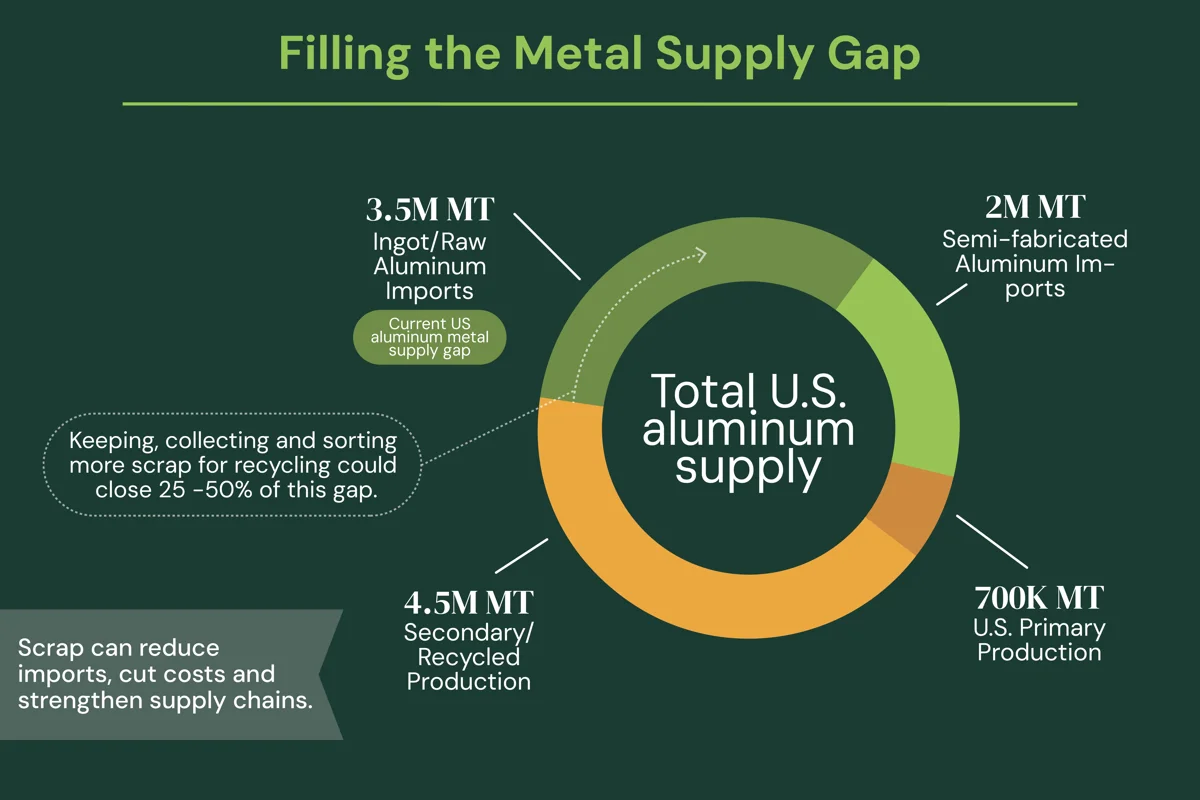
Aluminium industry leaders say the United States is unwittingly ‘leaking’ a strategic resource by exporting vast quantities of scrap metal even as domestic makers scramble for feedstock. The Aluminum Association’s new “Scrap The Exports” campaign notes that the US currently exports roughly 2 million tonnes of aluminium scrap each year, nearly half of what the country recycles.
Image source: https://www.aluminum.org/
Explore- Most accurate data to drive business decisions with 50+ reports across the value chain
“Scrap aluminium is a vital feedstock for American manufacturers, especially at a time when US aluminium firms are investing and need reliable and affordable access to metal like never before,” says Charles Johnson, president and CEO of the Aluminum Association (AA). By losing high-grade scrap, US companies contend, the nation cedes raw material that could otherwise be used in domestic factories – handing an advantage to foreign competitors like China.
Domestic scrap flow and supply gaps
As the US aluminium industry depends overwhelmingly on recycled metal, about 85 per cent of US aluminium production today uses scrap, even as a big share of that scrap heads abroad.
In 2024, the United States generated roughly 7.6 million tonnes of aluminium scrap and used about 5.6 million tonnes domestically, while 2.0 million tonnes (24 per cent) were shipped overseas. Much of that export consists of clean, mill-ready scrap and used beverage cans (UBCs).
The result is a domestic scrap trade deficit of roughly 1.3 million tonnes each year, even though the US already runs a larger raw-aluminium gap of about 3.5-4.0 million tonnes annually.
US makers have poured over USD 11 billion into new rolling mills and recyclers since 2016, betting that domestic supply chains would support expanded production. Two new multi-billion-dollar aluminium plants are slated to open by 2026, each of which is capable of gobbling up hundreds of thousands of tonnes of scrap annually.
“By focusing only on the scrap, we can use and value most, we make sure that American recyclers win,” Johnson notes, arguing it to be a strategy that is needed to keep America’s “competitive edge” in advanced manufacturing. If that scrap instead flows abroad, US plants must turn to more expensive primary ingots (much of which now comes from Canada) or slow production growth. In fact, about two-thirds of the aluminium consumed in the US each year is imported in primary form – a dependency Johnson states could be alleviated if more scrap stayed onshore.
Higher material prices have already strained US producers. This year saw the US impose a 50 per cent tariff on imported primary aluminium. The result was a sharp jump in the Midwestern aluminium premium (P1020A) to a near-record high, even as scrap prices have risen on surging demand (Fastmarkets pegged US used-beverage-can scrap at roughly USD 0.90 per pound in October).
The AA notes that keeping the 2 million tonnes of scrap currently exported in America would save on the order of 31 billion kWh of energy annually, roughly what 3 million US homes consume each year. That energy savings come at a time of record demand for electricity (for data centres, EV charging networks, etc.), making the domestic scrap supply a clear environmental asset.
Also read: Tariff turmoil: US push for self-reliance triggers a global rewire of medical supply chains
The global scrap race
From a global perspective, the US seems to be treading with risks on both ends. Its metal is feeding booming recycling centres abroad even as other countries move to lock down their scrap. Asia is the dominant destination for American scrap exports.
In 2024, 77 per cent of US scrap went to just a handful of Asian markets led by India, Thailand, Malaysia, South Korea and (the Chinese mainland plus Hong Kong). Of US scrap exports, used beverage cans (UBCs) and clean mill scrap are especially prized. India’s policy shift in 2024, for example, suspended restrictions on UBC imports, triggering a surge of American cans into the subcontinent.
Meanwhile, China is rapidly scaling up its recycling industry. After lifting previous bans, Chinese scrap imports have more than doubled since 2020. Beijing’s five-year plan now targets well over 15 million tonnes of recycled aluminium by 2027. One recent analysis notes China has plans to commission some 22 million tonnes of secondary aluminium capacity by 2026.
In practical terms, this means China can pay high scrap prices, process it using heavily subsidised new mills, and ship back finished metal – often below global cost. European producers, for example, complain that China’s subsidies and looser standards make it an irresistible scrap buyer.
“It’s perfectly understandable that scrap traders prefer to sell to the highest bidder,” said Paul Voss of European Aluminium, “but it’s the role of public policy to correct these kinds of market failures to protect [our] strategic interests”.
The EU itself is now keeping a close eye on this trend. In mid-2025, the European Commission announced new customs surveillance of scrap flows, warning that US import tariffs had made it more attractive to ship scrap out of the EU.
European Union industry data show member states exported a record 1.26 million tonnes of aluminium scrap in 2024 (about 50 per cent more than five years earlier), and much of it to Asia.
A recent AA white paper notes that “major economies, including China, India, Russia and Saudi Arabia, restrict UBC scrap exports” as a matter of policy. These countries explicitly seek to keep high-value scrap in domestic supply chains for local manufacturers and alloy producers.
Indeed, in its “Scrap the Exports” briefing, the AA calls for US policies in line with these precedents. It emphasises that preventing scrap ‘leakage’ to non-market economies is a matter of national resilience: “When scrap leaves the country, it weakens our supply chains and the defence industrial base,” the Association warns.
Don't miss out- Buyers are looking for your products on our B2B platform
A divided industry
Within the US industry, debate is heated. The Aluminum Association and many manufacturers have rallied behind export controls, especially for the cleanest scrap grades. They argue that targeted steps (like banning UBC exports to non-North-American markets) would shore up raw material for mills without wrecking the broader recycling business. Johnson and colleagues point to over USD 11 billion already invested in new US recycling and rolling capacity, warning that those projects will struggle without enough premium scrap at home.
Johnson has asked rhetorically why America should keep shipping cans abroad: “we believe there is no reason to be exporting this scrap to countries we have already taken trade action against,” he said. The white paper also stresses reciprocity. Since China, India, Russia and others restrict scrap exports to protect local jobs, the US should not face a one-way flow of material to foreign competitors.
The Recycled Materials Association and affiliated recyclers, on the other hand, warn of unintended consequences. “Without reliable access to global markets, recyclers would be forced to make decisions resulting in decreased investments in US operations, their workforces and local communities,” says RMA president Robin Wiener.
As one Fastmarkets analyst put it, any export curb now “will depress the UBC price and the scrap market is sensitive to low prices” without sufficient recycling capacity.
The two sides agree on one point of whether new processing infrastructure is needed. Every scenario assumes that, to fully capitalise on domestic scrap, the US must build more sorting and remelting capability. Congressional bills like the bipartisan CIRCLE Act are aimed at spurring such investment. Some suggestions include refining tariff codes to distinguish “mill-ready” scrap, and grants for advanced recycling tech.
Sustainability vs stakes
The debate also dovetails with US policies on “critical materials” and reshoring. Like rare earths and semiconductor materials, aluminium (especially for defence applications) is seen as strategically important. The AA white paper states that exporting nearly half of US scrap in the face of growing demand is “helping foreign rivals with access to cheaper inputs” while depleting American mills of feedstock. It even frames aluminium as “energy” itself – pointing out that the annual energy embedded in exported scrap is equivalent to powering the city of Chicago for a year.
Information credit: The Aluminum Association
Also read: Recycled ALuminium outlook: demand surge, capacity race, and the policy forces shaping it all
Unlock full access – sign up for FREE.
Key benefits
Recycled ALuminium outlook: demand surge, capacity race, and the policy forces shaping it all
Next articleAustralian recycler turns nearly half a million aluminium cans into a two-bedroom home
Grow with
AL Circle












_md.webp)
_md.webp)
_md.webp)







