What is up with the primary aluminium production at the end of the third quarter 2025 - wonders many people, especially with China nearing its 45 million tonnes cap, Australia grappling with energy crisis, and North America shifting its focus to secondary aluminium. Till the end of June, the world primary aluminium production was found stable, although with a few random shifts in dynamics, standing at 36.5 million tonnes – up by 1.4 per cent from 36 million tonnes a year ago. Even the quarterly production climbed up the graph from 18.115 million tonnes in Q1 2025 to 18.377 million tonnes in 2025.
Growth persists but at a cooler pace
Now, it remains to be seen whether the trend will persist through Q3 or take a different course over the next three months. Ultimately, we will assess whether production stays aligned with this year’s projected outlook. According to the IAI data, the global aluminium production gained another 1.33 per cent in Q3, reaching 18.621 million tonnes. However, it is to be noted that the growth rate dipped slightly from the previous quarter from 1.45 per cent to 1.33 per cent. Annually, the Q3 production in 2025 grew by 0.83 per cent from 18.467 million tonnes, compared to a year-on-year hike of 2 per cent seen in Q3 2024.
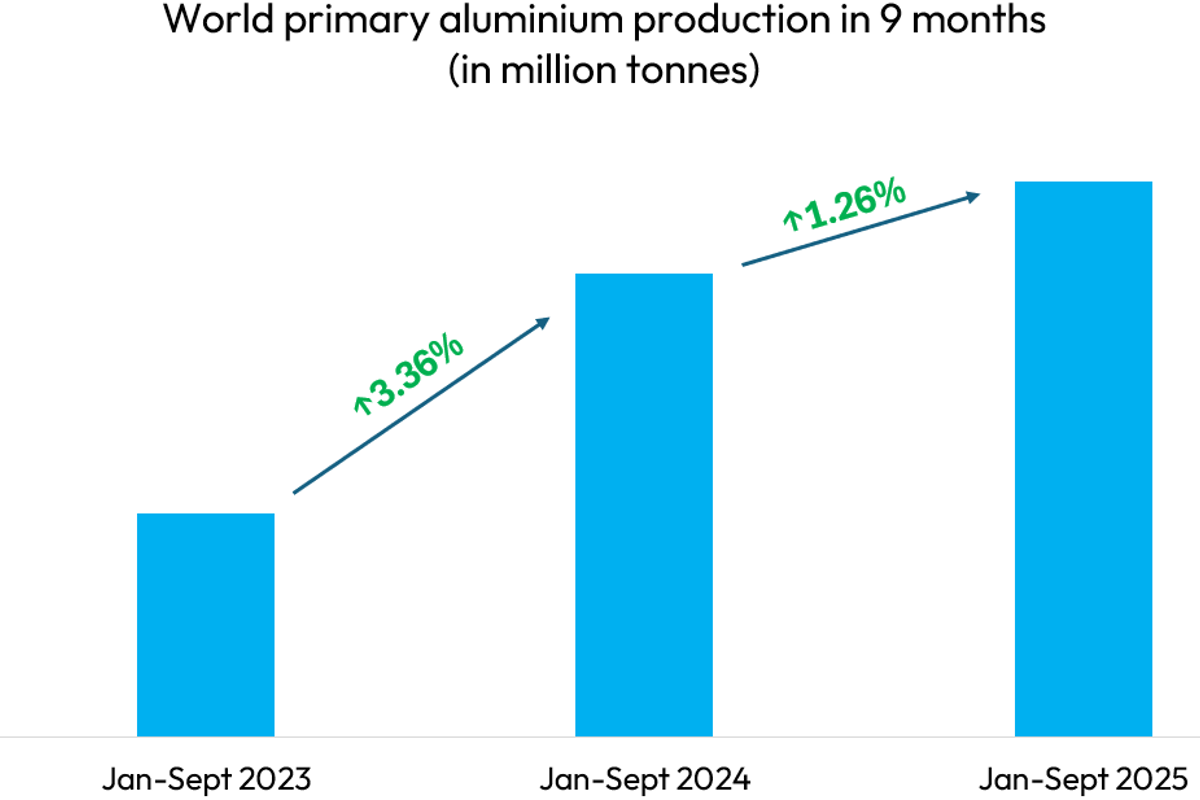
Cumulatively, from January to September 2025, the world primary aluminium production totalled 55.113 million tonnes, up by 1.26 per cent from 54.427 million tonnes. During the first nine months of 2023, the world primary aluminium output was 52.657 million tonnes, meaning the production in the subsequent period saw an annual increase of 3.36 per cent. Hence, there has been a sluggish growth rate through the nine months of 2025 compared to the previous year.
In September alone, the global output was 6.08 million tonnes - down by 3.12 per cent from 6.276 million tonnes in August - marking the fourth lowest figure this year, contributed by all the major primary-aluminium producing regions.
China’s Q3 production stays muted – what lies ahead?
While the world witnessed its fourth lowest monthly output in September 2025, China experienced the third least production after 3.366 million tonnes in February and 3.624 in April, showed the IAI data. In September 2025, China churned out 3.644 million tonnes of the primary metal, compared to 3.764 million tonnes in the previous month, representing M-o-M drop of 3.2 per cent. However, the monthly decline caused no damp to the quarterly output, which totalled 11.172 million tonnes – 1.38 per cent higher than 11.020 million tonnes in the June quarter. Also, over a year, China’s Q3 output recorded an increase of 1.33 per cent from 11.025 million tonnes, although a slower growth rate compared to 2.28 per cent seen in Q3 2024.
It is to be noted that China’s primary aluminium production grew each month from January to September 2025 but at a limited rate. The country’s daily average output of the metal stood range-bound, hovering between 120,400 tonnes and 120,800 tonnes from January to April. May onwards, it entered the 121,000 tonnes level, standing mostly at 121,400 tonnes and 121,500 tonnes.
In September, China’s smelting capacity was down than the earlier month, standing at 45.84 million tonnes versus 45.79 million tonnes. However, the operating rate slightly grew from 44 million tonnes to 44.06 million tonnes, owing to the commissioning of the Phase II replacement projects in Shandong and Yunnan and the production resumption of previous technological transformation projects in Guangxi.
Explore industry data to drive business decisions with our 50+ reports across the value chain
Until the third quarter of 2025, China’s total production of primary aluminium amounted to 33.023 million tonnes, climbing up by 2.2 per cent from 32.323 million tonnes. Whereas in the previous year, China’s primary aluminium production gained 4.28 per cent Y-o-Y.
Now, given the slower growth rate, how much would be China’s primary aluminium production at the end of 2025? If the country operates at a similar capacity and increases its production at a similar rate, then its year-end output is likely to come in around 44.2 million tonnes. However, amid all this, China’s contribution to the world primary aluminium production remained steady until September, accounting for 60 per cent versus 59.4 per cent during the same period of 2024 and 59 per cent in 2023.
High energy costs undercut producers beyond Australia
Well, while China is squeezing its production rate, the Oceania is witnessing a decline. As per the IAI data, the region produced 1.397 million tonnes – slightly down by 0.43 per cent Y-o-Y from 1.403 million tonnes. Although August and September saw annual rise from 155,000 tonnes to 160,000 tonnes and from 146,000 tonnes to 156,000 tonnes, all other preceding months saw declines. In each month from January to July remained range-bound between between 157,000 tonnes and 158,000 tonnes, as against the production volumes above 160,000 tonnes in a few months of 2024.
High energy costs have been a major factor behind the primary aluminium output fall in Oceania, particularly in Australia. Due to cost pressures, smelters have been operating at limited capacity, with daily average output at 5,100 tonnes through first seven months of the year. Only in August and September, the daily output grew to 5,200 tonnes.
The crisis is growing so acute that is bringing Tomago’s fate to a test of time. The smelter, which was once a powerhouse of production is now grappling with the crisis and even bracing for a potential shut down by 2028. As the smelter’s electricity supply contract with AGL Energy is nearing expiry and it is weighing new proposals from multiple power producers, both for coal and renewable, Tomago realises the unviability of the continuation of operations, given the high costs. Definitely, the impact of this incident will be seen on the Oceania’s metal output in the further future.
Now, amid the sluggish output in Australia and slower growth rate in China, is any region ready to uphold the global output? If an analysis is conducted around the present condition in Europe, it is found that the region (including Russia) records a Y-o-Y increase of 1.4 per cent in primary aluminium output during January-September 2025, from 5.2 million tonnes to 5.3 million tonnes. In comparison with the growth rate of 3.32 per cent in the previous year, Europe saw a marginal rise of 1.4 per cent this year. Rusal, one of the major producers in Europe had posted a 1.7 per cent decline in its primary aluminium output during H1 2025 to 1.924 million tonnes. Hydro, on the other hand, has bolstered Europe’s output, with a production of 1.537 million tonnes in the first nine months of 2025 versus 1.523 million tonnes during the corresponding period of the previous year.
Strategic cutbacks at GCC
The GCC countries also underwent a slower production through the nine months of 2025, totalling 4.602 million tonnes versus 4.743 million tonnes. That reflected a downfall of 3 per cent annually. At the beginning of the year, Gulf producers had decided to indulge in no new investments in production capacity expansion; instead they would concentrate on upgrading operational efficiency and performance. Accordingly, EGA’s primary aluminium production in H1 2025 showed no growth but decreased from 1.42 million tonnes in H2 2024 to 1.41million tonnes. Similarly, Alba’s primary aluminium production decreased from 813,456 tonnes in H2 2024 to 799,778 tonnes in H1 2025.
Even Asia (ex-China) saw a growth of only 0.86 per cent in its 9-month primary aluminium production in comparison with a 3.6 per cent rise a year ago. Thus, the region’s year-to-date output totalled 3.63 million tonnes, while that in 2024 stood at 3.6 million tonnes.
Given the ongoing growth rate of primary aluminium production across the globe, the world output is likely to amount to 73.5 million tonnes, reflecting a marginal increase of 0.7 per cent from 73.009 million tonnes in 2024, compared to a hike of 3.24 per cent from 70.716 million tonnes. Meanwhile, global consumption is likely to reach 104.2 million tonnes, indicating that the widening supply gap will increasingly be met through secondary (recycled) aluminium.
Must read: Key industry individuals share their thoughts on the hottest topics













_md.webp)








