Aluminium rod inventory sees seasonal accumulation after the holiday, processing fee center expected to gradually rise
This image has been obtained via an official Press Release
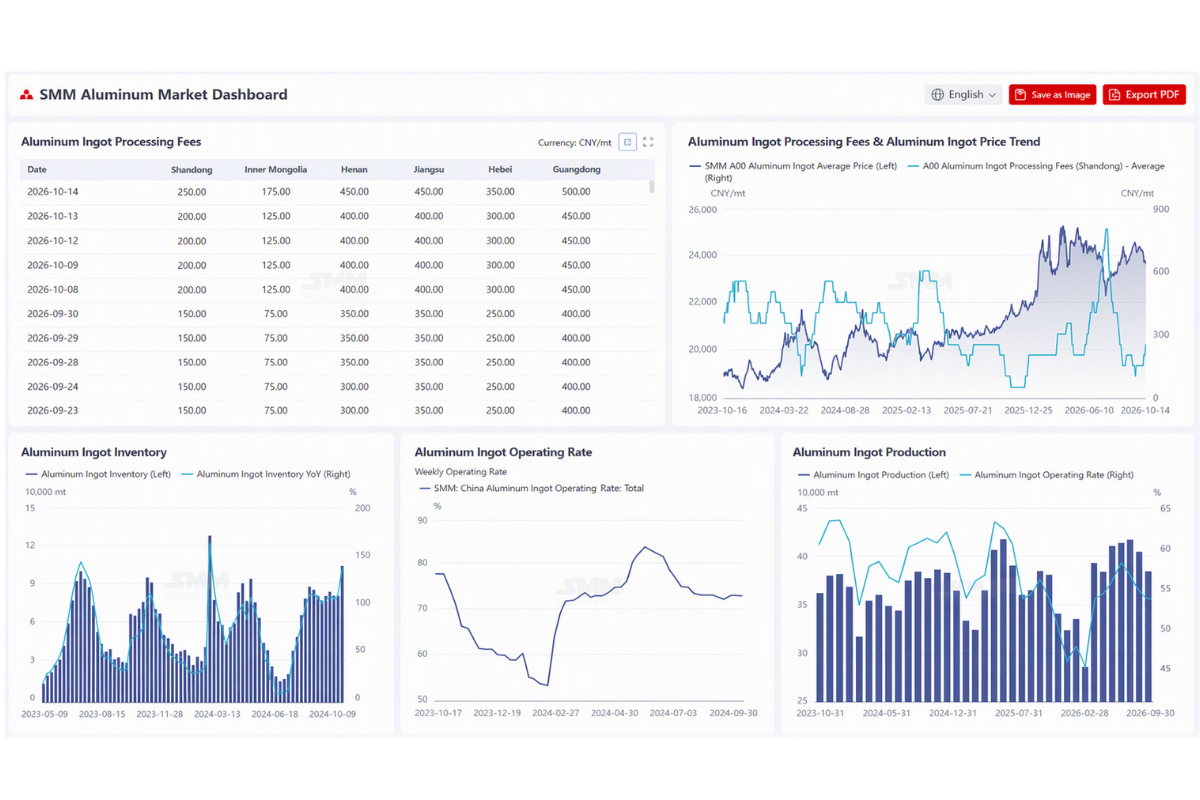
China's aluminium rod production in September was 384,000 tonnes, with producer operating rate at 53.2 per cent. Both production and operating rate trended lower under pressure. The aluminium rod market remained severely oversupplied in September, with suppliers successively lowering processing fees to move accumulated inventory, but downstream buying sentiment stayed subdued due to absolute price levels. According to SMM statistics, as of October 9, days of inventories at domestic aluminium rod plants stood at 10.33 days, up 2.19 days from 8.14 days before the holiday (September 30). The inventory ratio rose from 106.67 per cent to 137.14 per cent, a sharp increase of 30.47 percentage points, mainly driven by the National Day holiday—downstream processing enterprises concentrated maintenance shutdowns during the holiday and the pace of cargo pick-up stalled, while aluminium rod plants mostly maintained continuous production, causing goods to accumulate passively in-factory. This is typical post-holiday seasonal inventory buildup rather than a trend deterioration in demand. Over the same period, the comprehensive operating rate of leading aluminium rod enterprises was 72.85 per cent, basically flat MoM (72.89 per cent on September 24), stabilizing overall in the low range of 72 per cent–73 per cent. After the holiday, aluminium prices fell sharply, downstream buying sentiment rebounded quickly, and active market trading drove destocking at producers. Power grid projects are gradually resuming construction, and PV and wind power installations are expected to recover. With demand repairing, producer inventories are expected to destock further, operating rates are expected to rebound as orders improve, and the center of aluminium rod processing fees is expected to gradually rise.
During the week, aluminium prices showed an overall drift lower, falling from RMB 24,030 per tonne before the holiday (September 30) to RMB 23,620 per tonne on October 14, a cumulative decline of about RMB 410 per tonne. The center shifted notably lower compared with pre-holiday levels, and the weaker aluminium prices provided a clear boost to processing fees. As of October 13, aluminium rod processing fees across all regions rose by RMB 50 per tonne from pre-holiday levels (September 30), with Shandong at RMB 200 per tonne, Inner Mongolia at RMB 125 per tonne, Henan at RMB 400 per tonne, Jiangsu at RMB 400 per tonne, Hebei at RMB 300 per tonne, and Guangdong at RMB 450 per tonne. Quotes on October 14 moved further up to the RMB 250–500 per tonne range. Under September's oversupply, suppliers successively lowered processing fees to move accumulated inventory, and processing fees had long been under pressure at low levels. After the holiday, the sharp drop in aluminium prices combined with a rapid rebound in downstream buying sentiment significantly boosted market trading activity, driving processing fees up simultaneously across all six regions. Considering that power grid projects are gradually resuming construction and PV and wind power installations are expected to recover, the center of processing fees is expected to gradually rise as demand repairs.
The operating rate of China's aluminium wire and cable industry in September was 54.8 per cent, up 0.6 percentage points from August. The industry operating rate this month underperformed peak-season expectations. Although the power grid re-entered the construction period and manufacturers stockpiled in advance in September, the actual boost was relatively limited. The earlier export concentration period has ended, providing limited support to the current month's operating rate, with end-use orders shifting mainly back to the power grid and new energy sectors. In terms of orders, the fifth batch of tenders for State Grid UHV power transmission and transformation officially began in 2026, with the delivery peak centered around February-March 2027, providing long-term support for consumption in Q1 next year. Focusing on domestic orders, new energy installations are expected to gradually rise in Q4, and end-use demand from the power grid is also recovering mildly. Driven by demand, the operating rate of aluminium wire is expected to maintain its rebound trend.
Note: This article has been shared by SMM and has been published by AL Circle with its original information without any modifications or edits to the core subject/data.
China aluminium extruders diverge as holiday lull deepens on price moves
Next articlePyroGenesis completes seven-system aluminium dross recovery deployment in Saudi Arabia
Grow with
AL Circle